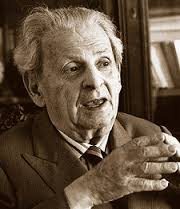
Ivan Illich, Ricoeur, A. Glucksmann, Finkielkraut,
Enrique Dussel, Benny Lévy, Z. Bauman, Judith
Butler, Pope John Paul II
From Wikipedia
Levinas was a French philosopher... known for his work within Jewish philosophy, existentialism, and phenomenology, focusing on the relationship of ethics to metaphysics…. In the 1950s, Levinas emerged from the circle of intellectuals surround- ing the philosopher Jean Wahl as a leading French thinker. His work is based on the ethics of the Other or, in Levinas's terms, on "ethics as first philosophy." For Levinas, the Other is not know- able and cannot be made into an object of the self, as is done by traditional metaphysics....
Introductory Comments
For Levinas, philosophy begins not with wonder but with the unsettling experience of encoun- tering another person - a face that looks back at me and shatters my comfortable illusion that I am the center of the universe. The Other can- not be known, categorized, or absorbed into my mental framework; the Other resists me, and that resistance is what makes the encoun- ter revelatory. In meeting the Other, I discover that being extends beyond my subjective hori- zon and that the Other bears a "trace" of the Divine - something sacred enough to place an "infinite demand" on me. Ethics is, then, not deduced in solitude: it is born when another person says, without words, you are responsible for me. If Descartes needed a quiet room to discover philosophy's foundations, Levinas needed only a doorbell.
This emphasis on the Other raises questions that have kept philosophers quarreling for decades. Is my responsibility for the Other truly "infinite," or does that demand crush the self under an impossible weight - making ethics less a calling than a guilt trip? Is the encounter fundamentally asymmetrical, as Levinas insists, or does genuine ethical life require reciprocity? And what happens when other people appear, forcing me to weigh "infinite responsibilities" against one another - moving from intimate one-on-one ethics to the messy business of social problems and political debates?
Some of Levinas's Key Positions
As witnessed in the life of Heidegger, who became a Nazi in the 1930's and who never renounced his membership, a philosophy centered on metaphysics but devoid of ethics will be dangerously flawed. Ethics is the "first philosophy" and in certain ways the basis of all philosophy.
In particular, the ethics of the Other is where philosophy begins. The Other is not knowable and is not an object of the self, yet ethics begins with encountering this Other - this not-self. With this encounter, I must come to terms with the fact that I am not the sum total of being.
Encountering the Other is in this sense a dawning metaphysical awareness, but it is also the awareness of something sacred. That is, the Other is not only worthy of my communion with it (à la Buber's "Thou"), he or she reveals "the proximity of God in the countenance of my fellowman." A fellowman is not God, but he or she has a "trace" of the Divine. I therefore feel an "infinite responsibility" for the Other.
Encountering the Other, then, reveals a meta- physical truth: that my subjective being-in-the-world does not represent the entirety of being. But it's also, more importantly, the beginning of moral awareness: that in sharing some of the divinity of the eternal Other, the mortal Other is worthy of my love and requires my kindness.
Place in the History of Ideas
Levinas's Place in History of Ideas
Peter Carrierre: According to Levinas, we con-struct our world in our individual minds, and this constructed reality has boundaries or "horizons" as Levinas calls it. But when the Face of the Other intrudes into this boundaried construction, what Levinas terms our "same," the Other inevitably becomes part of our con-struction. The key phrase is "our construction," because our construction of the Other is not the Other; the Other can never become one with our "same": it continually transcends our poor attempt to know it.
Bettina Bergo: Levinas’ intellectual project was to develop a first philosophy. Whereas tradi-tionally first philosophy denoted either meta- physics or theology, only to be reconceived by Heidegger as fundamental ontology, Levinas argued that it is ethics that should be so con- ceived. But rather than formulating an ethical theory, Levinas developed his philosophy in op- position to both these aforementioned ap- proaches. It takes the form of a description and interpretation of the event of encountering another person. Giving rise to spontaneous acts of responsibility for others, the encounter un-folds, according to Levinas, at a precognitive level... [that of] our embodied "sensibility."
Peter Carrierre: [Levinas's] work is in ongoing, critical dialogue with three philosophers: Husserl, Heidegger, and Hegel.
Random Thoughts on Levinas
Levinas's conviction that encountering the Oth- er is where something essential first comes to light runs through a wide range of thinkers. Jesus taught that the neighbor - the wounded stranger, the forgotten prisoner - is where love of God becomes concrete, so that to pass by the Other is to pass by the Divine itself. Hegel ar- gued that self-consciousness arises only through recognition by another self-consciousness, mak- ing the encounter a metaphysical necessity - no Other, no self. Buber distinguished the I-It rela- tion from the I-Thou, insisting that every genu- ine Thou-encounter opens onto the Eternal Thou - God glimpsed not in solitary prayer but in the space between persons.
Beyond this trio, Kierkegaard held that genuine love begins with the neighbor who offers me nothing, because only such love escapes the gravitational pull of self-interest. Sartre, with characteristic cheer, observed that the Other's gaze transforms me into an object - and, thus, "Hell is other people." De Beauvoir (Sartre's better half) argued that my own freedom is hol-low unless I struggle for the freedom of the Other, linking personal ethics to political libera- tion. Different thinkers therefore reach the same crossroads by very different roads: wheth-er through love, recognition, freedom, or spirituality, the message is roughly the same - the Other is not an intruder in our story but the plot twist that makes the story worth telling.
Buber (Human life is not self-enclosed. Relationships give birth to meaning.)
Butler, Joseph (Human motives are less selfish and simple than cynics claim.)
Einstein (The most important human endeavor is the pursuing of moral aims.)
Fromm (Love is based on care, responsibility, respect, and knowledge.)
Kant (All people should be treated as ends in themselves, not means to ends.)
Lukács (Our social existence determines or shapes our consciousness.)
Lyotard (Post-modern society has no grand narratives - & doesn't need them.)
Marcel (Human life is not self-enclosed. Relationships give birth to meaning.)
Rorty (There can be no non-circular justification for any metaphysical belief.)
Thinkers with opposing positions:
Bataille (To be free means to be unrestrained by any chains of morality.)
Engels (All recorded history hitherto has been a history of class struggle.)
Hobbes (Our ultimate motive is always to experience pleasure and avoid pain.)
MacIntyre (Society relies on narratives that give coherence & meaning to life.)
Rand (An Individual should exist for her own sake, not for the community.)
Spinoza (Moral absolutes do not exist. Nothing is inherently good or evil.)
Tillich (Faith in God is man's ultimate concern, even for the nonbeliever.)
What others said about Levinas
Ruth Domrzalski: Levinas asks us to hold these two pieces of human life (human finitude and infinite uniqueness) together at the same time.
Richard Wolin: [Levinas argued that] because instrumental reason does not determine the ends to which it is applied, it can be - and has been - used in the pursuit of goals that are destructive or evil.
Peter Carrierre: Levinas's insights into the responsibility… for the Other... were shaped by the degradation, destruction, and chaos of the 20th century. He was... subjected to the violence of the Bolshevik Revolution, the rise of Hitler… and World War II…. These experiences led to Levinas's great concern: how humanity might exist… morally in [an immoral] world.
Ruth Domrzalski: … Levinas offers a theoretical backdrop against which to understand important concepts of relational life, ethical responsiveness, and the complexities of human uniqueness.
Ruud Welten: … to Levinas, violence is not a phenomenon to be eliminated by rational ethics, but one that forms the very notion of humanity....
Richard Wolin: [Some have] described Levinas’s philosophical project as an attempt to "translate Hebrew into Greek" - that is, to reconfigure the ethical tradition of Jewish monotheism in the language of first philosophy….
Peter Lang: For Levinas there is a radical opposition between politics and religion. The former enslaves liberty by encompassing it within the "Great All." Religion on the other hand, which for Levinas is the metaphysical relationship with the Other, is based in respect and mutual aid even beyond need, submission, and generosity.
Bettina Bergo: Despite [his various] innovations, Levinas’s philosophical project remains largely constant: to rethink the meaning of existence in terms of the ethical transcendence of the other.
Main interests: Alienation, Childhood, Community, Desire, Ethics, Faith, Human Will, Metaphysics, Music, Personal Identity, Religion, Social Philosophy, Time, Tragedy