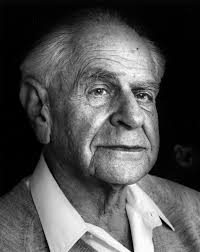
[Popper was one] of the 20th century's most influential philosophers of science, Popper is known for his rejection of the classical inductivist views on the scientific method in favor of empirical falsification. According to Popper, a theory in the empirical sciences can never be proven, but it can be falsified, meaning that it can (and should) be scrutinized with decisive experiments…. In political discourse, he is known for his vigorous defense of liberal democracy and the principles of social criticism….
Introductory Comments
Science, Popper held, earns its stripes not by piling up confirmations but by sticking its neck out. Take the case of mammals. The claim had been all mammals give birth to live young. Centuries of cows, cats, and whales back it up. Then the platypus turns up and lays eggs. Goodbye claim. That vulnerability, Popper insisted, is not a weakness but the signature of honest inquiry. Einstein's general relativity, for instance, predicted that the sun's gravity would bend passing starlight by a precise amount. The 1919 solar eclipse could have demolished the claim. It didn't, but what impressed Popper was that it might have. A theory that can't lose the bet has no business sitting at the scientific table.
That is why Popper cast a cold eye on the psychologies of Freud and Adler. Consider Popper's own example: Two strangers are standing by a river. One pushes a child into a river to drown him; the other leaps in to save him. Freud's theory, Popper observed, could explain the first man's cruelty as the result of repressed impulses and the second man's heroism as the sublimation of those impulses. Adler could likewise explain both actions as expressions of an inferiority complex - one man proving his courage through cruelty, the other through sacrifice. Either way, the theory wins. Even a patient's rejection of an analysis counted as "resistance," and so as further proof. The verdict: a theory that explains everything risks nothing, and so, as science, tells us nothing.
Some of Popper's Key Positions
No scientific theory can be proven true. However many confirming instances pile up, the next observation may overturn it: a thousand white swans cannot establish that all swans are white, but a single black one refutes the claim. A theory is scientific not because it has been verified but because it is falsifiable: it rules out certain observable outcomes and so risks being shown false. Science advances by bold conjectures and attempted refutations.
A theory that no observation could contradict is not strong for that reason; its power to explain everything is a weakness. Freud's psychoanalysis and Adler's individual psychology are prime examples, since they can accommodate any human behavior, including its exact opposite. Marxism began as a testable theory, but when its predictions failed, its defenders reinterpreted theory and evidence to save it, giving up its scientific standing. Such theories resemble myths more than science.
The critical attitude that drives science should also govern society. An open society welcomes criticism and reforms its institutions piece by piece, correcting mistakes as they come to light. Utopian blueprints, and "historicist" claims to know the inevitable course of history (found in Plato, Hegel, and Marx), lead instead to closed societies. And by silencing criticism, totalitarian regimes destroy their own ability to learn from error.
Place in the History of Ideas
Popper's Place in History of Ideas
Ayer: [Popper] rejected the Principle of Verifi- ability, and indeed condemned the attempt to put forward any general criterion of meaning. Instead, he suggested a criterion which would serve as a principle of demarcation between statements that were scientific and those that were not. He was willing to say of statements which failed to pass the test for being scientific that they were metaphysical, but did not take this to imply that they were meaningless.... The criterion he chose was that of falsifiability. Its superiority to a criterion of verifiability, even if one was looking for nothing more than a prin- ciple of demarcation, was supposed to consist in the fact that whereas no finite number of positive instances can fully establish a generali-zation whose range extends beyond them, one negative instance can definitely refute it.
Bryan Magee: Popper's ideas go so deep, and are so unobviously revolutionary in their consequences, that it is rare to find someone who has a good grasp of them. In any case he is a thinker whom other thinkers tend to know about rather than to know - it is obvious that even most people in the world of professional philosophy have not read most of his books, though they think they know as much about him as they need to. Two or three big ideas are generally associated with his name... but knowl- edge of his work rarely goes beyond that. He has never been in the eye of fashion....
Random Thoughts on Popper
A healthy society, Popper believed, must do what good science does: hold its convictions up to the light and discard those that fail inspection. He worked out that argument in New Zealand during the Second World War. He was an exile from Austria, which Hitler had annexed, and he called the book his "war effort." The century supplied grim illustrations. Nazi Germany was so wedded to its own mythology that in the end it preferred ruin to revision. The Soviet Union treated the Party line as holy writ for seven decades. Its rulers could not admit mistakes, so the mistakes piled up until, in 1991, the whole edifice folded with startling speed. An open society, by contrast, treats its institutions the way a good scientist treats a hypothesis: with respect, yes, but never with reverence.
Yet Popper was no starry-eyed champion of openness at any price. Unlimited tolerance, he warned, leads to the disappearance of tolerance. As long as intolerant ideas can be answered with argument and kept in check by public opinion, he thought, suppressing them would be unwise. But a tolerant society must reserve the right to suppress those who refuse to argue: those who forbid their followers to listen and answer reasons with "fists or pistols." Weimar Germany is the cautionary tale usually told here, a democracy whose enemies used its freedoms to destroy it. Tolerance, in short, is no suicide pact. The open society can be open to almost anything except a determined effort to slam it shut.
Einstein (Epistemology without contact with science is an empty scheme.)
Goodman (Our theories are just practical fictions - that is, useful until falsified.)
Humboldt, A. (In nature no single fact should be considered in isolation.)
Nagel (As limited creatures, we will never achieve a unified worldview.)
Peirce (Science achieves statistical probabilities, not certainties.)
Quine (Scientific theories must be viewed holistically, not as a set of parts)
Thinkers with opposing positions:
Bacon, Francis (Progress in science springs from careful observation.)
Carnap (Scientific knowledge can be reduced to a series of sense-data claims.)
Feyerabend (There is no universal methodological guidelines in science.)
Hamann (Scientific reason leads to doubts about the reality of the world.)
Hume (We only really know the immediate impressions of our senses.)
Kierkegaard (Philosophy must embrace subjectivity as an essential resource.)
Kuhn (Scientific theories & understanding can never be entirely objective.)
Proclus (All truth is interior. The objects of knowledge are inside the soul itself.)
Rousseau ("Progress" in science & reason has not benefitted humankind.)
Strauss (To remove values from the science of man is a self-deluded project.)
What others said about Popper
Nassim N. Taleb: I learned from Popper, in addition to the difference between an open and a closed society, that between an open and a closed mind.
James Ladyman: There has been a tendency for philosophers of science to regard Popper as something of an embarrassment. However, ... Popper has long been the favorite philosopher of science among scientists….
Bryan Magee: He believed that the world presents us with innumerable problems of a genuinely philosophical nature, and that no problem of substance is to be solved by analysis. New explanatory ideas are what is called for, and they form the chief content of worthwhile philosophy, and have always done so.
John Eccles: I learned from Popper what for me is the essence of scientific investigation - how to be speculative and imaginative in the creation of hypotheses, and then to challenge them with the utmost rigor….
James Ladyman: The leading critic of the positivists in their heyday was of course Popper.
Voegelin: Popper is philosophically so uncultured, so fully a primitive ideological brawler, that he is not able even approximately to reproduce correctly the contents of one page of Plato. Reading is of no use to him….
Ayer: [Popper acknowledged that] there may be cases in which we are led to entertain a hypothesis by generalizing from experience, but how we come by our hypotheses is of no importance, except perhaps to psychologists. What matters is whether they are testable and how they meet the tests.
Hayek: The conception of science as a hypothetico-deductive system has been expounded by Karl Popper in a manner which brings out clearly some very important points.
Main interests: Epistemology, Free/Unfree Will, History, Logic, Mathematics, Metaphysics, Mind, Political Philosophy, Politics, Probability, Progress, Science, Social Philosophy, War