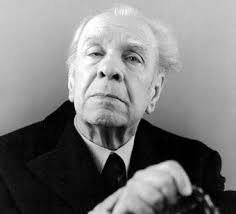
Borges was an Argentine short-story writer, essayist, poet and translator, and a key figure in Spanish-language and international literature. His best-known books Ficciones (Fictions) and El Aleph (The Aleph)... are interconnected by common themes, including dreams, labyrinths, philoso- phers, libraries, mirrors, fictional writers, and mythology. Borges's works have contributed to philosophical literature and the fantasy genre, and influenced the magic realist movement in 20th century Latin American literature.
Introductory Comments
Most of us assume we know who we are because we remember who we were. In a late poem, Borges agreed, and then made the agreement unsettling. We are our memory, the poem says, but that memory is a fantastical museum whose exhibits keep changing shape, a heap of shattered mirrors. Each shard still reflects something, but no two show quite the same face, and nobody can fit them back together. Memory, on this view, does hold the self together, but loosely, the way a thread holds a string of mismatched beads. So why would a writer who doubted that the self had any fixed core give memory such a starring role?
Part of the answer lies in a paradox that delighted him: a perfect memory would be a disaster. In "Funes the Memorious" (1942), a young man thrown from a horse wakes to find that he can forget nothing. He remembers every leaf on every tree, and every occasion on which he saw each one. The trouble is that he can no longer think. It bothers him that the dog seen in profile at 3:14 should share a name with the dog seen from the front at 3:15. To think, the narrator concludes, is to forget differences, to generalize, to abstract, and Funes, buried in particulars, cannot. The moral cuts against common sense. Forgetting is not memory’s failure but its partner. Only by letting details go can we gather experience into ideas, and perhaps gather ourselves into something like a self. A broken mirror, it turns out, may be the only kind that reflects anything at all.
Some of Borges's Key Positions
The line between fiction and nonfiction is less firm than it appears. A story can argue like an essay, and an essay can be pure invention. This is no surprise, since the line between dreaming and waking is no firmer: a dreamer cannot be sure he is not himself being dreamed.
Time is the deepest of these puzzles, and the least real. If two moments are exactly alike, what makes them two rather than one? The idealist arguments that dissolved matter and then the self can dissolve succession as well. Yet the refutation never quite succeeds, for time is the stuff we are made of: the river that carries us along is also us.
Simultaneity poses a related problem. Experience can arrive all at once, but language proceeds word by word, so every account of the world loses something in translation.
Such questions breed skepticism, and skepticism is no vice. Every classification of the universe is arbitrary and conjectural, because we do not know what the universe is. The grand systems of metaphysics and theology are best admired as masterpieces of the fantastic imagination, prized for their beauty rather than their proof.
The self fares no better. A self that is forever undergoing new experiences, its memories shifting and fading, has no fixed core, only a succession of states.
Place in the History of Ideas
Borges's Place in History of Ideas
Suzanne Jill Levine: In creating the most original writing of his time, Borges taught us that nothing is new, that creation is recreation, that we are all one contradictory mind, connected amongst each other and through time and space, that human beings are not only fiction makers but are fictions themselves, that everything we think or perceive is fiction, that every corner of knowledge is a fiction.
Jane Ciabattari: Reading the work of Jorge Luis Borges for the first time is like discovering a new letter in the alphabet, or a new note in the musical scale. His friend and sometime collaborator Adolfo Bioy Casares called his writings "halfway houses between an essay and a story." They are fictions filled with private jokes and esoterica, historiography and sardonic footnotes. They are brief, often with abrupt beginnings.... He presents the most fantastic of scenes in simple terms, seducing us into the forking pathway of his seemingly infinite imagination.
Jonathan Russell Clark: And moreover, it turns out that Borges was a hell of a critic who saw deeply into any work under his consideration, sometimes in remarkably prescient ways, and who was able - though it sounds like the antithesis to his fiction - to take intricate and confounding ideas and render them comprehensible to a layperson.
Random Thoughts on Borges
Memory does not stay inside the skull. Borges once observed that most human tools extend the body: the telescope extends the eye, the plow and the sword the arm. And the book extends memory and imagination. A library is thus a warehouse of other people's recollections, and every reader a kind of medium through whom the dead speak again. Not that they say the same thing twice. In "Pierre Menard, Author of the Quixote," a twentieth-century Frenchman composes several chapters of Don Quixote word for word. The narrator finds them far richer than Cervantes's, because the same words, written three centuries later, mean something else. Shared memory, it seems, is as fickle as the private kind, forever rearranged by whoever happens to be remembering.
Which brings us to funerals. When we say the departed "live on in memory," we mean it as comfort, not metaphysics. Yet the phrase may be truer than we intend. If a self is little more than a loosely bound bundle of memories, then the version of us assembled in other people's heads is not so different in kind from the one we assemble ourselves. The fantastical museum stays open for a while after the curator dies. And for writers, it stays open a little longer: Whenever we repeat a line of Dante, we become, for a moment, Dante. Of course, even for writers, the museum closes eventually. A very temporary eternity, then. But at least it is a democratic one, open to poets and plumbers alike, and that is some consolation.
Berkeley (Essentially the world does not consist of things, but of mental events.)
Berlin (There is no single criterion of meaningfulness. No absolute certainty.)
Jefferson (Governments should guarantee freedom of religion and expression.)
Kafka (Fictive writing is in a sense little more than a guided dream.)
Murdoch (Literature can help us clarify and improve our moral perspective.)
Ortega (Life is a struggle between our inner self and our outer circumstances.)
Sartre (Existence precedes essence: Humans GIVE meaning & purpose to life.)
Shakespeare (Nothing is certain in life: We change as much as do our judgments)
Zeno (The more we understand the world, the more paradoxical it becomes.)
Thinkers with opposing positions:
Anselm (God, not man, is the source of all meaning and purpose in life.)
Engels (The just distribution of goods is an inherently political responsibility.)
Jung (The differentiation of the self is the main task of human development.)
King (Man is not sufficient unto himself. We need God’s living Word & guidance.)
Marcel (Neither the isolated self nor the death of God are existential realities.)
Plato (Being a copy of a copy of a Form, art removes us even further from truth.)
Reid (Common sense proves existence of an external world & an abiding self.)
What others said about Borges
Suzanne Jill Levine: Today one could consider Borges the most important writer of the 20th Century.
José Saramago: [Borges was the] inventor of virtual literature, that literature of his that seems to have detached itself from reality in order better to reveal its invisible mysteries.
James Irby: [Borges thought that] time must exist in order to provide the successive identities with which it is to be "refuted." The two symmetries noted above, if we pursue their implications far enough, finally coalesce, with something of the same dizzying sense, so frequent in Borges' stories, of infinite permutations lurking at every turn.
Emir Rodriguez Monegal: By the time of his death, the nightmare world of his "fictions" had come to be compared to the world of Franz Kafka and to be praised for concentrating common language into its most enduring form.
J. M. Coetzee: He... renovated the language of fiction and thus opened the way to a remarkable generation of Spanish-American novelists.
Jonathan Russell Clark: [Borges wrote excellent literary criticism] through the clarity of [his] intelligence and the directness of his prose.... Borges the critic is a dedicated learner, an earnest lover of literature and ideas.
Joseph Agassi: It is the Schopenhauerian principle in Borges which makes him wonder what is real and what is illusory in our common experience. And it is this which makes him deliberately blur the borderline between his fiction and his essays: as if in order to imitate nature he blurs the boundary between reality and dream.
James Irby: [Borges likened] our dreams to a theatrical performance - and adds that true metaphors cannot be invented, since they have always existed. Such "avatars" point beyond the flux and diversity of history....
Schools: Existentialism
Main interests: Alienation, Death, Dreams, Fate, Free/Unfree Will, Game Theory, Immortality, Infinity, Literature, Mathematics, Memory, Metaphors, Mind, Personal Identity, Philology, Physics, Poetry, Politics, Probability, Psychology, Religion, Salvation, Semiotics, Time, Universals, Will