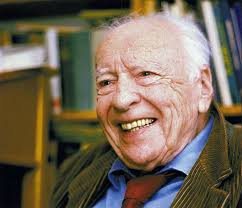
Gadamer was a German philosopher of the conti- nental tradition, best known for his 1960 magnum opus, Truth and Method on hermeneutics.... Gadamer's goal was to uncover the nature of human understanding. In Truth and Method, Gadamer argued that "truth" and "method" were at odds with one another. For Gadamer, "the experience of art is exemplary in its provision of truths that are inaccessible by scientific methods, and this experience is projected to the whole domain of human sciences."
Introductory Comments
For Gadamer, the meaning of a text is not a treasure buried beneath the words, waiting for some scholarly archaeologist to brush away the dust and hold it up to the light. Meaning happens in the encounter between text and interpreter - what Gadamer calls a "fusion of horizons." Every reader arrives already swimming in a historical stream of traditions and assumptions, which Gadamer, with evident relish, calls "prejudices." He means the word literally - pre-judgments - and he rehabilitates it with a perfectly straight face. Because the stream never stops flowing, today's interpreter brings a different horizon than yesterday's. What spoke to a medieval monk will not speak in the same way to a modern skeptic. Hunting for a reading made from nowhere in particular is not unlike trying to nail jelly to a wall.
Hence Gadamer treats interpretation not as detective work aimed at recovering an author's intentions, but as a conversation with the text itself. No reader can climb into Shakespeare's head. And a reader who could would find that the plays have long since left home and made lives of their own. Interpreter and text sit across from each other and work toward an understanding of the subject at hand, each shaping the other. This is no free-for-all. A good conversation partner pushes back, and a text that refuses to fit our expectations is usually teaching us something. The result is not universal Truth, but neither is it mere opinion. It is an understanding that knows where it stands.
Some of Gadamer's Key Positions
Scientific procedures work well in their own domain, but the humanities went astray by imitating them. They treated a poem or a historical event as an inert object awaiting the right technique. The deepest truths of art and history can't be secured by method, only experienced.
Art is the clearest case. A work of art is neither an object for detached appreciation nor an occasion for private feeling. It makes a claim on its audience and says something true about the world. Like a good game, it absorbs those who play it.
Prejudices, literally "pre-judgments," are preconditions of understanding, not obstacles to it. The Enlightenment's "prejudice against prejudice" imagined a reasoner standing outside history, but no such reasoner exists. Everyone understands from within a tradition that has already shaped which questions can be asked. The task is not to shed prejudices, which is impossible, but to put them at risk, so that an encounter with a text exposes the misleading ones.
Understanding happens through a "fusion of horizons." A horizon is the range of vision from a particular standpoint in history. Text and reader each have one, and understanding occurs when the two merge, as in a good conversation. The aim is not to reconstruct the author's intentions but to grasp what the text says, and whether it is true - from the perspective of the reader.
Place in the History of Ideas
Gadamer's Place in History of Ideas
Jeff Malpas: Hans-Georg Gadamer is the decisive figure in the development of twentieth century hermeneutics…. Trained in neo-Kantian schol- arship, as well as in classical philology, and pro- foundly affected by the philosophy of Martin Heidegger, Gadamer developed a distinctive and thoroughly dialogical approach, grounded in Platonic-Aristotelian as well as Heideggerian thinking, that rejects subjectivism and relativi- sm, abjures any simple notion of interpretive method, and grounds understanding in the linguistically mediated happening of tradition.
Stanley Grenz: Gadamer's idea of a "fusion of horizons" offers him a point of departure for interpreting literary texts. Meaning is not merely a matter of what the author intended, lying in the text, waiting to be unloaded by means of scientific and empathetic interpreta- tion. Rather, meaning emerges as the text and the interpreter engage in a dialogue, in a "hermeneutical conversation." The goal of this dialogue is an intersection of the horizon of the author and the horizon of the interpreter. Because meaning emerges within a conversa- tion, the goal of hermeneutics is not to discover the "one meaning" of the text. The meaning of the text is not that strictly circumscribed: the limits of the text's meaning are not confined to just the author's intent or the reader's under- standing. In fact, we can never claim that any one interpreation is correct "in itself."
Random Thoughts on Gadamer
Gadamer insists that understanding begins with what he calls the "anticipation of truth" - the working assumption that a text hangs together and may well be right about something that matters. This is less a matter of good manners than of sheer necessity. Readers who sit down with Plato or Kant already convinced they are muddled have locked the door before the conversation starts. Reading defensively, scanning for errors the way an auditor scans the books, may feel rigorous. But it turns a voice into a specimen. Understanding, for Gadamer, is an event in which the reader risks being addressed, even unsettled, by a claim to truth. Accepting that risk is what separates interpretation from autopsy.
None of this means swallowing every claim whole. The presumption can fail, and a text may turn out to be confused after all. But that verdict belongs at the end of a reading, not the beginning. The same stance explains why the fusion of horizons runs in both directions. Only a text granted the benefit of the doubt can question its readers as well as be questioned by them. Without that, readers are not holding a dialogue at all - they are merely eavesdropping on themselves. For anyone drawn to the history of ideas, this is liberating counsel. Reading Pascal or Hegel becomes not a tour of antique errors but an invitation to think alongside minds that may still have something to say. The price of admission is modest: listening before answering back.
Gadamer influenced: Babich, B., Brandom, Dworkin, Habermas, Henrich, D., Jauss, Hans R., Koselleck, R., MacIntyre, McDowell, Rorty, Schmidt, D.J., Vattimo, G.
Similar and opposing positions
Thinkers with similar positions:
Adorno (Our concepts are not eternal, but change with history and society.)
Berlin (There is no single criterion of meaningfulness. No absolute certainty.)
Cassirer (Humans are symbolic animals. We comprehend with signs & symbols.)
Dilthey (Our understanding depends on past worldviews and interpretations.)
Dilthey (Understanding in the human sciences is a type of re-experiencing.)
MacIntyre (Rationality is inevitably linked to cultural traditions.)
Ortega (In order to understand a reality we must understand its history.)
Saussure (Linguistic signs only have meaning in relation to other signs.)
Thinkers with opposing positions:
Collingwood (Texts don't change their meaning with each generation.)
Comte (All valid knowledge is scientific: Knowledge requires verification.)
Derrida (A word's meaning is never nonlinguistic: Nothing's outside the text.)
Kant (Consciousness is self-constituting, not socio-historically determined.)
Russell (Language that is not verifiable is not true or untrue but meaningless.)
Schleiermacher (The meaning of a text can be found via an objective process.)
Schlick (Outside logic & math, the truth of statements must rest on evidence.)
Tarski (The meaning of a sentence is equivalent to its truth conditions.)
What others said about Gadamer
Nicholas Davey: [Gadamer thought that in an aesthetic] experience one is always participating, perhaps unwittingly, in something beyond oneself.
Lauren Swayne Barthold: Gadamer was influenced by Heidegger’s interest in the "question of Being," which aimed to draw our attention to the ubiquitous and ineffable nature of Being that underlies human existence.
Jeff Malpas: The "dialogical" character of Gadamer’s approach is evident, not merely in the central theoretical role he gives to the concept of dialogue in his thinking, but also in the discursive and dialogic, even "conversational," character of his writing, as well as in his own personal commitment to intellectual engagement and exchange.
Nicholas Davey: Gadamer’s approach to aesthetic experience stands squarely in the phenomenological tradition. He is primarily concerned with the place of art in our experience of the world.
Krzysztof Michalski: From Gadamer I learned that to understand a given thinker requires one to presuppose that he is right.
Alex Scott: [Gadamer believed] that truth cannot be adequately explained by scientific method, and that the true meaning of language transcends the limits of of methodological interpretation.
Stanley Grenz: Through a work of art, he argues, we experience truth that we cannot attain in any other way. The experience of art challenges the scientific consciousness to acknowledge its own limits. From this starting point - the justification of the truth of art - Gadamer attempts to develop a new understanding of knowledge and truth.
Richard J. Bernstein: A genuine dialogue between Gadamer and Derrida has never taken place. This is a shame because there are crucial and consequential issues that arise between hermeneutics and deconstruction.
Schools: Aristotelianism, Common Sense Realism, Communitarianism, Continental Philosophy, Critical Theory, Hermeneutics, Historicism, Phenomenology, Pluralism
Main interests: Art and Aesthetics, Communication, Epistemology, Ethics, Health, History, History of Ideas, History of Philosophy, Jurisprudence, Language, Law, Literature, Medicine, Metaphilosophy, Metaphors, Metaphysics, Philology, Poetry, Political Theory, Science, Semiotics, Sublime Nature, Tragedy