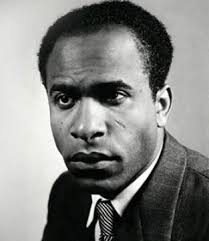
Fanon's works have become influential in the fields of post-colonial studies, critical theory, and Marxism. As well as being an intellectual, Fanon was a political radical, Pan-Africanist, and Marxist humanist concerned with the psychopathology of colonization and the human, social, and cultural consequences of decolonization…. Fanon published numerous books, including "The Wretched of the Earth" (1961). This influential work focuses on what he believed is the necessary role of violence by activists in conducting decolonization struggles.
Introductory Comments
Frantz Fanon, the Martinique-born psychiatrist and revolutionary, argued that colonization is not merely a political or economic arrangement but also a psychological assault that deforms the inner lives of both colonizer and colonized. His central thesis, threaded through Black Skin, White Masks and The Wretched of the Earth, is that empire does its dirtiest work not on the battlefield but in the bedroom mirror. The colonized, told endlessly that their language is crude, their traditions primitive, their skin a stain, eventually begin to believe what their oppressors say. Colonization, in short, does not just conquer land - it recruits the soul, turning identity into a quiet battleground where the enemy wears your face.
Fanon's psychological insight cuts deep because he saw it firsthand in his clinics in Algeria and the Antilles. He described the Black Antillean who travels to Paris and returns rolling his "r"s with theatrical Parisian flourish, embarrassed by his own mother's Creole. He wrote of pa- tients who dreamed in the colonizer's catego- ries, women who scrubbed their skin raw, and children who, when asked to draw themselves, reached instinctively for the white crayon. The tragedy, Fanon insisted, is that the colonized comes to measure his worth on a scale he did not make and cannot win with. As Fanon saw it, the colonizer who makes you hate yourself has won a victory that no army could achieve.
Some of Fanon's Key Positions
Colonialism of the 19th and early 20th centuries represented not only an arrogant dismissal of other countries' sovereignty, but also a blatant racism that denied many millions of their rights simply because of the color of their skin.
Part of the tragedy of racism is that many peo- ple of color internalize racial attitudes directed against them. That is, they feel a sense of inferi- ority when facing white people. This in turn often leads to either a type of resigned self-hatred or a pathetic attempt at a performance of White-ness. This latter response can be seen in their attempt to master the language, dress, and habits of the white colonizers.
People of color must fight against such self-destructive responses to the racism of others. Instead of internalizing racial attitudes directed against them, people of color need to be proud of themselves and their culture.
They also need to fight back. Decolonization is inherently a violent process, because the colo- nizer and the "colonized" are seen by each par- ty as binary opposites. This sense of opposition first starts as an ongoing tension, but must eventually lead to actual violence. And in attempting to decolonize their country, people of color are at the same time decolonizing their minds. They are refusing to internalize racism and they are asserting their own humanity.
Place in the History of Ideas
Fanon's Place in History of Ideas
Tracey Nicholls: Frantz Fanon was one of a few extraordinary thinkers supporting the decoloni- zation struggles occurring after World War II, and he remains among the most widely read and influential of these voices. His brief life was notable both for his whole-hearted engage- ment in the independence struggle the Algerian people waged against France and for his astute, passionate analyses of the human impulse towards freedom in the colonial context.
Lewis R. Gordon: Fanon's contributions to the history of ideas are manifold. He is influential not only because of the originality of his thought but also because of the astuteness of his criticisms. He developed a profound social existential analysis of antiblack racism, which led him to identify conditions of skewed rationality and reason in contemporary discourses on the human being.
Charles Peterson: Fanon was naturally critical of the institutions of colonialism, but he also was an early critic of the postcolonial governments, which failed to achieve freedom from colonial influences and establish a national conscious-ness among the newly liberated populace. For Fanon the rise of corruption, ethnic division, racism, and economic dependence on former colonial states resulted from the "mediocrity" of Africa’s elite leadership class.
Random Thoughts on Fanon
It is from Fanon's psychological analysis of colonization (see Introductory Comments) that his ethical defense of revolutionary violence emerges - less a celebration of bloodshed or even a demand for retribution than a prescrip- tion for psychic detox. Since colonization is itself a relentless, daily violence - structural, cultural, and intimate - Fanon argued that pleas for polite reform merely ratify the arrange- ment. Violent revolt, in his view, is the act through which the colonized rejects the colonizer's verdict on his humanity, recovers agency, and stops asking permission to exist. Liberation, for Fanon, had to be seized, not negotiated over tea.
This is where Fanon parts company, sharply, with Martin Luther King Jr. and Nelson Man- dela - though the disagreement is more familial than fundamental. King, steeped in Gandhi and the Gospels, believed nonviolent resistance exposed the moral bankruptcy of the oppressor and preserved the soul of the oppressed; Mandela, for his part, began as a Gandhian, took up arms when peaceful avenues were sealed shut, and then famously laid them down again to build a nation rather than burn it down. Where Fanon saw violence as the crucible of a new self, King and Mandela saw restraint as its forge - proof that the oppressed had already outgrown the moral universe of the oppressor.
Fanon influenced: Biko, Steve, Bugul, Ken, Freire, P., Glissant, E., Gordon, L., Guevara, Malcolm X, Mbembe, A., Newton, Huey, Said, Seale, Bobby, Sembene, O., Shariati, A.
Similar and opposing positions
Thinkers with similar positions:
Adler (The social realm plays a large role in shaping human psychology.)
Bourdieu (Language is not merely a means of expression, but also of power.)
Derrida (Western culture imposes implicit hierarchies on a text's meaning.)
Diderot (Colonial powers have no right of access to fully inhabited lands.)
Foucault (Though conceptually distinct, power & violence are often connected.)
Gramsci (Overthrowing unjust regimes requires overthrowing their worldviews)
Herder (Different cultures should not be measured against one another.)
Said (Colonization is an attack on the dignity and self-worth of the colonized.)
Sartre (Identity is not a given. Our actions determine who we are.)
Thinkers with opposing positions:
Arendt (Only rights granted by the state matter, not "inalienable human rights.")
Dostoyevsky (The cure to social ills is not socialism, but a true Christianity.)
Evola (Mixing with inferior non-European races leads to cultural decline.)
Freud (The social realm plays a minimal role in shaping human psychology.)
Hegel (Freedom springs not from within, but from our belonging to a state.)
King (Peaceful protests are not only more moral, they're also more effective)
Thoreau (Citizens have a duty to peacefully protest governmental injustice.)
What others said about Fanon
Tracey Nicholls: [Fanon is noted] for his astute, passionate analyses of the human impulse towards freedom in the colonial context.
Pankaj Mishra: In Fanon’s view, the Western bourgeoisie was "fundamentally racist" and its "bourgeois ideology" of equality and dignity was merely a cover for capitalist-imperialist rapacity.
Josh Pallas: Frantz Fanon provides a useful account of both the positive and negative effects of colonial violence on individuals. Violence has the potential to be liberatory and cathartic, in the sense that it allows a colonial subject to free themselves and recreate a positive new identity.... Conversely, violence also has [obvious]negative effects.
John E. Drabinski: He was, in his time and certainly in the decades following his death, a hero to and intellectual inspiration for anti-colonial and anti-racist struggle, informing the work of thinkers from all over the global South.
Pankaj Mishra: In his view, anti-colonial nationalism was only the first step toward a new radical humanism "for Europe, for ourselves, and for humanity."
John E. Drabinski: His work drew on a wide array of poetry, psychology, philosophy, and political theory, and its influence across the global South has been wide, deep, and enduring.
Pankaj Mishra: Fanon wrote about how the Black man, cowed by the colonists’ unprecedented mixture of greed, righteousness, and military efficacy, tended to internalize the demoralizing judgment delivered on him by the white gaze.… But mimicry [of whites] could be a cure worse than the disease, since it reinforced the existing racial hierarchy….
Sartre: Read Fanon: you will learn how, in the period of their helplessness, their mad impulse to murder is the expression of the natives’ collective unconscious.
Main interests: Alienation, Anthropology, Civil Rights, Class Struggle, Colonialism, Cultural Criticism, Cultural Studies, Democracy, Desire, Equality, Freedom, Government, Ideology, Justice, Labor, Law, Literary theory, Political Activism, Political Philosophy, Political Theory, Politics, Power, Psychoanalysis, Psychology, Racism, Revolution, Social Criticism, War