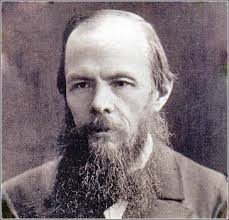
Dostoyevsky was a Russian novelist, short story writer, essayist and journalist. He is regarded as one of the greatest novelists in... world literature, and many of his works are considered highly influential masterpieces. Dostoevsky's literary works explore the human condition in the troubled political, social and spiritual atmospheres of 19th-century Russia, and engage with a variety of philosophical and religious themes…. His Notes from Underground… is considered one of the first works of existentialist literature.
Introductory Comments
In 1849, with the revolutions of the year before still smoldering across Europe, Tsar Nicholas I was in no mood for socialists. Dostoyevsky's chief crime was reading aloud a forbidden letter by the radical critic Belinsky, and for that he was sentenced to death. On a freezing December morning, he stood in a St. Petersburg square and watched the first prisoners tied to posts, awaiting his turn. Then a courier galloped up with word that the Tsar had spared them all. The reprieve had been settled in advance: the whole scene was theater, staged on the Tsar's orders. Nicholas, it seems, liked his lessons unforgettable. Instead of a firing squad, Dostoyevsky got four years of hard labor in a Siberian prison camp, followed by years of forced service as a common soldier.
Legend says that the young prince Siddhartha, the future Buddha, left his palace at 29 and saw sickness, old age, and death for the first time. Dostoyevsky, at almost the same age, took a harsher road to a similar discovery. Siddhartha looked; Dostoyevsky lived it. He was a gentleman in chains among murderers and thieves, many of whom despised him for his class. He found cruelty and degradation, but also unexpected flashes of compassion, both among hardened convicts and within himself. He emerged with a deepened Orthodox faith and a conviction that suffering can redeem. Salvation, he came to believe, lies not in revolution or reason, as he once hoped, but in humility, spiritual rebirth, and simple compassion.
Some of Dostoyevsky's Key Positions
Serfdom must end, but Western-style republics and constitutions are the wrong cure for Russia, whose history and spirit differ from Europe's. Russia's deepest wound is not chiefly the gap between rich and poor. It is the gulf between the Westernized educated class and the common people, the narod. The educated must return to the "native soil," meaning the faith and customs of ordinary Russians, and learn from the people.
The path to healing runs through Christ, not through politics. The West has organized its life around "every man for himself." Russia, through its Orthodox faith, can offer something better: a brotherhood built on "thou shalt love thy neighbor as thyself."
Yet no one can fully live by Christ's command. The self, the insistent "I," gets in the way, so love of neighbor remains an ideal to strive for on earth rather than a state to achieve. Worse, human beings are not rational calculators of their own advantage. They will act against their own interests, even to their own ruin, simply to prove that they are free and not piano keys played by the laws of nature.
Freedom is real, and suffering is part of its price. A creature that can choose its own harm is no machine for maximizing pleasure. But freedom is also a heavy burden, one that many would gladly trade for bread and a strong authority.
Place in the History of Ideas
Dostoyevsky's Place in History of Ideas
Gary Saul Morson: Dostoevsky understood not only our need for freedom but also our desire to rid ourselves of it. Freedom comes with a terrible cost, and social movements that promise to relieve us of it will always command a following. [In his story of "The Grand Inquisitor," Dostoyevsky vividly portrays our conflicting views on freedom.] One view, which the Inquisitor rejects, is Jesus’s: human beings are free and goodness has meaning only when freely chosen. The other view, maintained by the Inquisitor, is that freedom is an insufferable burden because it leads to endless guilt, regret, anxiety, and unresolvable doubts. The goal of life is not freedom, but happiness, and to be happy people must rid themselves of freedom and adopt some philosophy claiming to have all the answers.
Sartre: Dostoevsky once wrote, "If God did not exist, everything would be permitted"; and that, for existentialism, is the starting point. Everything is indeed permitted, if God does not exist, and man is in consequence forlorn, for he cannot find anything to depend upon either within or outside himself. He discovers forthwith that he is without excuse. For if indeed existence precedes essence, one will never be able to explain one's action by reference to a given and specific human nature; in other words, there is no determinism - man is free, man is freedom.
Gary Saul Morson: [Dostoyevsky showed us] that people, far from maximizing their own advantage, sometimes deliberately make victims of themselves in order, for example, to feel morally superior. In fact, people harm themselves for many reasons. They tear at their own wounds and derive a peculiar pleasure from doing so. They deliberately humiliate themselves. To their own surprise, they experience impulses stemming from resentments long suppressed and, as a result, create scandalous scenes or commit horrible crimes. Freud particularly appreciated Dostoevsky’s exploration of the dynamics of guilt. But neither Freud nor most Western readers have grasped that Dostoevsky intended his descriptions of human complexity to convey political lessons. If people are so surprising, so “undefined and mysterious,” then social engineers are bound to cause more harm than good.
Random Thoughts on Dostoyevsky
FFew novelists have gathered their material at such personal cost. Dostoyevsky was a young writer on the rise. Then came arrest, a staged execution, and four years in a Siberian prison. His hopes did not survive. What survived was material, a lifetime's worth of it, for the tormented characters of his later novels. Consider the narrator of Notes from Underground, a spiteful, painfully self-aware recluse who mocks the rationalist optimism of his day. He especially mocks the idea, popular among Russian radicals, that people who understand their true interests will naturally pursue them. In Crime and Punishment, Raskolnikov commits murder, convinced that an extraordinary man may step over the moral law. Torment follows, but torment alone does not save him. Only in the epilogue, in Siberia and through the love of the long-suffering Sonya, does he begin a new life. The Brothers Karamazov offers a sharper twist. Dmitri Karamazov is innocent of his father's murder but convicted anyway, and he accepts the sentence, because he did wish his father dead.
Or, to put it in Christian terms: In the 15th century, Thomas à Kempis, in The Imitation of Christ, saw deliberate suffering as a discipline of devotion. In contrast, Dostoyevsky's sufferers are rarely so orderly. Their pain arrives through crime, folly, or plain bad luck, and grace ambushes them when they least expect it. Thomas maps the royal road to heaven. Dostoyevsky shows people tumbling into the ditch and finding God there.
Bakunin (Law & the state are at times obstacles to freedom & human rights.)
Bourdieu (We don't always act according to rational or economic criteria.)
de Beauvoir (We can neither escape our personal freedom nor give it away.)
Fromm (Man is burdened by his freedom and often attempts to escape it.)
Ibn Tufail (Religion is for the masses, but philosophy is a privilege of the few.)
Jaspers (Philosophical claims are expressions of our mental dispositions.)
Orwell (Literature at its best enlightens the reader, both morally & politically.)
Tolstoy (Our greatest hope is in following Christ's original & radical teachings.)
Thinkers with opposing positions:
Borges (Man's search for meaning in a seemingly infinite universe is fruitless.)
Lukács (Commmunism should lead to the dictatorship of the proletariate.)
Machiavelli (Religion is essential for keeping a republic in order.)
Marcel (Neither the isolated self nor the death of God are existential realities.)
Nietzsche (Christianity has a "slave morality" placing weakness over strength.)
Popper (The search for truth should be completely fact-based and objective.)
Sade (To be free means to be unrestrained by any chains of morality.)
Smith, Adam (Humans are consistently rational & narrowly self-interested.)
What others said about Dostoyevsky
Nietzsche: [Dostoevsky was] the only psychologist... from whom I had something to learn; he ranks among [my] most beautiful strokes of fortune....
Freud: Four facets may be distinguished in the rich personality of Dostoevsky: the creative artist, the neurotic, the moralist and the sinner. How is one to find one's way in this bewildering complexity?
James Joyce: [Dostoyevsky] is the man more than any other who has created modern prose, and intensified it to its present-day pitch. It was his explosive power which shattered the Victorian novel with its simpering maidens and ordered commonplaces; books which were without imagination or violence.
Vladimir Nabokov: Dostoevky’s lack of taste, his monotonous dealings with persons suffering with pre-Freudian complexes, the way he has of wallowing in the tragic misadventures of human dignity - all this is difficult to admire.
Einstein: [Dostoyevsky is a] great religious writer [who explores] the mystery of spiritual existence.
Hemingway: [In Dostoevsky] there were things... not to be believed, but some so true that they changed you as you read them; frailty and madness, wickedness and saintliness, and the insanity of gambling were there to know.
Kornelije Kvas: [Dostoevsky’s use of many voices and his emphasis on dialogue] postulates the non-existence of the "final" word, which is why the thoughts, emotions and experiences of the world of the narrator and his/her characters are reflected through the words of another, with which they can never fully blend.
Knut Hamsun: No one has analyzed the complicated human structure as Dostoyevsky. His psychologic sense is overwhelming and visionary.
Schools: Christian Humanism, Christian Theology, Existentialism, Nihilism
Main interests: Alienation, Causality, Community, Death, Desire, Dreams, Eschatology, Faith, Family, Fate, Free/Unfree Will, Freedom, Friendship, Game Theory, Habits, Happiness, Human Will, Jurisprudence, Literature, Love, Mind, Personal Identity, Politics, Power, Psychology, Punishment, Religion, Salvation, Spirituality, Time, Tragedy, Will