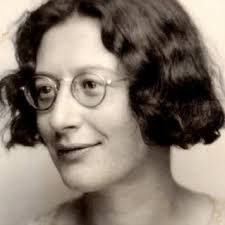
Weil was a French philosopher, mystic, and political activist…. She taught intermittently throughout the 1930s, taking several breaks due to poor health and to devote herself to political activism…. Taking a path that was unusual among 20th-century left-leaning intellectuals, she became more religious and inclined towards mysticism as her life progressed. Weil wrote throughout her life, although most of her writings did not attract much attention until after her death.
Introductory Comments
Weil held that we are born into a kind of cos- mic homesickness we can't quite name. God, being absolute fullness, had to step back to make room for creation - a divine act of self-delimitation. The result is that every human soul enters a world defined by God's deliberate absence, and we feel that absence as a deep, nameless ache. Rather than sit with the pain, we paper it over with attachments: fantasies of what others owe us, daydreams of reward, an endless interior ledger of imaginary debts. The self - the "I" - becomes a little propaganda ministry, projecting its desires onto reality and then mistaking the projection for the world.
The way back, Weil insisted, is not to add some- thing but to subtract something - specifically, the "I" itself. Through a fierce spiritual discipline she called decreation, one strips away illusion, suspends the imagination's constant chatter, and learns to desire without grasping at any particular object. This looks, from the outside, a lot like madness; your friends may stage an in- tervention. But Weil saw it as the highest sani- ty: a state of pure attention in which we finally perceive things as they are rather than as we wish them to be. In letting go of self, God's presence - which was always there, only veiled by our self-serving fictions - becomes palpable again. We do not fill the void; we become the void, and in doing so, participate in the very act by which God first made space for us to exist.
Some of Weil's Key Positions
We should not be xenophobic in religious matters. Each religious tradition has something profound to teach us. Greek and Egyptian mysteries, Hinduism's Upanishads and its Bhagavad Gita and Mahayana Buddhism's teachings all contain genuine revelations.
This does not mean that we should try to merge religious insights from the various religions into some new synthesis. For a spiritual tradition to take hold of our lives, it must be embraced in all its particularity and approached in a singularly devout manner, "as if there were nothing else."
The religious tradition I have chosen to embrace is Christianity. For me - Jewish by birth but most devoted to the commandment in Leviticus to "love your neighbor as yourself" - Christ's life best exemplifies and his teachings best articulate the importance of love and self-sacrifice. And if self-sacrifice leads to personal suffering, we must remember that in suffering, much more than in pleasure, the soul finds both itself and God.
But these insights and ideals must not remain mere abstractions. They must be put into action, especially political action. Unjust wars, intolerable treatment of workers, political oppression by fascist leaders - all forms of oppression must be fought against.
Place in the History of Ideas
Weil's Place in History of Ideas
J. Edgar Bauer: Simone Weil's intellectual and existential search encompassed several of the major religious and sapiential traditions. Since her religiosity was imbued by Greek thought, Gnosticism, Chinese wisdom, Christian mysticism, and Indian philosophy, it is not surprising that scholars have been especially attentive to her perceptive elaborations on the universal truths informing these - at first sight - hardly compatible spiritual worldviews.
Gustave Thibon: Most sins can be traced back to the social element. They spring from a thirst to appear and to dominate. It is not that Simone Weil rejects the social element as such; she knows that our environment, roots and traditions form bridges between earth and heaven; what she repudiates is the totalitarian city - symbolized by the "Great Beast" of Plato and the Beast of the Apocalypse - whose power and prestige usurp God’s place in the soul.
Albert Camus: Simone Weil, I maintain this now, is the only great spirit of our times and I hope that those who realize this have enough modesty to not try to appropriate her overwhelming witnessing. For my part, I would be satisfied if one could say that in my place, with the humble means at my disposal, I served to make known and disseminate her work whose full impact we have yet to measure.
Random Thoughts on Weil
There is a long and disreputable tradition of diagnosing thinkers rather than engaging with their arguments. Nietzsche had syphilis, thus the will to power is a fever dream; Kierkegaard suffered from romantic heartbreak, thus the leap of faith is just a rebound relationship. The move is seductive because it lets us off the hook: if a philosohy can be explained away by its author's neuroses, we don't have to do the harder work of deciding whether it's true.
And yet, completely ignoring the life behind the thought has its own dishonesty. Ideas don't arrive by immaculate conception; they are forged in particular bodies, under particular pressures, and understanding those pressures can illuminate - without invalidating - what a thinker was trying to say. In Weil's case, the biographical lens is both irresistible and genu- inely productive - though one should handle it with care, since she herself would have consid- ered it an impertinence of the first order. Her lifelong asceticism, her political fervor, her com- pulsive identification with the suffering of oth- ers, her inability to accept comfort even when dying: these are not incidental facts about a person who also happened to write philosophy. They are the philosophy lived at full volume. A woman who argued that the self must be emp- tied, and who then emptied herself without remainder, is not a case study. She is, uncom- fortably, a kind of evidence.
Weil influenced:Agamben, Allen, D., Camus, Carson, Anne, Derrida, Eliot, T.S., Fanon, Godard, Keller, T., Levinas, Milosz, Murdoch, Phillips, D.Z., Pilinszky, Pope Paul VI, West, Cornel, Winch, Peter
Similar and opposing positions
Thinkers with similar positions:
Buber (People must never be seen as mere means to our personal ends.)
Dostoyevsky (The cure to social ills is not socialism, but a true Christianity.)
Einstein (The most important human endeavor is the pursuing of moral aims.)
Fromm (Love is based on care, responsibility, respect, and knowledge.)
King (Social injustice is an inherently religious problem for Christians.)
King (Man is not sufficient unto himself. We need God’s living Word & guidance.)
Levinas (Ethics involves taking responsibility for the absolute Other.)
Orwell (The abuse of language in political discourse undermines democracy.)
Said (Colonization is an attack on the dignity and self-worth of the colonized.)
Thinkers with opposing positions:
Bataille (Violence & erotic excess can be liberating & sacramental experiences.)
Calvin (Salvation is fated. God predestines both the saved & the damned.)
Holbach (The foundation of morality is not in Scripture but in happiness.)
Nietzsche (Christianity has a "slave morality" placing weakness over strength.)
Rand (An Individual should exist for her own sake, not for the community.)
Spinoza (Nothing is good or bad independent of human desires and beliefs.)
Stirner (Humans are always motivated by self-interest and selfishness.)
Tillich (God isn't personal. God is a pure absolute devoid of consciousness & life.)
What others said about Weil
de Beauvoir: I envied her for having a heart that could beat right across the world.
Richard Rees: [By 1939] Simone Weil had developed a social and political awareness which it took... the German occupation to awaken in many French intellectuals and beyond which many of them... have never progressed.
T. S. Eliot: We must simply expose ourselves to the personality of a woman of genius, of a kind of genius akin to that of the saints.… I cannot conceive of anybody's agreeing with all of her views, or of not disagreeing violently with some of them. But agreement and rejection are secondary: what matters is to make contact with a great soul.
J. Edgar Bauer: In her relatively short life, Simone Weil… created a body of work whose intellectual scope and acuity are remindful of religious thinkers such as Blaise Pascal or Søren Kierkegaard.
Camus: [Simone Weil was] the only great spirit of our times.
Kenneth Rexroth: She could introject all the ill of the world into her own heart, but she could not project herself in sympathy to others. Her letters read like the more distraught signals of John of the Cross in the dark night.
Rebecca Rozelle-Stone: Simone Weil philosophized... across borders. Her persistent desire for truth and justice led her to both elite academies and factory floors, political praxis and spiritual solitude. At different times she was an activist, a pacifist, a militant, a mystic, and an exile; but throughout, in her inquiry into reality..., she remained a philosopher.
Gustave Thibon: [As to our last meeting, not long before her death,] I will only say that I had the impression of being in the presence of an absolutely transparent soul which was ready to be reabsorbed into original light.
Schools: Christian Humanism, Christian Mysticism, Communitarianism, Existentialism, Mysticism, Platonism
Main interests: Alienation, Classics, Communication, Democracy, Desire, Equality, Ethics, Faith, Freedom, Friendship, Geometry, Habits, Happiness, Health, Human Will, Industrialism, Journalism, Just War, Justice, Labor, Law, Literature, Love, Mathematics, Mind, Personal Identity, Political Activism, Political Philosophy, Psychology, Religion, Salvation, Science, Social Criticism, Spirituality, Technology, Time, Tragedy, Virtue, War, Will, Wisdom