Max Stirner (1806 - 1856)
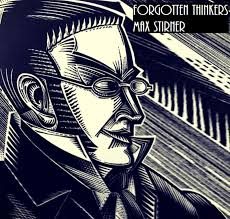
Open Stirner's interactive page (graphs of influences, similar and opposing positions, and quotes)
Background
Max Stirner
Born: October 25, 1806 in Bayreuth, Bavaria
Died: June 26, 1856 (aged 49) in Berlin, Prussia
Schools: Young Hegelians, Egosim, Egoist
anarchism
Main interests: Ethics, politics, ontology,
property, value theory
Influences: Bauer, Feuerbach, Hegel, Goethe,
Adam Smith, Jean-Baptiste Say
Influenced: Julius Evola, Frank Brand, Steven T.
Byington, Friedrich Engels, Karl Marx, Saul
Newman, Friedrich Nietzsche, Benjamin R.
Tucker, John Henry Mackay, Ernst Jünger,
Rudolf Steiner, Emile Armand, Albert Camus,
Carl Schmitt, Renzo Novatore, Adolf Brand,
Emma Goldman, Bob Black, Miguel Gimenez
Igualada, Wolfi Landstreicher, Herbert Read,
Robert Anton Wilson, Wilhelm Reich, Gustav
Landauer, Max Adler, Otto Gross, Ayn Rand
From Wikipedia
Stirner was a German post-Hegelian philosopher, dealing mainly with the Hegelian notion of social alienation and self-consciousness…. Stirner, whose main philosophical work was The Unique and Its Property, is credited as a major influence in the development of nihilism, existentialism and post-modernism as well as individualist anarchism, post-anarchism and post-left anarchy. He also influenced illegalists, feminists, nihilists and bohemians, as well as fascists, right-libertarians and anarcho-capitalists.
Introductory Comments
As an undergraduate, Stirner attended the lectures of Hegel, and a few years later joined the circle of Young Hegelians who subjected their old master's system to increasingly radical criticism. The chief disputes centered on religion and politics. Hegel saw history as a rational process in which human freedom gradually comes to consciousness and finds expression in modern institutions. The Young Hegelians were far less reconciled to the world around them. They attacked religious orthodoxy and political authority, while figures such as Feuerbach and Marx increasingly challenged Hegel's idealism by turning attention toward human beings, society, and material life.
Stirner, however, eventually turned his fire on both Hegel and his fellow Young Hegelians. In The Ego and Its Own, he attacked abstractions - God, Spirit, Morality, the State, Humanity - whenever they become "spooks," fixed ideas to which actual individuals are expected to subordinate themselves. However pure or noble the cause, once it demands obedience for its own sake, Stirner smells another master. That was his quarrel with the Young Hegelians. They congratulated themselves on having escaped religious dogma, but Stirner thought they had merely replaced the old gods with secular ones: Man, Reason, Humanity, Progress, Revolution. The altar remained; only the idol had changed. The ego, Stirner insisted, must answer to nothing but itself. Yet there is one final twist. (See Random Thoughts.)
Some of Stirner's Key Positions
Every abstraction that claims the individual's allegiance - God, Man, Humanity, the State, Society, Morality - is a "spook" or "fixed idea," a creation of the mind that has taken charge of its maker. Liberals, socialists, and humanists such as Ludwig Feuerbach thought they had dethroned God. In fact they had only seated "Man" or "Society" on the throne - their own new version of God.
Rights are spooks too. An individual is entitled to whatever he has the power to take and hold. Property, likewise, is not a title the state grants but whatever one can make one's own.
Against all this sits der Einzige, "the unique one," to whom nothing is sacred, not even the individual as an ideal. The unique one is not an essence but a "creative nothing," the source from which thoughts and values arise and into which they dissolve. It cannot be defined. The name merely points to a particular living person.
Everyone is already an egoist. The "involuntary egoist" serves God or humanity while quietly pursuing his own satisfaction. The conscious egoist knows what he is doing, and may love, give, even sacrifice, so long as he does so for his own sake. Those who deny themselves for "higher" causes are not betraying a true self, which would be one more spook. They are simply possessed. The goal is not "freedom," the empty ideal of being rid of things, but "ownness": belonging to oneself.
Place in the History of Ideas
Stirner's Place in History of Ideas
Daniel Guérin: [Stirner] rehabilitated the indi- vidual at a time when the philosophical field was dominated by Hegelian anti-individualism and most reformers in the social field had been led by the misdeeds of bourgeois egotism to stress its opposite.
Douglas Moggach: Stirner refused to conceptu- alize the human self, and rendered it devoid of any reference to rationality or universal stand- ards. The self was moreover considered a field of action, a "never-being I." The "I" had no essence to realize and life itself was a process of self-dissolution. Far from accepting, like the humanist Hegelians, a construal of subjectivity endowed with a universal and ethical mission, Stirner's notion of "the Unique" distances itself from any conceptualization whatsoever.
Leszek Kołakowski: Stirner's philosophy has nothing to say against conformism, it only objects to the Ego being subordinated to any higher principle: the egoist is free to adjust to the world if it is clear he will better himself by doing so. His "rebellion" may take the form of utter servility if it will further his interest; what he must not do is to be bound by 'general' values or myths of humanity. The totalitarian ideal of a barrack-like society from which all real, historical ties have been eliminated is perfectly consistent with Stirner's principles....
Random Thoughts on Stirner
By making the ego everything, Stirner in effect makes it nothing. Critics did not have to dig this paradox up. Stirner plants it in plain view when he asks us to consider the trouble with any definition of the self. Call it rational, and Reason becomes its master. Call it moral, and Morality moves in. Even the "true self," that old favorite of reformers, is just one more ideal hovering over the actual person and issuing instructions. So Stirner strips away every candidate: Then self has no essence, no inner law, no higher purpose. What remains is less a thing than an activity. Stirner calls it a "creative nothing." It throws up thoughts, uses them, and dissolves them again, until at last this mortal creator consumes itself too.
Such a self can be described only by what it is not. Here Stirner borrows from the theologians. They say of God that no name can name him. The same holds of me, says Stirner, for no concept expresses me. Whether this is a profound insight or a clever trick with words has been argued ever since. Nietzsche struck similar notes a generation later, though whether he ever read Stirner remains disputed. Foucault's attack on the fixed self echoes him too, without any clear line of descent.
One last joke lies waiting. Stirner's book The Ego and Its Own opens up with a line from Goethe that says in effect "I've built my life on nothing." But by now we know what "nothing" means for Stirner: the creative nothing, which is to say himself.
Influences
Stirner was influenced by: Bauer, Bruno, Feuerbach, Goethe, Hegel, Say, Jean-B., Smith, Adam
Stirner influenced: Armand, Emile, Black, Bob, Brand, Adolf, Brand, Frank, Byington, S.T., Camus, Engels, Evola, Goldman, Junger, Ernst, Landauer, Marx, Nietzsche, Novatore, R., Rand, Read, Herbert, Reich, Wilhelm, Schmitt, Steiner, Tucker, B.
Similar and opposing positions
Thinkers with similar positions:
- Evola (The Ego is absolute. To deny this is to be both deluded and enfeebled.)
- Foucault (All life, including science and other inquiry into truth, seeks power.)
- Godwin (Government by its very nature counteracts creative & original thinking.)
- Kropotkin (All hierarchical associations, like church and state, are oppressive.)
- Nietzsche (Autonomy is spontaneous, creative human action, not rule-bound.)
- Protagoras (No absolute truth exists - only what people deem to be the truth.)
- Proudhon (All forms of absolutisms are evil: government, capitalism & religion.)
- Rand (In the struggle between freedom and equality, freedom deserves to win.)
- Rand (An Individual should exist for her own sake, not for the community.)
Thinkers with opposing positions:
- Bosanquet (The state has more reality than the individual persons within it.)
- Buber (No radical distinction exists between the individual & the community.)
- Butler, Joseph (Human motives are less selfish and simple than cynics claim.)
- Erasmus (The Christian scripture teaches us the transformative power of love.)
- Freud (Our conscience naturally rules over our passions and self-love.)
- Gentile (The state is the source of all authority and the object of all loyalty.)
- Goldman (Anarchism is the liberation from oppression of govt. & religion.)
What others said about Stirner
- Goldman: That Stirner's individualism contains the greatest social possibilities is utterly ignored.
- Engels: [W]hat is true [in Stirner] is that before we can be active in any cause we must make it our own, egoistic cause - and that in this sense, quite aside from any material expectations, we are communists in virtue of our egoism….
- Daniel Guérin: Stirner accepted many of the premises of communism but with the following qualification: the profession of communist faith is a first step toward total emancipation of the victims of our society, but they will become completely 'disalienated,' and truly able to develop their individuality, only by advancing beyond communism.
- Iain McKay: [Stirner] had nothing but contempt for those who defended property in terms of 'natural rights' and opposed theft and taxation with a passion because it violates said rights.
- Engels: When others cry savagely "down with the kings," Stirner immediately supplements "down with the laws also."
- Jason McQuinn: ... when I (and other anti-ideological anarchists) criticize ideology, it is always from a specifically critical, anarchist perspective rooted in... the skeptical, individualist-anarchist philosophy of Max Stirner.
- Berlin: [Stirner believed] institutions are created freely by human beings for the benefit of other human beings and in time become worn out. When, therefore,… we see they are worn out, we must abolish them and have new institutions, freely arrived at by our own indomita-ble will…. [This] is equally true of doctrines. Doctrines can also be… fearful chains….
- Lange: Stirner went so far... as to reject all moral ideas. Everything that in any way, whether it be external force, belief, or mere idea, places itself above the individual and his caprice, Stirner rejects as a hateful limitation of himself.
Schools: Anarchism, Atheism, Continental Philosophy, Egoism, Existentialism, Hegelianism, Nihilism, Personalism, Voluntarism, Young Hegelians
Main interests: Desire, Ethics, Politics, Property, Revolution, Will
Stirner's answers to philosophical questions
Ethics
"My concern is neither the divine nor the human…, but solely what is 'mine.'… Nothing is more to me than myself!"
"We have only one relation to each other, that of usableness, of utility, of use. We owe each other nothing...."
Love is egoistic: "I love because loving is natural to me, because it pleases me. I know no 'commandment of love.'"
"Whoever will be free must make himself free.... What is freedom? To have the will to be responsible for one's self."
Law
Governmental laws have nothing to do with moral truth. Laws are simply attacks on the freedom of the individual ego.
Metaphysics
"Liberate yourself as far as you can, and you have done your part; for it is not given to every one to break through all limits...."
Mind
A strong & insistent ego is not an aberration nor an evil, but the force through which all things are done - even selfless things.
Political Philosophy
"The object of the state is always the same: to limit the individual, to tame him, to subordinate him, to subjugate him."
The state represents an attack on the individual ego. "The state calls its own violence law, but that of the individual crime."
"The freedom of man is, in political liberalism, freedom from persons, from personal dominion, from the master…."
Nothing must impede the ego: "State, religion, conscience, these despots, make me a slave, and their liberty is my slavery."
Equal rights as a principle is fine, but enforced social equality is an evil, since it steps on the rights of the individual ego.
Psychology
Though the self is our fundamental reality, it at times denies its own freedom in order to fulfill supposedly higher values.
Love springs from the ego. "I love... because love makes me happy, I love because loving is natural to me, it pleases me."
Religion and Theology
"God cares only for what is his, busies himself with only himself, thinks only of himself, and has only himself before his eyes."
"He was not a revolutionary, like Caesar, but an insurgent: not a state-overturner, but one who straightened himself up."