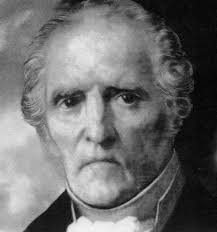
Charles Fourier (1772 - 1837)
Open Fourier's interactive page (graphs of influences, similar and opposing positions, and quotes)
Background
Charles Fourier
Born: 7 April 1772 in Besançon, France
Died: 10 October 1837 (aged 65) Paris, France
Era: 19th-century philosophy
Schools: Utopian socialism, Fourierism
Main interests: Civilization, Work, Economics,
Desire, Community, Education, Feminism
Influences: Nicolas-Edme Rétif, Jean-Jacques
Rousseau, Henri de Saint-Simon
Influenced: Pierre-Joseph Proudhon, Joseph
Déjacque, Karl Marx, Peter Kropotkin, Walter
Benjamin, Émile Armand, Paul Goodman, André
Breton, Herbert Marcuse, Raoul Vaneigem, Bob
Black, Hakim Bey, David Harvey, Friedrich
Engels, Peter Lamborn Wilson, Horace Greeley,
Gustav Wyneken, Guy Davenport, Alexander
Herzen, Mikhail Petrachevsky, Nikolaï
Tchernichevsky, Albert Brisbane, Ralph Waldo
Emerson, Henry David Thoreau
From Wikipedia
Fourier was a French philosopher, an influential early socialist thinker, and one of the founders of utopian socialism. Some of his views, held to be radical in his lifetime, have become mainstream in modern society. For instance, Fourier is credited with having originated the word feminism in 1837. Fourier's social views and proposals inspired a whole movement of intentional communities…. Fourier later inspired a diverse array of revolutionary thinkers and writers.
Introductory Comments
Fourier spent yearsa waiting for a rich patron to bankroll his idealized community. None came. The single attempt made in his lifetime to create his phalanx - a colony near Rambouillet, begun in 1832 - broke ground, ran out of money, and folded within a year. The "phalanx" that became famous was not his doing at all. Brook Farm (1841–1847), outside of Boston, began as a Transcendentalist experiment under George Ripley and turned Fourierist only in 1844, once Albert Brisbane had begun preaching the French master to American readers. Its members included Charles A. Dana and Hawthorne. Emerson was invited but declined - signing on in spirit while leaving his flesh comfortably ensconced in Concord.
The plan was to balance intellectual work with physical labor, thereby overcoming the gulf between the life of the mind and the life of the hands. In practice, many of the residents proved far more at ease discussing Kant than milking cows, and considerably more eager to theorize about work than to actually perform it. Then the half-built phalanstery burned in 1846, uninsured, and the debts came due. Brook Farm dissolved soon after. Hawthorne immortalized the whole earnest, muddy business in The Blithedale Romance. The novel is less a satire of Brook Farm than a darkly comic meditation on the stubborn human passions that survive even our noblest attempts to build a better world. Or as Kant asked: Can anything be built straight from the crooked timber?
Some of Fourier's Key Positions
Human nature needs no reforming - society does. Moralists urge people to restrain their passions, but if society is properly organized, the passions will do the work of virtue. Cooperation follows from arrangement, not from preaching.
Hence work should be assigned by interest, aptitude, and desire, in short sessions that change as often as enthusiasm flags. Attractive labor is productive labor.
Reward should track contribution, but not labor alone. Private property survives, and so does inequality. Still, necessary but unpleasant work - the jobs attraction will never fill - should pay best.
Every member is guaranteed a decent minimum, working or not, as compensation for the rights to hunt, fish, and forage that civilization took away. Poverty then vanishes.
These principles apply to women without qualification: Every career should be open to them by interest, aptitude, and skill, and paid accordingly.
To realize this vision, society should be organized into self-contained "phalanxes," each housing roughly 1,620 people of mixed trades and classes in a single vast building known as a "phalanstery," where communal living would train people out of selfishness and into cooperation.
Place in the History of Ideas
Fourier's Place in History of Ideas
Michael Spencer: In his works Fourier criticized contemporary civilization and urged change according to a scientific model of human organization. He believed that the universe operated according to fixed natural and social laws that humans needed to discover and live by in order to enjoy fruitful lives. Society would operate best, he said, when people created communities called phalanges (phalanxes) that were organized according to individual personalities and emotions. Fourier calculated that there were just over eight hundred individual characteristics among twelve basic human passions. The perfect community would include all these human characteristics in people of different ages, genders, and abilities. Such communities would comprise between 1,600 and 2,000 men, women, and children, who would work and live together in a single building called a phalanstery. There residents would be grouped not according to family organization but according to age and wealth.
Peter Lamborn Wilson: In Fourier's system of Harmony all creative activity including industry, craft, agriculture, etc. will arise from liberated passion - this is the famous theory of "attractive labor." Fourier sexualizes work itself - the life of the Phalanstery is a continual orgy of intense feeling, intellection, and activity, a society of lovers and wild enthusiasts.
Random Thoughts on Fourier
What sets Fourier apart from other utopians is not his love of order, nor his defense of the passions, but his insistence on having both at once. He was a systematizer of ferocious precision. He counted twelve basic passions and catalogued 810 characters. He fixed the population of each phalanx at 1,620 - 810 doubled for the two sexes - so that every temperament would be present and no task would go unloved. And he claimed, without visible embarrassment, to have done for society what Newton did for the heavens: to have discovered the law of attraction that governs it.
That combination is what makes him strange. From Plato's charioteer to Kant's stern sense of duty, the Western tradition has generally set reason against passion and handed reason the reins. Fourier proposed that reason's whole job is to arrange the world so the passions can be indulged. The idea came out of his working life. He spent decades as a clerk and traveling salesman and loathed nearly every hour of it. Boredom, he concluded, is not a private misfortune but a social disease.
So let people choose work they like, in short spells, changing often. And the jobs nobody wants? Raise the rewards until somebody does. Fourier's own favorite answer was odder still: give the filthiest work to roving bands of children, who love muck and would do it for the fun. Failing that, money. Doctors and lawyers may keep their prestige - the garbage collector gets the Mercedes.
Influences
Fourier was influenced by: Retif, N., Rousseau, Saint-Simon
Fourier influenced: Armand, Emile, Benjamin, Bey, Hakim, Black, Bob, Breton, Andre, Brisbane, A., Davenport, G., Dejacque, J., Emerson, Engels, Goodman, Paul, Greeley, H., Harvey, David, Herzen, Kropotkin, Marcuse, Marx, Petrachevsky, Proudhon, Thoreau, Vaneigem, R., Wilson, P.L., Wyneken, G.
Similar and opposing positions
Thinkers with similar positions:
- Condorcet (Enlightenment principles can lead us toward the perfect society.)
- Fromm (We need a socialist humanism that fights both injustice & alienation.)
- Horkheimer (Cultural, not just economic, forces drive history & shape society.)
- Irigaray (The power dynamics between men & women can be harmful to both.)
- Marcuse (Transforming labor into pleasure is a humane and worthy goal.)
- Piaget (To function well, democracy requires an engaged & educated citizenry.)
- Rousseau ("Progress" in science & reason has not benefitted humankind.)
- Spencer (Society is a living organism and its parts serve various functions.)
- Weber (Modern society lacks cohesion and is fragmented into unrelated parts.)
- Wollstonecraft (As rational beings, women must have same rights as men.)
Thinkers with opposing positions:
- Burke (Laws of commerce are laws of Nature & therefore the laws of God.)
- Engels (The working class will lead the revolution against the bourgeoisie.)
- Evola (Liberal democracy represents an ignoble trend towards mediocrity.)
- Evola (Women are by nature completely subordinate to men & must remain so.)
- Goldman (Revolution is a violent process, but also at times a necessary one.)
- Hayek (The common interest requires everyone seek economic self-interest.)
What others said about Fourier
- Dominic Pettman: [Fourier was] a revolutionary thinker who hated and feared revolutions and a hyper-controlling conductor of freedom.
- Steven Kreis: Fourier’s vision, together with his criticism of the existing system, places him as one of the most inspired prophets of 19th century socialism.
- Dominic Pettman: Fourier’s most essential claim would have seen him burnt at the stake a century or so earlier: specifically, that all of humanity’s various instincts and passions, including lust, are part of God’s grand design and should not be repressed or stigmatized as sinful. The problem... is not with our primal urges, but with the way these desires are stifled [and warped].
- Jonathan Beecher: In his lexicon civilization was a depraved order, a synonym for perfidy.... Fourier's attack on civilization had qualities not to be found in the writing of any other social critic of his time.
- Steven Kreis: As a visionary, Fourier’s ideas seem quite fantastical and without ground in reality.
- Michael Spencer: [Fourier thought that in an ideal community people] would work according to their natural inclinations and be paid according to their own contributions to the labor of the group.
- Marcuse: The idea of libidinal work relations in a developed industrial society finds little support in the tradition of thought, and where such support is forthcoming it seems of a dangerous nature. The transformation of labor into pleasure is the central idea in Fourier's giant socialist utopia.
- Steven Kreis: He despised laissez-faire liberalism and the factory system not because of what effects they might have on human society, but because he believed that industrial society was a passing phase.
Schools: Feminism, Socialism, Utopian Socialism
Main interests: Agriculture, Commerce, Community, Desire, Economics, Education, Equality, Government, Industrialism, Labor, Love, Progress, Property, Utopia
Fourier's answers to philosophical questions
Economics
"Wisdom, virtue, morality, all these have fallen out of fashion: everybody worships at the shrine of commerce."
Ethics
"The passionate desire for their own happiness makes men hard-hearted towards the misfortunes of others."
"Happiness is the only sanction of life; where happiness fails, existence remains a mad and lamentable experiment."
We all must help one another: "Civilization is the subordination of the individual to the welfare of the community."
Repression is unhealthy: "Passion stifled at one point reappears at another like water held back by a dike…."
History
"The peoples of civilization see their wretchedness increase in direct proportion to the advance of industry."
Leaders help us break through the old, tired rationale that confine us: "All progress depends upon the unreasonable man."
Philosophy
"Every day, philosophers, you add new errors to the errors of the past, whereas we see the... sciences daily advancing...."
Philosophy is a way of life: "The true philosopher is one who is detached from worldly possessions and desires."
Political Philosophy
Those not able to work should be provided with a "decent minimum" pension. In this way, poverty will be eliminated.
Yes, wealth redistribution! "The character of a society can be measured by the way it treats its most vulnerable members."
"When you give people liberty, it must be bolstered by two supports, the guarantee of comfort and [agreeable work].”
Psychology
Too often men treat wives & children as property. Marriages should be replaced with free love & group rearing of children.
"The philosophers say that the passions are too lively, too fiery; in truth they are weak and languid."
Science
Mathematics is the language of nature: "The deep study of nature is the most fruitful source of mathematical discoveries."
Sex and Gender
Civilization restrains and stunts human sexuality too much. People's sexual urges should be given much fuller play.
Because men so often treat their wives as mere property, marriage should be replaced with a free love between the sexes.
“The extension of the privileges of women is the fundamental cause of all social progress.”
All jobs, even the most important ones, should be open to women on the basis of interest, aptitude and skill.
Society
"Love in the Phalanstery is no longer... a recreation which detracts from work; on the contrary it is the soul… of all works…. "
Civilization breeds needless needs: "The civilized man has created a thousand needs and lacks the means to satisfy them all."