Philippa Foot (1920 - 2010)
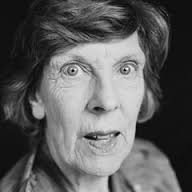
Open Foot's interactive page (graphs of influences, similar and opposing positions, and quotes)
Background
Philippa Ruth Foot
Born: 3 October 1920 in Owston Ferry,
Lincolnshire, England
Died: 3 October 2010 (aged 90) in Madrid, Spain
Alma mater: Somerville College, Oxford
Era: 20th-century philosophy
Region: Western philosophy
Schools: Analytic philosophy, Aretaic turn
Main interests: Ethics, Philosophy of mind
Notable ideas: Trolley problem, Virtue ethics
Influences: Ludwig Wittgenstein, G. E. M.
Anscombe, Aristotle, Thomas Aquinas, Thomas
Nagel, Nietzsche, Donald M. MacKinnon
Influenced: Bernard Williams, Candace Vogler,
Michael Slote, John McDowell, Rosalind
Hursthouse, Judith Jarvis Thomson, Iris
Murdoch
From Wikipedia
Foot's work in the 1950s and 1960s sought to revive Aristotelian ethics in modernity, competing with its major rivals, modern deontology and consequentialism (the latter a term dubbed by Anscombe). Some of her work were crucial to a re-emergence of normative ethics within analytic philosophy, notably her critiques of consequential- ism and non-cognitivism. Foot's approach was influenced by the later work of Wittgenstein, although she seldom dealt explicitly with his materials.
Introductory Comments
Mid-20h-century British philosophy had largely concluded that moral statements aren't real evaluations at all - merely commands, entreat- ies, or emotional outpourings in declarative disguise. To say "cruelty is wrong" was, on this view, roughly to say "cruelty - boo!" with bet-ter grammar. Foot thought this nonsense. Eval- uative terms, she argued, are not free-floating attitudes we paste onto neutral facts; they are tied to criteria of goodness rooted in the kind of thing being evaluated. To call an action rude, dishonest, or cowardly is not merely to disap- prove of it but to say something substantive - something that can be correct or incorrect. Moral language, in short, is answerable to facts about human beings and their lives.
This insight matured into a distinctive ethical naturalism. Moral evaluation of humans, Foot argued, belongs to the same logical family as evaluations of any living thing. Just as we call an oak defective when its roots are shallow, or a wolf a poor specimen when it cannot hunt with its pack, we can call a human good or de- fective in light of what humans need to live well as the kind of creature they are. Moral good- ness is species-relative goodness - not a mysteri-ous non-natural property, but a judgment grounded in the form of life humans share. And ethics, for Foot, wasn't handed down from the heavens; it grew, quietly and stubbornly, out of the same soil as everything else that lives.
Some of Foot's Key Positions
Some philosophers have argued that moral judgments are not real propositions, but merely commands, entreaties, or emotional outpour- ing. But these philosophers have by and large been focusing on abstract ethical concepts, like good, bad, right, and wrong.
When we look at life-based ethical concerns - like "it would be cowardly," "it's for her to do," or "I promised her I wouldn't do it" - we cannot help but see them as real evaluations. They de- scribe prior conditions and likely results, yet at the same time have an obvious moral element.
Thus, at least some moral statements are both descriptive and evaluative in nature. They ac- knowledge actual conditions while at the same time point to certain values - like courage and honesty - that help us succeed in meeting the challenges and adventures of life.
As Aristotle taught, such human virtues are not etherial abstractions, but, rather, life-grounded, down-to-earth human traits. They help us flouish in life. And statements that refer to these virtues are often admirably rational, in that they recognize both the unique strengths and weaknesses of our species and the corre- sponding opportunities and pitfalls awaiting us. The virtues, therefore, are not arbitrary ideals shining down on us, but natural traits linked to our very earthly existence.
Place in the History of Ideas
Foot's Place in History of Ideas
Jane O'Grady: The moral philosopher Philippa Foot... started a new trend in ethics. She challenged, in two seminal papers given in the late 1950s, the prevailing Oxbridge orthodoxy of A. J. Ayer and Richard Hare; and, for the next few decades, passionate debate over her natu- ralism, as against Hare's prescriptivism, occu- pied most moral philosophers in Britain and America. She was also one of the pioneers of virtue ethics, a key development in philosophy from the 1970s onwards.
John Hacker-Wright: The views she argued against were known as emotivism and prescrip- tivism.... On these views, moral judgments feature a... pro or con attitude that is absent from straightforward descriptive claims. What the judgments are about is irrelevant to whether they count as moral judgments. In "Moral Arguments," Foot memorably presents these views as offering a "private enterprise theory of moral criteria," which highlights the way in which these views take the individual’s attitude as settling the question of the scope of morality. In this line of argument, she demon- strates a commitment to a Wittgensteinian approach…. The idea that terms must have public criteria and cannot be given arbitrary meaning by the individual speaker is among these commitments, along with the approach to investigating terms by way of a "grammatical investigation."
Random Thoughts on Foot
If Foot was right that "good human behavior" just means "behavior that exhibits the traits characteristic of the species," then, critics ar- gued, morality collapses into something like statistical or biological normality - and two worries follow. The leveling-down worry: hu- mans are, on average, tribal, self-interested, and prone to violence, which threatens to bap- tize our worst tendencies as natural and there- fore acceptable. The deeper transcendence worry: moral creatures seem distinguished pre- cisely by their capacity to rise above nature - to forgive, to sacrifice, to extend concern to strangers, even enemies. A wolf cannot be a saint; a human can. Doesn't Foot's framework flatten that asymmetry?
Foot saw the punch coming, though whether her defense fully lands is another matter. Char- acteristic, she insisted, does not mean statisti- cally common: "humans reason practically a- bout how to live" is true as a species-norm even if most humans reason badly, just as "the oak puts down deep roots" holds in a forest full of stunted specimens. In like manner, the capaci- ties her critics call transcendent - forgiveness, impartiality, sacrifice - are not departures from human nature but among its highest expres- sion. The dispute, then, comes down to this: Foot's critics think humans are noble precisely when they escape their nature; Foot thinks they are noble precisely when they fulfill it.
Influences
Foot was influenced by: Anscombe, Aquinas, Aristotle, MacKinnon, Nagel, Nietzsche, Wittgenstein
Foot influenced: Hursthouse, McDowell, Murdoch, Slote, M., Thomson, J.J., Vogler, C., Williams, B.
Similar and opposing positions
Thinkers with similar positions:
- Anscombe (Moral absolutes do exist. Some things are inherently good or evil.)
- Chrysippus (A life of human happiness must also be a life of wisdom & virtue.)
- Fukuyama (Our moral instincts are innate & evolved with our social instincts.)
- Habermas (Reason plays a constructive role in moral, political & social systems.)
- Lewis, C.I. (Value statements are not merely expressive. They have meaning.)
- MacIntyre (Philosophy should return to basic questions that concern all of us.)
- Mead (Rationality has ethical implications. It's not merely instrumental.)
- Santayana (All human values, including those of ethics, have a natural basis.)
- Singer, Peter (There's no evidence that God exists nor that belief in Him is good)
Thinkers with opposing positions:
- Ayer (Moral statements express attitudes or feelings, not empirical facts.)
- Bataille (To be free means to be unrestrained by any chains of morality.)
- Bentham (Greatest happiness of greatest number determines right & wrong.)
- Hare (Moral statements do not objectively describe, but rationally prescribe.)
- Mill (Consequences, not intentions, determine the moral value of actions.)
- Russell (Language that is not verifiable is not true or untrue but meaningless.)
- Spinoza (Moral absolutes do not exist. Nothing is inherently good or evil.)
What others said about Foot
- Lawrence Solum: She made the moves that made people see things in a fundamentally new way. Very few people do that in philosophy.
- John Hacker-Wright: [Foot maintained that] self-interest is rationally required: we must have desires for what is evidently in our self-interest or else we are irrational.
- Jane O'Grady: [She asked if] morality really were... just a matter of each person commending and prescribing ways of acting... then why not commend a man who clasps his hands three times a day, or prescribe that this be done? No one would, of course, unless the clasping somehow had some relation to human wellbeing or harm, which is what morality must... be about….
- Nikhil Krishnan: [For Foot, to] say that vice is a natural defect is not an answer to any question; it is simply a way of interpreting the question, of telling us where we should be looking.
- Jane O'Grady: Unlike many philosophers, Foot never strained our basic intuitions in the interests of pursuing some wild theory to its (il)logical conclusion.
- Nikhil Krishnan: But all three of them [Murdoch, Anscombe, and Foot] took seriously the claim that moral judgments are an attempt, however flawed in particular cases, to get at something true independently of human choices.
- John Hacker-Wright: Can Foot show morality to be something with a foundation in human nature, as she understands it? The account Foot gives is promising, yet also programmatic. Foot believes that the moral virtues, together with prudence and virtues like friendship and loyalty… are justifiable on the basis of facts about human life. But which facts matter...?
- Rosalind Hursthouse: … her colleagues and pupils [loved many qualities] in her: her delightful sense of humor, her rich capacity for enjoyment, the clarity of her thought, her originality, her tender [regard for the] less fortunate….
Schools: Analytic Philosophy, Aristotelianism, Virtue Ethics
Main interests: Ethics, Fact–value distinction, Health, Mind, Virtue
Foot's answers to philosophical questions
Ethics
Moral judgments are not merely expressions of emotion but are grounded in objective facts about human nature & wellbeing.
Practical rationality and morality are deeply connected: We must understand ourselves and others to be moral.
Virtues are beneficial traits that humans need to flourish, much like plants and animals need certain characteristics to thrive.
Morality must be rooted in the ground of human nature: Human wellbeing and human harm are the two poles of morality.
Moral judgments describe real features of actions and of character, not just express attitudes or emotions.
Philosophy
"If... Martians take the writings of moral philosophers as a guide to [human behavior] they will get a shock when they arrive."
Psychology
"Of course what is best is to live boldly, yet without imprudence or intemperance, but [of course] few can manage that."