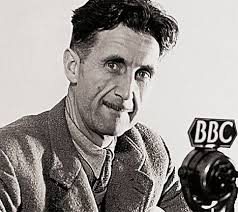
Orwell was an English novelist, essayist, journalist, and critic. His work is characterised by lucid prose, social criticism, opposition to totalitarianism, and support of democratic socialism…. Orwell's work remains influential in popular culture and in political culture, and the adjective "Orwellian" - describing totalitarian and authoritarian social practices - is part of the English language, like many of his neologisms, such as "Big Brother," "Thought Police," … " "Newspeak," "memory hole," "doublethink," and "thoughtcrime."
Introductory Comments
Orwell went to Spain in late 1936 to fight fascists and came home believing in socialism more than ever, and in Communists not at all. In revolutionary Barcelona, where waiters refused tips and everyone was "comrade," he saw equality actually working. Then, in May 1937, he watched the Soviet-backed Communists turn their guns on their own allies: the anarchists and the small Marxist party (the POUM) whose militia he had joined. The POUM was outlawed and its leaders arrested. Orwell, still recovering from a fascist bullet through the throat, fled the country one step ahead of the police. The lesson stuck. Stalin would happily sacrifice a revolution on the altar of Soviet foreign policy, and Western admirers would happily lie about it. From then on, Orwell refused to lie for his own side.
Was the revolution's slide into tyranny inevitable? Plenty of thinkers have said yes. Hayek's argument is brutally simple: abolish markets, and someone must decide who gets what. Whoever decides holds enormous power, and enormous power attracts the ruthless. The grim record of 20th-century communist states gives the argument real force. Orwell granted it "a great deal of truth," but not the final verdict. The turning point of Animal Farm, he later explained, is the moment the pigs quietly keep the milk and apples for themselves. Revolutions fail, in his view, when ordinary people stop watching their leaders. The moral isn't "never revolt." It's "always ask where the milk went."
Some of Orwell's Key Positions
Political language is largely the defense of the indefensible. Euphemism lets politicians endorse atrocities without anyone picturing them: bombed villages become "pacification," expelled peasants a "transfer of population." Muddled thinking breeds muddled language, and muddled language makes muddled thinking easier.
Totalitarianism goes further than disguising facts: it attacks the very idea of objective truth. When the state controls the record, the past becomes whatever the Party says, and truth-telling becomes a crime. Words like "freedom," "democracy," and “justice” survive, emptied of meaning or turned upside down. The final step is "doublethink": holding two contradictory beliefs at once and accepting both.
The Soviet Union is the great cautionary tale: a revolution made in the name of equality, betrayed by leaders who loved power for its own sake. The rot set in early and hit bottom under Stalin. Exposing the Soviet myth is a duty, above all for socialists, since it discredits socialism itself.
Hayek's warning that central planning breeds tyranny holds a great deal of truth. But unregulated capitalism brings its own tyranny, perhaps a worse one because it answers to no one. The goal is democratic socialism: economic justice and political liberty pursued together, however hard the combination proves in practice.
Place in the History of Ideas
Orwell's Place in History of Ideas
John Newsinger: The other crucial dimension to Orwell's socialism was his recognition that the Soviet Union was not socialist. Unlike many on the left, instead of abandoning socialism once he discovered the full horror of Stalinist rule in the Soviet Union, Orwell abandoned the Soviet Union and instead remained a socialist - indeed he became more committed to the socialist cause than ever.
Lionel Trilling: If we ask what it is he stands for, ... the answer is: the virtue of… fronting the world with nothing more than one's simple, direct, undeceived intelligence…. He implies that our job is not to be intellectual..., but merely to be intelligent according to our own lights - he restores the old sense of the democracy of the mind…. He has the effect of making us believe that we may become full members of the society of thinking men.That is why he is a figure for us.
Cyril Connolly: He could not blow his nose without moralizing on conditions in the hand- kerchief industry. This habit of mind informed everything he wrote. Animal Farm and 1984 are political novels, Homage to Catalonia, The Road to Wigan Pier and all his essays ask a cui bono and try to unseat the profit-makers, whoever they be. This ruling purpose is the secret of his best writing but far too evident in his worst.
Random Thoughts on Orwell
For Orwell, bad writing and bad politics weren’t just related. Each made the other worse. His 1946 essay "Politics and the English Language" makes the case with relish. His targets were vagueness, abstraction, and euphemism: the habits that let a writer sound meaningful while saying nothing, or say something monstrous while sounding respectable. Prisoners shot in the back of the neck or sent to die in Arctic labor camps become the "elimination of unreliable elements." The phrase isn't just prettier than the facts. It works as a small dose of moral anesthesia. Orwell’s own image was gentler and more sinister: inflated words fall on the facts "like soft snow," blurring their outlines until no one can see what lies underneath.
If Orwell were around today, he might notice that the soft snow has turned into a blizzard. Political language still hides things, but now it also drowns them in slogans, memes, and clips stripped of context. He would hardly be surprised. The same essay already mocks "ready-made phrases" that do your thinking for you. Nineteen Eighty-Four gave us the Two Minutes Hate, a daily ritual of outrage on a screen, which sounds less like satire every year. What might disturb him most is a fear he wrote down in 1942, thinking back on the propaganda of the Spanish Civil War: that "the very concept of objective truth is fading out of the world." He meant it as a warning, not a prophecy. Readers can check their newsfeeds and decide whether it has become one.
Horkheimer (Popular culture can itself be a form of insidious totalitarianism.)
Hume (Fictive literature can increase our empathy and improve our morals.)
Jaspers (Our freedom is threatened by modern science, economics and politics.)
Said (Cultural stereotypes in literature can encourage political aggression.)
Singer, Peter (There's no evidence that God exists nor that belief in Him is good)
Veblen (The leisure class is addicted to wasteful and conspicuous consumption.)
Thinkers with opposing positions:
Arendt (Only rights granted by the state matter, not "inalienable human rights.")
Bataille (Literature has no moral purpose. It's best when disrupting morals.)
Dostoyevsky (The cure to social ills is not socialism, but a true Christianity.)
Hayek (Only free market capitalism is consistent with freedom & democracy.)
Proust (Art is justified by revealing to us the beauty and charm of everyday life.)
What others said about Orwell
Paul Potts: There was something about him, the proud man apart, the Don Quixote on a bicycle… that caught one's imagination right away.
V. S. Pritchett: George Orwell was the wintry conscience of [his] generation…. He was a kind of saint and, in that character, more likely in politics to chastise his own side than the enemy.
George Woodcock: [His physical] resemblance to Don Quixote was appropriate, for in many was Orwell can only be understood as an essentially quixotic man.... He defended, passionately and as a matter of principle, unpopular causes. Often without regard to reason he would strike out against anything which offended his conceptions of right, justice, and decency….
Clive James: Two of Orwell's best attributes operating at once: he had a global grasp, and he was able to guess the truth by the way the other side told lies.
Simon Leys: ... a recurrent theme in the testimonies of all those who knew him... was his "terrible simplicity." He had the "innocence of a savage."
Isaac Deutscher: What struck me in Orwell was his lack of historical sense and of psychological insight into political life, coupled with an acute, though narrow, penetration into some aspects of politics, and with an incorruptible firmness.
Peter Edgerly Firchow: Toward the end of his life he did... become a kind of Tory anarchist - as he once described himself... - or even Tory socialist, someone, that is, who, though without exercising double-think, managed to fuse conservative ideas (about patriotism, for example) with radical ones (about the equitable distribution of wealth, for example).
Eric Hobsbawm: Orwell's reputation was constructed as an intellectual anti-Soviet missile site and even today, when the rest of Orwell has emerged or re-emerged, it still remains frozen in the 1950s.
Main interests: Alienation, Autobiography, Childhood, Communication, Cultural Criticism, Democracy, Freedom, Freedom of the press, Game Theory, Government, History, Ideology, Industrialism, Journalism, Labor, Literature, Metaphors, Mind, Political Activism, Politics, Power, Property, Public Administration, Punishment, Rhetoric, Social Criticism, War, Welfare State, Will