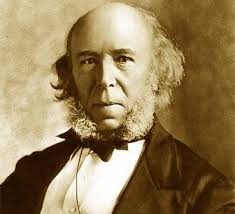
Spencer was an English polymath active as a philosopher, psychologist, biologist, sociologist, and anthropologist.... Spencer developed an all-embracing conception of evolution as the progres- sive development of the physical world, biological organisms, the human mind, and human culture and societies. As a polymath, he contributed to a wide range of subjects, including ethics, religion, anthropology, economics, political theory, philosophy, literature, astronomy, biology, sociology, and psychology.
Introductory Comments
Herbert Spencer, the Victorian sage often (if awkwardly) linked with Social Darwinism, wielded his pen like a philosophical machete. He hacked through the tangled undergrowth of government, raising eyebrows and blood pressure alike. Public education, poor relief, factory legislation: he opposed them all, along with much else that reformers hoped the state might provide. Such measures, he argued, violated individual liberty and blocked the natural consequences through which individuals and societies slowly adapt. At his harshest, Spencer warned that shielding the "unfit" from those consequences would only preserve the weaknesses that social evolution would otherwise weed out. It was Spencer, after all, who coined "survival of the fittest." Darwin merely borrowed it.
Yet the man who demanded such strenuous self-reliance of others was himself remarkably fragile. After a breakdown in his mid-thirties, Spencer suffered recurrent bouts of nervous exhaustion and chronic insomnia, and he hoarded his energies like a miser. A spirited argument could cost him a night's sleep. So the great apostle of the survival of the fittest took to carrying ear-stoppers, which he clamped on whenever conversation grew too lively. Spencer could sound like the lion of laissez-faire, but in person he was closer to the Cowardly Lion of The Wizard of Oz. Though even Dorothy might have thought twice about rescuing a lion whose own philosophy said she shouldn't.
Some of Spencer's Key Positions
Evolution is the great engine of progress. Throughout nature, relatively simple forms develop into forms that are increasingly differentiated, integrated, and complex. Biological evolution is only one example: the same pattern appears in the development of the human mind, culture, political institutions, and society.
Evolution operates everywhere, from stars and nebulae above to organisms and societies below.
We need, then, an ambitious "Synthetic Philosophy" that brings biology, psychology, sociology, ethics, and cosmology under the same general evolutionary laws. Yet the ultimate reality behind these laws remains forever "unknowable."
Human society likewise evolves from relatively simple and coercive forms toward increasingly complex and cooperative ones. Aggression and coercion, useful in earlier "militant" societies, become maladaptive as humanity advances toward peaceful "industrial" society.
Because this progress depends upon the gradual adaptation of individuals to social life, government should interfere as little as possible. Poor relief, compulsory public education, and other state interventions, however well-meaning, only prop up the unfit and delay the very progress they claim to hasten. Evolutionary philosophy thus entails a rigorous defense of individual liberty and laissez-faire government.
Place in the History of Ideas
Spencer's Place in History of Ideas
Harry Burrows Acton: ... individualism is the key to all of Spencer’s work. His contrast between military and industrial societies is drawn be- tween despotism, which is primitive and bad, and individualism, which is civilized and good. He believed that in industrial society the order achieved, though planned by no one, is deli- cately adjusted to the needs of all parties. In The Man Versus the State (1884), he wrote that England’s Tories generally favor a military and Liberals an industrial social order but that the Liberals of the latter half of the 19th century, with their legislation on hours of work, liquor licensing, sanitation..., education, and so on, were developing a "New Toryism" and prepar- ing the way for a "coming slavery."
J. Doyne Farmer: One of the factors that caused Spencer's ideas to lose popularity was social Darwinism…. Social evolution is different from biological evolution: it's faster, it's Lamarckian, and it makes even heavier use of altruism and cooperation than biological evolution does. None of this was well understood at the time.
William Sweet: Today, however, [Herbert Spencer] is usually remembered in philosophical circles for his political thought, primarily for his defense of natural rights and for criticisms of utilitarian positivism, and his views have been invoked by "libertarian" thinkers such as Robert Nozick.
Random Thoughts on Spencer
Spencer believed that evolution climbs. Life, mind, and society all ascend a staircase from the simple to the complex, and the staircase leads, inevitably, somewhere better. It is a stirring picture. It is also not how evolution looks to most biologists today. Natural selection has no destination in mind. It favors whatever helps organisms leave offspring in the circumstances at hand, and sometimes that means more complexity, sometimes less. Fish that colonize lightless caves lose their eyes. Birds on predator-free islands give up flying. These are not failures but successful adaptations: evolution taking the stairs down when down is where the food is. And for most lineages the final verdict is not progress but disappearance. By common estimates, more than 99 percent of all species that ever lived are extinct.
Darwin himself, to be fair, wavered. He jotted a reminder never to call one species "higher" than another, yet he closed the Origin by predicting that bodily and mental endowments would "tend to progress towards perfection." Spencer's "survival of the fittest" misleads too. He did not want to reward the ruthless. He loathed violence, and his ideal society ran on peaceful exchange and voluntary cooperation. His quarrel with reformers was over means: he thought state aid would short-circuit the very adaptation that would, eventually, make people spontaneously altruistic. Spencer's staircase, it seems, did lead somewhere lovely. He simply refused to install a handrail.
Comte (History shows that, like reason & science, societies progress over time.)
Darwin (The struggle for existence is both a destructive & constructive force.)
Durkheim (Society is a living organism and its parts serve various functions.)
Heraclitus (All is strife - a constant process of building up & tearing down.)
Huxley (The most rational approach to religious belief is an agnostic one.)
Malthus (The struggle for survival is an immense force at work in our world.)
Saint-Simon (Society and economy can be perfected thru science and reason.)
Sumner (Survival of the fittest requires we abandon liberal social reforms.)
Thinkers with opposing positions:
Adorno (Civilization does not inevitably lead to progress in morality and justice.)
Bergson (Life is a continuously creative force that transcends "laws of nature.")
Dawkins (Humans can opt out of survival contests since we are conscious of self.)
Edwards (Intricate design in the natural world is the work of God alone.)
Galbraith (Govt. should play an assertive role in improving general welfare.)
Green (The state should foster & protect the social & econonic environment.)
Marcel (Science & technology threaten to destroy the mystery of being.)
Nicholas of C. (All the sciences are but the handmaids of theology.)
What others said about Spencer
Thomas Eriksen: [Spencer was] the single most famous European intellectual in the closing decades of the nineteenth century.
Arendt: And the first philosopher of evolution, Herbert Spencer, who treated sociology as part of biology, believed natural selection to benefit the evolution of mankind and to result in everlasting peace.
J. Doyne Farmer: Spencer argued in a very articulate way for the communality of these processes of self-organization, and used his ideas to make a theory of sociology. However, he was not able to put these ideas into mathematical form or argue them from first principles. And no one else has, either....
James: [Spencer] enlarged the imagination, and set free the speculative mind of countless doctors, engineers, and lawyers, of many physicists and chemists, and of thoughtful laymen generally.
Hofstadter: [Spencer was] the metaphysician of the homemade intellectual, and the prophet of the cracker-barrel agnostic.
Rothbard: [Herbert Spencer's "Social Statics" is] the greatest single work of libertarian political philosophy ever written.
Russell: I don't know whether [Spencer] was ever made to realize the implications of the second law of thermodynamics; if so, he may well be upset. The law says that everything tends to uniformity and a dead level, diminishing (not increasing) heterogeneity.
Darwin: The expression often used by Mr. Herbert Spencer of the Survival of the Fittest is more accurate, and is sometimes equally convenient.
Main interests: Biology, Cosmology, Ethics, Evolution, Government, Political Philosophy, Progress, Property, Psychology, Science, Social Philosophy, Social Theory, War