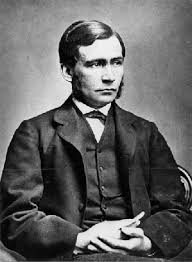
Thomas Green (1836 - 1882)
Open Green's interactive page (graphs of influences, similar and opposing positions, and quotes)
Background
Thomas Hill Green
Born: 7 April 1836 in Birkin, Yorkshire, England
Died: 26 March 1882 (aged 45) in Oxford,
England
Alma mater: Balliol College, Oxford
Schools: British idealism, social liberalism
Main interests: Political philosophy, education,
ethics, metaphysics, social activism, politics,
religion, epistemology, freedom
Influences: Immanuel Kant, Georg Wilhelm
Friedrich Hegel, Hermann Lotze, Johann
Gottlieb Fichte, Jesus, Benjamin Jowett,
William Wordsworth, Thomas Carlyle, Frederick
Denison Maurice
Influenced: F. H. Bradley, John Dewey, Leonard
Trelawny Hobhouse, Hastings Rashdall, Alfred
North Whitehead, Herbert Samuel, H. H. Asquith,
David George Ritchie, Roy Hattersley
From Wikipedia
T. H. Green, was an English philosopher, politi- cal radical and temperance reformer, and a member of the British idealism movement.... He was one of the thinkers behind the philosophy of social liberalism…. Green's teaching was, directly and indirectly, the most potent philo- sophical influence in England during the last quarter of the 19th century.... [Green helped] bring the universities more into touch with the people, and to break down the rigor of class distinctions.
Introductory Comments
There is something faintly insulting about being compared to a sponge. Yet that, in Green's view, is roughly what the British empiricists had done to the human mind. Locke and Hume, as Green read them, explained all experience and knowledge as an accumulation of sensations, with the mind passively soaking up whatever the world supplied. Green thought this picture could not survive inspection. Sensations arrive one by one, but knowledge consists of connections among them. Something has to do the connecting, and that something is self-consciousness - the mind's capacity to hold its experiences together and know them as its own. A sponge, however absorbent, does not even know it is wet.
From this one argument Green built nearly everything else: an inspiring ethics, a progressive politics, and a metaphysics that has struck many readers, then and since, as far-fetched. The ethics follows most directly. A creature that can stand back from its desires can decide which of them to act on and what ideal self it hopes to become. Moral life, for Green, is the effort to realize that better self. Then comes the twist. Green held that no one's true good can be gained at anyone else's expense, so pursuing one's best self already means pursuing a good shared with others. This does not mean dissolving into the community. It means finding that one's own fulfillment is bound up with theirs. From there it is a short step to Green's social and political views. (See Random Thoughts.)
Some of Green's Key Positions
Locke and Hume pictured the mind as a passive receiver of separate sensations. But knowledge is made of relations: this follows that, resembles that, causes that. A mere succession of feelings contains no relations, any more than a heap of bricks contains a house. Relations exist only for a consciousness that connects things. The mind is not a receptacle but an active, unifying principle.
Nature, too, is a system of relations, so it presupposes a unifying consciousness. This cannot be ours, which is limited and arrives late, but must be an "eternal consciousness." Each human mind partially reproduces it, knowing in part what it knows in whole. Of this consciousness in itself, we know it chiefly through its workings in us.
The self-consciousness that makes knowledge possible also makes moral action possible. An animal acts on its wants. A human being can stand back from a want and act instead for an idea of a better self. Because each person's best self includes the good of others, the true good is a common good, one no one can gain at another's expense.
Freedom is not merely the absence of restraint but a positive capacity for "doing or enjoying something worth doing or enjoying" with others. The state cannot make people moral, but it can remove obstacles to moral life. Compulsory education, factory laws, and limits on the liquor trade are examples.
Place in the History of Ideas
Green's Place in History of Ideas
Terence Green: Thomas Hill Green was an absolute idealist.... [As] a philosopher, it means he thought that reality was ultimately consti- tuted by minds and their contents.... He was also, however, a pivotal figure in the history of liberalism. Before Green, the sort of freedom liberals were worried about was the freedom to act as you wished: you were free if you could run and jump and skip and play; but if there were chains around you, literally or metaphor- ically, you weren’t free. Green’s seminal insight was to say that although such freedom is im- portant, it’s not sufficient to enable you to live a meaningful life.... Meaningful freedom re- quires that we can consciously will and execute our actions in a way that most effectively pro- motes the fullest development of the potential latent within us. What’s more, we can only achieve this blossoming of our individuality within the cosy bosom of society.
David O. Brink: His idealist approach to ethics embraces a perfectionist theory of self-realiza- tion committed to rich conceptions of freedom and the common good that aims to synthesize the best elements in Greek eudaimonism and Kantian rationalism. Though perfectionism is an underappreciated tradition, Green makes en- during contributions to that tradition. Green’s perfectionism leads him to develop a progres- sive conception of liberalism that was influen- tial in British politics [for several decades].
Random Thoughts on Green
Green's road from epistemology to politics runs through his ethics. A self that can reflect on its desires can aim at a better self, and no one's better self can be gained at a neighbor's expense. A society, then, is less a crowd of rivals than a joint venture. Freedom needs rethinking too. The right to be left alone is cold comfort to a laborer free in law to sign any contract but too poor to refuse a bad one. Positive freedom, for Green, is a real capacity to make something worthwhile of one's life, in common with others. The state cannot hand anyone that capacity, since morality must come from within. But it can clear away obstacles: hence Green's support for compulsory education, factory laws, and curbs on alcohol.
And then there is the universe. Nature, Green reasoned, is a web of relations, and relations exist only for a mind that connects them. Our minds are too small and too late to do the job. So there must be an eternal consciousness holding it all together, of which each of us is a partial reproduction. A skeptic might grumble that Green made the universe in his own image - a cosmic Oxford don with a weakness for the common good. Green would have turned the charge around: it is not the universe that resembles us, but we who faintly resemble it. But why assume any resemblance? Even if Green is right that an eternal consciousness somehow holds the universe together, it may resemble a human mind about as much as the ocean resembles the fish swimming in it.
Influences
Green was influenced by: Carlyle, Fichte, Hegel, Jesus, Jowett, B., Kant, Lotze, Maurice, F.D., Wordsworth
Green influenced: Asquith, H.H., Bosanquet, Bradley, Dewey, Hattersley, R., Hobhouse, L.T., Rashdall, H., Ritchie, D.G., Samuel, H., Whitehead
Similar and opposing positions
Thinkers with similar positions:
- Anscombe (Moral absolutes do exist. Some things are inherently good or evil.)
- Dewey (To function well, democracy requires an engaged & educated citizenry.)
- Foot (Moral judgments, though linked to human nature, can be true and rational.)
- Hayek (A society with a strong economy can still provide a social safety net.)
- Hegel (The finite world is a reflection of mind, which alone is truly real.)
- Hegel (God is the fullest reality, arising out of ourselves, the world, and nature.)
- MacIntyre (Philosophy should return to basic questions that concern all of us.)
Thinkers with opposing positions:
- Bentham (Talk of natural rights is mere rhetoric - just "nonsense upon stilts.")
- Carnap (Metaphysics should play no role in responsible human discourse.)
- Darwin (Evolution has created the cognitive tools we use to function & survive.)
- Hare (Moral statements do not objectively describe, but rationally prescribe.)
- Harris (One can be moral without having any religious beliefs.)
- Hume (We only really know the immediate impressions of our senses.)
- Mill (Government interference in an economy is usually counterproductive.)
- Spencer (Survival of the fittest is the driving force in the mechanism of life.)
- Spinoza (Moral absolutes do not exist. Nothing is inherently good or evil.)
What others said about Green
- David O. Brink: Green was perhaps the most important figure within the tradition of British idealism. But [his influence] extends beyond that tradition.
- W. H. Walsh: Green's object in metaphysics was plainly to state an alternative to materialism, which struck him as both insidiously attractive and intellectually preposterous.
- Terence Green: For earlier liberals, the state just had to do basic things like keep the peace so all good citizens could freely go about their business. That’s not enough for people to achieve complete freedom, that is, their self-realization, said Green. Instead, the state will need to intervene... to make sure everyone gets all they need to be all they can be.…
- James Bryce: He was a thoroughgoing Liberal, or what used to be called a Radical, full of faith in the people, an advocate of pretty nearly every measure that tended to democratize English institutions....
- Colin Tyler: [Green believed a] shared conception of a collective end - a common good - is... the basis of the individual's existence as a moral agent.
- Andrew Vincent: [I]f there is one important intellectual bequest from Green, it is a strong communitarian and ethical theory of citizenship and the state, devoted to the promotion of a worthwhile life for all its citizens.
- David Thompson: In the quarter century before 1914, during which much social legislation was passed by the liberal governments, Green’s ideas permeated social thought in England…. They spread wide and sank deep because they were in the direct evangelical tradition of philanthropic humanism.
- Geoffrey Thomas: Thomas Hill Green was that rare combination, a high-powered philosopher and political theorist who also contributed effectively to practical politics.
Schools: British Idealism, Epiphenomenalism, Liberalism, Metaphysical Idealism, Objective Idealism, Social Liberalism
Main interests: Education, Epistemology, Ethics, Freedom, Metaphysics, Political Activism, Political Philosophy, Politics, Religion
Green's answers to philosophical questions
Epistemology
The Kantian forms and categories of thought show that knowledge is both empirical and rational.
Ethics
As spiritual beings, we can rise above our animal nature and seek moral perfection through self-sacrifice and holiness.
As self-conscious and self-realizing beings, humans are moral agents who freely decide their aims and actions.
Metaphysics
Reality is ultimately constituted by minds and their contents. However, people have certain physical needs that must be met.
Except when acting on pure impulse, humans - as intelligent and spiritual beings - are the authors of their own acts.
Nature
As there is a spiritual element at work in mankind, so there is a spiritual dimension to nature.
Humans transcend the workings of nature through their intelligence and will. Our voluntary actions are self-directed.
Political Philosophy
Government should help maintain a society in which each citizen can realize his or her individual potential.
Government should restrict citizen rights only when a severe threat exists - but even then, only on the local level.
Though government shouldn't enforce morality, it should help maintain an environment that allows citizens to act morally.
Religion and Theology
"It is impossible for the infinite God to be captured by our finite thoughts, images, and feelings."
Sex and Gender
Women should be given the same opportunities for a higher education as men have - and at the finest universities.