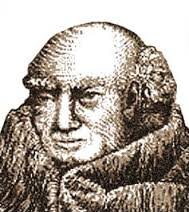
John Eriugena (c. 815 - c. 877)
Open Eriugena's interactive page (graphs of influences, similar and opposing positions, and quotes)
Background
John Scotus Eriugena
Born: c. 815 in Ireland
Died: c. 877 (age c. 62) in probably West Francia
or Kingdom of Wessex
School: Neoplatonism
Main interests: Free will, logic, metaphysics
Influences: Plato, Augustine of Hippo, Plotinus,
Cappadocian Fathers, Pseudo-Dionysius,
Maximus the Confessor, Boethius, Basil of
Caesarea, Gregory of Nyssa, Cicero, Martianus
Capella, Denis the Areopagite, Ambrose
Influenced: Berengar of Tours, Honorius of
Autun, Hildegard of Bingen, Israel the
Grammarian, Amaury of Bene, Alain de Lille,
Peter Damian, Thomas Aquinas, Nicholas of
Cusa, Hegel, Anselm of Canterbury, Meister
Eckhart, Hugh of Saint Victor, Suger of Saint-
Denis, Gilbert of Poitiers, Peter Abelard
From Wikipedia
Eriugena (c. 800 – c. 877) was an Irish... philoso- pher, theologian and poet of the Early Middle Ages. Bertrand Russell dubbed him "the most astonishing person of the ninth century."… Eriuge- na is generally classified as a Neoplatonist, though he was not influenced directly by such pagan philosophers as Plotinus or Iamblichus. Jean Trouillard stated that, although he was almost exclusively dependent on Christian theological texts and... Canon, Eriugena "reinvented the greater part of the theses of Neoplatonism."
Introductory Comments
Legend has it that Eriugena was such an original thinker and challenging teacher that one day his students, in a spontaneous sort of professor evaluation, rose as one, approached their honored master, and then, dispensing with normal classroom formalities, stabbed him to death with their pens. Whether or not there is any truth to the tale, there is perhaps a certain poetic justice:
To appreciate just how radical Eriugena's theology sounded to many of his contemporaries, here it is in a nutshell: God is a mystery even unto Himself, yet His goodness is so overflowing, that it pours itself forth into the astonishing variety of beings and things that make up the universe. All things then exist only through their participation in God. Human beings may fall into sin, but sin does not alter their deepest nature. Evil is not a thing in itself, but a privation - a turning away from what truly is. At our core, we remain expressions of the divine goodness from which we came. Thus, when Christ sacrificed himself on the cross, the redemption he accomplished was not merely local or partial, but cosmic in scope. In the end, all things would return to their divine source - even sinners, even serpents, even Satan.
And so, if his students were upset by all this, and if Jesus spoke truly when he said that those who live by the sword die by the sword, and if the pen is indeed mightier than the sword, well... who are we to cast aspersions on Eriugena's students?
Some of Eriugena's Key Positions
Though Christians must acknowledge the importance of revelation, they must also recognize that reason is needed to understand and interpret revelation. Indeed, reason is in a sense primary, while authority - even religious authority - is secondary or derivative. Genuine authority cannot contradict reason, for both ultimately spring from the same divine source.
Moreover, in many matters reason can stand on its own. Even the existence and nature of God can be approached philosophically. As Pseudo-Dionysius said, God is the ineffable Oneness that is both the source and the culmination of all being. Reason thus reveals a universe that flows forth from God and is destined, in some sense, to return to God.
Human beings, however, possess free will and can temporarily estrange themselves from their divine origin through disordered desires and sinful acts. God predestines only what is good, for all are called to holiness. Evil, having no true existence of its own, arises instead from the misuse of freedom.
Even so, the sinful and estranged soul will in the end be gathered back by God's love and mercy. Indeed the whole of creation will finally be redeemed under God's dominion, all things restored to their right relation with Him and returned to rest in His oneness. In the end, all things will find their fulfillment in the divine unity from which they first proceeded.
Place in the History of Ideas
Eriugena's Place in History of Ideas
Thomas Cahill: [John Scotus Eriugena is] the first philosopher of the Middle Ages, the first truly Christian philosopher since the death of Augustine in 430.... Here is a mind that could grasp the most rarefied distinctions of the Greek philosophical tradition and, far more important, could elaborate a new system of thought, one that is balanced and internally consistent.... In John Scotus's system Nature is a virtual synonym for Reality - all of reality, our natural world as well as the reality of God. In Scotus there is no useful distinction between natural and supernatural.... Reality is a continuum, and all God's creatures are theophanies of God himself, for God speaks in them and through them.
Deirdre Carabine: It has often been stated that what we find in Eriugena's work is a constant battle between Augustine (himself once an ardent Neoplatonist) and the Pseudo-Dionysius, broadly understood as West versus East. While that characterization is not entirely false, it could be said that Eriugena was simply trying to bring the diverse strands of Christian theology into agreement.... The ideas he drew on from the great Eastern [Christian] fathers opened a new window onto a fresh understanding of human and divine reality.... The ideas elaborated in [his work] can be understood as a very powerful alternative to the views elaborated by Augustine and later by Aquinas.
Random Thoughts on Eriugena
"We do not know what God is. God Himself does not know what He is, because He is not anything. Literally, God is not - because He transcends being." How might we begin to unravel the string of claims packed into these lines from Eriugena? Yes, many have said that God transcends our understanding, but what could it mean for an all-knowing God not to know what He Himself is? Is Eriugena saying that this is less a matter of ignorance than of infinitude, since a God who is no thing offers no "what" to be known? And what sort of perfection transcends being? Anselm's proof for God's existence assumes the very opposite - that perfection implies existence.
Trying to make sense of the passage, the modern mind might wander to the Big Bang. Before it, nothing existed. Yet since this Nothing somehow gave birth to the universe, it's hard not to picture it as harboring some intent - even some perfection, to borrow Eriugena's word, straining to be expressed. All of which can be waved away as anthropomorphizing, of course, and Eriugena knew nothing of modern cosmology. Yet at bottom he wrestled with the same question cosmologists face today: how do you get Something out of Nothing? His answer was that this Nothing - this God beyond being - held within itself such pent-up goodness that it burst forth into an expanding universe. Which is perhaps to say, à la Empedocles, that the force behind the universe is love - or perhaps, à la the Beatles, all you need is love.
Influences
Eriugena was influenced by: Ambrose, Augustine, Basil of C., Boethius, Cicero, Denis the A., Gregory of N., Martianus, Maximus the C., Plato, Plotinus, Pseudo-Denys
Eriugena influenced: Abelard, Alain de Lille, Amaury of B., Anselm, Aquinas, Damian, Peter, Eckhart, Gilbert of P., Hegel, Hildegard of B., Honorius of A., Israel the G., Nicholas of C., Pound, Ezra
Similar and opposing positions
Thinkers with similar positions:
- Abelard (Reason, not faith, is the foundation of most Christian beliefs.)
- Berlin (Meaningful rational activity rests on the concept of human free will.)
- Chrysippus (The universe itself is God or the universal outpouring of His soul.)
- Ficino (The soul is at a privileged midpoint between God and prime matter.)
- Kant (Notions like space and time are unifying forms imposed by the subject.)
- Plotinus (The One, being perfect & eternal, is stable, uniform and unchanging.)
- Pseudo-Denys (To truly know the moral good we must know the eternal Good.)
- Spinoza (God is not transcendent. Everything in Nature is part of God.)
Thinkers with opposing positions:
- Augustine (God is transcendent. He is above everything in nature.)
- Diderot (Even if God created laws of nature, he isn't now at work in nature.)
- Holbach (The universe is simply matter in motion. It has no spiritual dimension.)
- Kierkegaard (Christianity must be accepted on faith alone, never on reason.)
- Luther (Given God's sovereignty & our own sinfulness, there is no free will.)
- Luther (Reason cannot aid faith. It is the greatest enemy that faith has.)
- Pascal (God is infinitely incomprehensible. We can't reason our way to God.)
- Skinner (Free will is not possible in our deterministic world.)
What others said about Eriugena
- Richard Woods: It is largely through [Eriugena's] efforts that the mystical Neoplatonism of the Eastern Church entered the Latin West.
- Russell: He contended that reason and revelation are both sources of truth, and therefore cannot conflict; but if they ever seem to conflict, reason is to be preferred.... [T]rue philosophy is true religion.
- Thomas Cahill: [Eriugena] took the perfectly orthodox statement of Paul that in the end "God will be all in all" and used it... to suggest that at the end of time everyone - even the devils - will be saved [because God's love is all-embracing and all-powerful]!
- Deirdre Carabine: Eriugena's method confronts us with the full force of the inexplicable nature of God as the reconciliation of all opposites, for in God there cannot be opposition, and things in discord cannot be eternal.
- Russell: [Eriugena is] the most astonishing person of the ninth century; he would have been less surprising if he had lived in the 5th or the 15th century.
- Dermot Moran: Eriugena argues in "De Divina Praedestinatione" that God, being perfectly good, wants all humans to be saved, and does not predestine souls to damnation.
- Christopher Bamford: [Eriugena's] astounding synthesis of theology, philosophy, cosmology and anthropology... represent a perfect, nondualistic fusion of Christianity and Platonism and constitutes the only philosophical alternative in the West to the Aristotelian scholasticism of St. Thomas Aquinas.
- Schopenhauer: [I]n the seventeenth century pantheism [was rediscovered] through [the writings of] Bruno, Malebranche, Spinoza, and Scotus Eriugena.
Schools: Augustinianism, Christian Mysticism, Christian Theology, Emanationism, Mysticism, Neoplatonism, Platonism, Scholasticism
Main interests: Chain of Being, Faith, Free/Unfree Will, Logic, Metaphysics, Spirituality
Eriugena's answers to philosophical questions
Epistemology
Reason is secondary to faith in importance, but reason is not in the service of faith. Reason can be relied on by itself.
History
"The end of all motion is its beginning; for it terminates at no other end save its own beginning [in God]…."
Metaphysics
God created the Platonic Ideas. These in turn, with help from the Holy Ghost, give rise to the world of particular things.
God predestines only the good, for we are all summoned to be saints. All acts that are not good are freely chosen.
Nature
God's wisdom and love is seen at work throughout nature. We see this even in small seeds that later burst forth as plants.
Psychology
Union with God is not only the ultimate goal of life, it is also that which brings the greatest happiness.
Religion and Theology
God reveals Himself thru nature: "Observe the forms & beauties of sensible things & comprehend the Word of God in them."
God is unknowable, even to Himself. Through a gradual & baffling process, God simply emerges from divine darkness.
Faith is the acceptance of Christian dogma, but this dogma is supported by both revelation and reason.
The world is an expression of God's being: His goodness is so abundant that it spills over into the world we see about us.
Since God is outside time, He cannot be said to foreknow or to predestine anything.
"Christ wears 'two shoes' in the world: scripture and nature. Both are necessary to understand the Lord…."