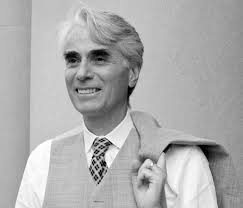
Robert Nozick (1938 - 2002)
Open Nozick's interactive page (graphs of influences, similar and opposing positions, and quotes)
Background
Robert Nozick
Born: November 16, 1938 in Brooklyn, New York,
United States
Died: January 23, 2002 (aged 63) in Cambridge,
Massachusetts, U.S.
Alma mater: Columbia University, Princeton
University, Oxford University
Schools: Analytic, Libertarianism
Main interests: Political philosophy, ethics,
epistemology
Notable ideas: Utility monster, experience
machine, justice as property rights, paradox of
deontology, entitlement theory
Influences: Locke, Kant, Mill, Hayek, Murray
Rothbard, Sidney Morgenbesser, Carl Gustav
Hempel, Milton Friedman
Influenced: Roderick T. Long, Jan Narveson,
David Schmidtz, Tamar Gendler, David Boaz,
Tom G. Palmer
From Wikipedia
Nozick is best known for his books Anarchy, State, and Utopia, a libertarian answer to John Rawls' A Theory of Justice, in which Nozick also presented his own theory of utopia as one in which people can freely choose the rules of the society they enter into, and Philosophical Explanations, which included his counterfactual theory of knowledge. His other work involved ethics, decision theory, philosophy of mind, metaphysics, and epistemol- ogy. His final work before his death, Invariances, introduced his theory of evolutionary cosmology….
Introductory Comments
Nozick's theory of justice is built on a decep-tively simple foundation: individuals own them- selves, and therefore own the fruits of their labor and voluntary exchanges. Justice, on this view, is historical rather than patterned - what matters is not how a distribution looks at any given moment, but how it came about. A distri-bution is just if it arose through three legiti-mate steps: just acquisition of previously un- owned things, just transfer by voluntary ex- change or gift, and rectification of past viola- tions of the first two. If property is acquired fairly, exchanged voluntarily, and not stolen or coerced away, then whatever distribution results is just - even if some end up with yachts while others make do with canoes.
The animating assumption is Kantian: persons are ends in themselves, never mere means, and rights function as side-constraints rather than goals to be maximized for the greater good. From this flows Nozick's famous Wilt Chambet-lain argument: if people freely pay to watch Wilt play, the resulting inequality is just, and any attempt to preserve a preferred pattern of distribution requires "continuous interference with people's lives." Redistributive taxation of earnings, Nozick provocatively claims, is "on a par with forced labor." Justice, in short, is less about who ends up with what than about how they got there - the means are everything; the ends are none of his business.
Some of Nozick's Key Positions
The most that can be justified in the way of government - the form most respectful of human rights - is the minimal state whose func-tion is limited to protecting against force, fraud, and theft, and to administering courts of law. As long as adults are acting freely in their relat- ions and exchanges with one another, the state should not interfere with them. This means that even when economic dealings - buying and sel-ling, employing and working, etc. - result in large inequalities, the state should not try to "improve" such dealings or afterwards "make things right." What matters is not what a distri-bution looks like, but whether it arose through a just history of acquisitions and transfers.
This is not to say that there should never be any redistribution of goods, but only that any such redistribution must be freely made in the form of charitable donations. Nor is this an en- dorsement of anarchy - a state is needed to protect us from the problems inherent in what Hobbes and Locke called the state of nature. But as Kant argued, people must be treated as ends in themselves, not merely as means to an end. Redistributive taxation violates this principle: it appropriates the product of a per- son's labor without consent, treating that per- son as an instrument of social policy. However noble universal prosperity may be, and howev- er deplorable poverty may be, we may not use people as means to achieve these ends.
Place in the History of Ideas
Nozick's Place in History of Ideas
Edward Feser: A thinker with wide-ranging interests, Robert Nozick was one of the most important and influential political philosophers, along with John Rawls, in the Anglo-American analytic tradition. His first and most celebrated book, Anarchy, State, and Utopia, produced, along with his Harvard colleague John Rawls’ A Theory of Justice, the revival of the discipline of social and political philosophy within the ana- lytic school. Rawls’ influential book is a system- atic defense of egalitarian liberalism, but Nozick’s Anarchy, State, and Utopia is a compel- ling defense of free-market libertarianism. Un- like Rawls, Nozick neglected political philosophy for the rest of his philosophical career. He moved on to... other philosophical questions....
Jeff Riggenbach: [Nozick] identified voluntary cooperation as the "core principle" of ethics, maintaining that the duty not to interfere with another person's "domain of choice" is "[a]ll that any society should (coercively) demand"; higher levels of ethics, involving positive benevolence, represent instead a "personal ideal" that should be left to "a person's own individual choice and development." And that certainly sounds like an attempt to embrace libertarianism all over again. My own view is that Nozick's thinking about these matters evolved over time and that what he wrote at any given time was an accurate reflection of what he was thinking at that time.
Random Thoughts on Nozick
The strengths of Nozick's theory of justice (see Introductory Comments) are not trivial. Nozick takes individual liberty with bracing seriousness in an age fond of subordinating it to grand so- cial blueprints, and his insistence that process matters is a genuine philosophical achieve- ment - a useful corrective to theories that treat society as a pie to be sliced rather than a tapes-try of consenting agents. The Wilt Chamberlain argument lands a real blow against tidy egali- tarian patterns, showing how quickly liberty unsettles them. And his Lockean derivation of the minimal state from a state of nature is an ingenious attempt to refute the anarchist with- out conceding an inch to the welfare statist - no small feat of philosophical tightrope-walking.
Yet Nozick’s theory also faces serious difficul-ties. Its account of "just acquisition" is notori- ously vague, especially in a world shaped by conquest, slavery, colonialism, and inherited advantage. If past injustices stain nearly all ex- isting property holdings, then the clean moral ledger his theory requires may never have ex- isted in the first place. Critics also argue that extreme inequality can undermine the very freedom Nozick cherishes, since desperate peo- ple often "choose" under conditions that hardly resemble genuine independence. In the end, Nozick gives us a vision of justice so committed to clean hands that it risks leaving the world's actual messes precisely where it found them.
Influences
Nozick was influenced by: Friedman, Hayek, Hempel, Carl, Kant, Locke, Mill, Morgenbesser, Rothbard, Spencer
Nozick influenced: Boaz, David, Gendler, Tamar, Long, Roderick, Narveson, Palmer, Tom G., Schmidtz, D.
Similar and opposing positions
Thinkers with similar positions:
- Green (The state should foster & protect the social & econonic environment.)
- Hayek (Socialism requires central planning which in turns leads to oppression.)
- Mill (Government interference in an economy is usually counterproductive.)
- Rand (Rights are best secured by minimal state limited to narrow functions.)
- Smith, Adam (Govt. must be very careful when interfering with the economy.)
- Spencer (Collectivist social reforms usually have unintended consequences.)
Thinkers with opposing positions:
- Bentham (Govt. should play an assertive role in improving general welfare.)
- Condorcet (Enlightenment principles can lead us toward the perfect society.)
- Galbraith (Government has an important role in maintaining a good economy.)
- Hart (Anyone who benefits from an institution is obliged to help sustain it.)
- Keynes (Govt. interference in an economy is at times needed as a stimulus.)
- Rawls (Social justice requires a fair, though not equal, distribution of wealth)
- Rawls (Govt. should provide greatest benefit to those least advantaged.)
- Royce (Each individual gains fulfillment by joining and serving the larger whole.)
- Ruskin (Most importantly, govt. should promote economic and social justice.)
- Shaw (Socialism can cure many of the abuses found in our modern economies.)
What others said about Nozick
- C. Lehmann-Haupt: [Nozick's] critique of America's social welfare system… continues to define the debate between conservatives and liberals.
- Quine: [Nozick's "Anarchy, State, and Utopia" is a] brilliant and important book, bound to contribute notably both to theory and, in time, to the good of society.
- A. Gottlieb: From Mr. Nozick you always expect fireworks, even if some of them go off in their box. His questions, hints, counterarguments and suggestions come so thick and fast that it is next to impossible to appreciate all of them. Start pondering a sentence and you will find yourself led away prematurely by a parenthetical question; think about the question and you will….
- William Tucker: Perhaps the libertarian philosopher should not be expected to opt out of rent control voluntarily. But should he be pursuing his landlord through the maze of rent control regulations like a man possessed?
- Singer, Peter: [Nozick] is always stimulating; an open-minded study of what he has to say could be a healthy tonic for romantic leftists.
- Anthony Gottlieb: [Nozick] always attacks his problems in a disconcertingly original way.… [I]n "The Examined Life," he took on nothing less than the meaning of life, a subject that academic philosophers tended to steer clear of.
- Roderick Long: Given the extensive involvement of state violence in the process by which the corporate elite not only achieved its wealth in the past but continues to maintain and augment it in the present, it is clear that the massive inequalities of wealth that characterize present-day "capitalist" society are radically inconsistent with [Nozick's] approach to justice….
- Julian Sanchez: Nozick always thought of himself as a libertarian in a broad sense, right up to his final days, even as his views became somewhat less "hardcore."
Schools: Analytic Philosophy, Classical Liberalism, Deontological Ethics, Individualism, Intuitionism, Libertarianism, Rationalism
Main interests: Commerce, Epistemology, Ethics, Freedom, Game Theory, Government, Happiness, Justice, Law, Literature, Political Philosophy, Power, Property, Virtue, Wealth, Welfare State
Nozick's answers to philosophical questions
Economics
Adam Smith's "invisible hand" is a shallow notion if not coupled with a state that acknowledges and protects individual rights.
Labor alone cannot explain prices. We must also consider social preferences along with issues of supply and demand.
"I think a lot of Marx was quite sloppy. There was all sorts of politically aggressive language when he lacked arguments...."
Ethics
It might be best to be Socrates satisfied, both happy & deep, but we'd "give up some happiness in order to gain the depth."
"What else can matter to us, other than how our lives feel from the inside?"
Love means that "[y]our own well-being is tied up with that of someone (or something) you love."
Law
Though individual rights must be respected, they are not inalienable. One may even enter into a non-coercive slave contract.
Metaphysics
"No one has ever announced that because determinism is true thermostats do not control temperature."
Nature
"[O]ur rationality, both individual and coordinate, defines and symbolizes the distance we have come from mere animality."
Philosophy
"And it's also the case, I guess, that my temperament is to like interesting, new, bold ideas, and to try and generate them."
"[S]cientists often have more unfettered imaginations than current philosophers do." That's why science is more surprising.
Philosophy isn't a battle: Why be "intent on forcing others to believe things? Is that a nice way to behave towards someone?"
Political Philosophy
A state is justified only as a protection against the problems inherent in what Hobbes and Locke called the state of nature.
The best form of government is the "minimal state" whose function is limited to protecting against force, fraud, and theft.
As long as economic relations are free or uncoerced, the state should not try to "improve" them or regulate them in any way.
The state best guards our rights by limiting itself to protecting us against infringements of our rights, such as theft & violence.
"In a free system any... popular, revolutionary movement should be able to bring about its ends by... a voluntary process."
The redistribution of wealth is only justified when freely made in the form of charitable donations - never by state mandate.
As noble a notion as universal prosperity or universal health care may be, such ends must not be achieved thru state decree.
Psychology
"[A] capitalist society does not satisfy the principle of distribution 'to each according to his merit or value.'"
Religion and Theology
"Faith is caused by an encounter with something very real but which has extraordinary qualities which intimate the divine...."
Society
We evolved into social animals: "Those who are able to engage in social cooperation... do better in survival & reproduction."
No social entity exists for itself: "There are only individual people, different individual people, with their own individual lives."