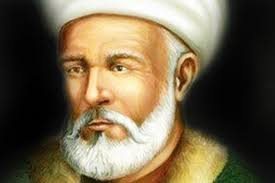
Al-Farabiwas an early Islamic philosopher and music theorist. He has been designated as "Father of Islamic Neoplatonism," and the "Founder of Is- lamic Political Philosophy." His fields of philo- sophical interest included... philosophy of society and religion; philosophy of language and logic; psychology and epistemology; metaphysics, political philosophy, and ethics. He was an expert in... music theory, and although he was not intrinsically a scientist, his works incorporate astronomy, mathematics, cosmology, and physics.
Introductory Comments
Scholars still argue over the particulars of al-Farabi's life - his ethnicity, his political ties, the order in which he wrote his books. But one thing is beyond dispute: he was a traveler. He moved across the Near East - from the fringes of Central Asia to Baghdad, and on to Damascus, Aleppo, and perhaps Cairo - and so he must have seen the Islamic Golden Age with his own eyes. The great madrasas and libraries, the flourishing scholarship and jurisprudence, the lively traffic among different faiths, the expanding machinery of the Caliphate, the bustling cities, the graceful architecture, the cool and orderly gardens - all of it. And, of course, all those unpleasant, unjust, and thoroughly ungolden things we conveniently forget whenever we dream of golden ages. That too al-Farabi must have witnessed firsthand.
Yet he and his fellow philosophers did more than witness the age; they helped build it. Steeped in Greek philosophy and the wider classical inheritance, they did not regard Islam as a break with the past but as its fulfillment. They disagreed about a great deal, but they shared a conviction that faith and philosophy, rightly understood, spoke with one voice, and that revelation gave in image and symbol what the philosophers had reached by argument. In making that case, they offered their fellow Muslims a striking way to see their religion: not as a revolution that swept the past away, but as a flowering - one whose roots ran deep into the soil of antiquity.
Some of al-Farabi's Key Positions
Logic is the philosopher's indispensable tool. The serious thinker should master the whole range of syllogistic reasoning - Aristotle's demonstrative syllogisms, hypothetical and conditional arguments, analogical inference, and even the "poetic" syllogisms that move an audience rather than prove a point. Each art has its proper use, and knowing which to apply is half of wisdom.
Logic also disciplines what philosophy may claim to know. By reasoning carefully and observing closely, we can map the boundary between what human beings can establish by demonstration and what lies beyond it. Where philosophy reaches its limit, religion takes over - not as a rival to reason, but as its image: revealed truth presents in symbol and story what philosophy grasps in argument.
Careful inquiry pays off in worldly matters too. For example, through careful reasoning we can conclude that a vacuum cannot exist, that dreams have causes, and that music reveals a deep kinship between harmony and mathematics.
But what is most important of all is understanding what it means to understand: The human mind advances from potential to actual understanding and can ultimately achieve conjunction with the Agent Intellect, the cosmic source of all intelligibility. This perfected intellectual life is what sets humans apart from other creatures - and what survives the body's death.
Place in the History of Ideas
Al-Farabi's Place in History of Ideas
Muhsin Mahdi: Alfarabi was the first philosopher who sought to confront, to relate, and as far as possible to harmonize classical political philosophy with Islam - a religion that was revealed through a prophet-legislator (Muham- med) in the form of a divine law, that organizes its followers into a political community, and that provides for their beliefs as well as for the principles and detailed rules of their conduct. Unlike Cicero he had to face and solve the problem of introducing classical political philosophy into a radically different cultural atmosphere; unlike Augustine he did not have a relatively free sphere of this-worldly life in the organization of which classical political philosophy could apply unchallenged....
Ian Richard Netton: In al-Farabi's conception of God, essence and existence fuse absolutely with no possible separation between the two. However, there is no getting away from the fact that it is the Neoplatonic element which dominates so much else of al-Farabi's work. We see this, for example, in the powerful picture of the transcendent God of Neoplatonism.... We see this too in al-Farabi's references to God in a negative mode, describing the deity by what he is not: he has no partner, he is indivisible and indefinable. And perhaps we see the Neopla- tonic element most of all in the doctrine of emanation as it is deployed in al-Farabi's hierarchy of being.
Random Thoughts on al-Farabi
Al-Farabi believed the road to Truth was paved by philosophers and logicians, stone by careful stone. Trouble is, cobblestone roads make for a rough ride - and not everyone has the stomach, or the training, for demonstrative logic's jolts and switchbacks. For those unable or unwilling to make the trek, al-Farabi offers a gentler route: religion. Where philosophy proves its truths through rigorous argument, religion delivers them through stories and symbols anyone can follow. The truths on offer may not survive a logician's cross-examination, and they won't deliver you to philosophy's grand summit - but they'll get you to a serviceable likeness of the view.
Take the Neoplatonic One, that difficult abstraction at the summit of al-Farabi's metaphysics. Religion doesn't ask believers to wrestle with it directly; it gives them Allah instead. And rather than tracing how the various levels of being emanate from - and participate in - that One, religion supplies a cast of characters standing in for the whole cosmic hierarchy. Al-Farabi worried that ordinary believers might mistake the stand-ins for the real thing, never seeing past the symbols to the truths they're meant to symbolize.
Fair enough. But turnabout is fair play: since all language is symbolic, we can fairly ask: Could al-Farabi himself see past his Neoplatonic vocabulary - the One, emanation, participation - to the truths behind them? Physician, heal thyself.
Aristotle (God is the First Cause, whose main activity is self-contemplation.)
Aristotle (Humans are social creatures and need others to develop properly.)
Averroes (Leadership of Islamic imam is akin to Plato’s philosopher-king.)
Avicenna (The human soul stands between the earthly & heavenly worlds.)
Boethius (Music is a natural and essential part of human nature.)
Eriugena (God is both the ground of all things and the end or goal of all things.)
Iamblichus (The purely contemplative part of the Soul is its eternal part.)
Plato (The philosopher has a duty to provide guidance to the state.)
Thinkers with opposing positions:
Aquinas (The afterlife is personal in that each soul keeps its unique identity.)
Epicurus (Happiness comes from maximizing pleasure & minimizing pain.)
Grotius (Differences in religious doctrine are a purely private matter.)
Jefferson (There should be a wall of separation between Church and State.)
Luther (Reason cannot aid faith. It is the greatest enemy that faith has.)
Luther (Because sin incapacitates human beings, free will is impossible.)
Machiavelli (The sovereign should base policies on pragmatism, not morality.)
Pythagoras (Each soul is immortal and upon death enters into a new body.)
What others said about Al-Farabi
Majid Fakhry: [Al-Farabi was] the founder of Arab Neo-Platonism and the first major figure in the history of that philosophical movement since Proclus.
Johannes Hirschberger: For Alfarabi,... beings of various degrees emanate from the Divine Being. Among the first of these grades we can find the spiritual substances or intelligences, which as souls set the spheres into motion.
Joshua Parens: [Al-Farabi] has no qualms about pronouncing one religion superior to another – though he does so without pointing fingers. Rather than declaring in advance the superiority of Islam to all other religions, he analyzes what it takes to be virtuous and rightly guided - and leaves it to his readers to compare existing religions with his account.
Anthony Kenny: Al-Farabi was a member of the mystical sect of the Sufis and stressed that the task of humans was to seek enlightenment from God and return to him from whom we origianlly emanated.
Randall Collins: Al-Farabi was most original in adapting Plato's "Republic" to the Islamic conditions: the Prophet... is the true philosopher-king....
Strauss: Farabi followed Plato not merely as regards the manner in which he presented the philosophic teaching in his most important books. He held the view that Plato’s philosophy was the true philosophy.
Ian Richard Netton: At the heart of al-Farabi's political philosophy is the concept of happiness. The virtuous society is defined as that in which people cooperate to gain happiness. The virtuous city is one where there is cooperation in achieving happiness. The virtuous world will only occur when all its constituent nations collaborate to achieve happiness.
Ralph McInerny: One of the striking things about al-Farabi's conception of philosophy is that he holds that the various philosophical schools teach, not many philosophies, but different aspects of the one philosophy.