John of Damas. (c. 675 - 749)
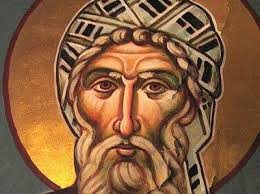
Open John of Damas.'s interactive page (graphs of influences, similar and opposing positions, and quotes)
Background
John of Damascus
Born: c. 675 in Damascus
Died: 748 at his monastery, Mar Saba, near
Jerusalem
Era: Medieval philosophy, Byzantine philosophy
School: Neoplatonism
Main interests: law, theology, Criticism of Islam,
Geometry, Mariology, arithmetic, astronomy,
music
Notable ideas: Dormition/Assumption of Mary,
Theotokos, Perpetual virginity of Mary,
Mediatrix, defence of icons
Influences: Paul the Apostle, Aristotle, Plato,
Gregory of Nazianzus, Basil, Gregory of Nyssa,
Cyril of Alexandria, Leo the Great, Athanasius
of Alexandria, John Chrysostum
Influenced: Medieval Scholastics
From Wikipedia
John Damascene was an Arab Christian monk, priest, hymnographer, and apologist.... A polymath whose fields of interest and contribution included law, theology, philosophy, and music, he was given the byname of Chrysorroas (... "the golden speaker"). He wrote works expounding the Christian faith, and composed hymns which are still used both liturgically in Eastern Christian practice throughout the world.... He is one of the Fathers of the Eastern Orthodox Church and is best known for his strong defence of icons.
Introductory Comments
John of Damascus grew up fluent in Greek philosophy, devoted to Christian orthodoxy, and surrounded by the new civilization of Islam - a combination about as unlikely as it sounds, and one that left its mark on everything he wrote. John himself served the Umayyad caliphs before trading it for a monk's cell, which means he knew the Islamic world not as a distant rumor but as his own workplace. Steeped in Aristotelian logic yet fervent in his faith, he pioneered a new kind of scholasticism - one that leaned on Aristotle, rather than Plato, to explain Christian doctrine. And as a Christian under Muslim rule, he mounted a series of sharp polemics against Islam that have earned him, in some modern accounts, the dubious title of one of history's first Islamophobes.
Zoom out to the wider history of ideas, and John becomes an emblem of a great handoff - the passing of the Greek and Roman baton to the Muslim world. His effort to "Aristotelianize" Christian theology arguably set a precedent for Muslim philosophers such as al-Kindi, whose own blend of philosophy and religion helped kindle the dazzling intellectual culture of the Islamic Golden Age. That world, unlike early medieval Europe, not only preserved classical inheritnace; it enriched it, with original contributions to metaphysics, ethics, and science. Then, some 400 after al-Kindi, Muslim scholars passed this enriched inheritance back to Europe, into the grateful - if slightly sheepish - hands of late-medieval thinkers like Aquinas.
Some of John of Damascus's Key Positions
Human beings have genuine free will and so bear responsibility for their salvation. The will is a rational appetite - a desire aimed at ends, not at the means of reaching them. Sorting out means belongs to deliberation and choice. And since the will naturally inclines toward the good, our task is to keep it fixed on the true good, the good that leads to salvation.
God created the material world for humankind's sake, and in Christ he went further, becoming matter himself so that we might work out our salvation through him. Matter is therefore no obstacle to holiness. We may rightly honor matter that serves our salvation - though worship, belongs to God alone.
The clearest case of this reverence is the Christian use of icons, which honor Christ, the saints, and the figures of Scripture. The devotion is not paid to the painted panel but passes through it to the one depicted. Just as a reader is bound not to paper and ink but to the Gospel's message, so the worshiper looks past the icon to the sacred reality it images.
Christian faith is beset from within and without. From within come the heresies - Arianism, which denies Christ's divinity, and any denial of the Trinity, the Incarnation, or the Blessed Virgin - each courting spiritual ruin. From without, Islam is the gravest danger of all.
Place in the History of Ideas
John of Damascus's Place in History of Ideas
Johannes Hirschberger: Many Platonic ideas are contained in [John Damascene's] works as well as many Aristotelian ideas; the latter are drawn, however, from the Syrian tradition of Aristotle. As in a recapitulation, we find united in him the chief intellectual movements which imparted to the Patristic period its special features: the Christian treasury of the Bible and the Fathers, Platonism and Neo-Platonism, Aristotelian philosophy. The latter, however, for a time receded into the background. But from this period on it moves more and more to the fore, so that in the golden age of Scholasticism it will dominate the entire scene.
Spahic Omer: [John of Damascus] was a paragon and also a trend-setter of Christian polemics. However, it is startling how thoughtless, insensitive and imprudent he was in his thought on Islam and Muslims. His views verged on… out-and-out ignorance. His predilection for bias, prejudgments, and aversion are discernible too. That is astounding beyond all reason. He was well-educated, familiar with Arabic, and held a post in the Islamic government, open to interreligious dialogue and debates. He lived and interacted his entire life with Muslims…. That said, John's scant and flawed knowledge of Islam, whence his equally flawed and dishonest judgments stemmed, was inexcusable. He set a bad example, which was followed by most subsequent Christian polemicists.
Random Thoughts on John of Damascus
John of Damascus is perhaps best remembered today for his answer to the iconoclasts, who wanted every religious image smashed on the grounds that icons were a species of idolatry. (Remember that second commandment?) John's defense was simple yet startling: how could God take offense at icons when God had himself become an icon of sorts - when he took on physical form in Jesus Christ? The invisible God consented, for a few short years, to be seen. The inexplicable became, at least in part and for a lucky few, explicable. If God was willing to assume the body of a man, how could he bristle at our attempts to give physical form to the figures we revere - Christ himself, or Mary, or the saints and angels?
But John pushed the thought further, claiming that the world itself is an icon of God: just as an artwork reflects the mind and spirit of its maker, so Creation reflects the mind and spirit of its Creator. And what should we make of that? Are we to conclude that the physical world is, in itself, worthy of our love? Or should we look through it, past the thing to the spiritual reality it represents? Or does the very distinction between being and representing start to wobble here? It is a little like asking whether we should love a person for her qualities or for the qualities she represents. What's the difference? Maybe that is John's quiet lesson: that to love the image and to love what it images are not two acts but one - a love that the whole of Creation is an invitation to experience.
Influences
John of Damas. was influenced by: Aristotle, Athanasius, Basil the Great, Cyril of Alexan., Epiphanius, Gregory of N., J. Chrysostum, Leo the Great, Maximos, Paul of Tarsus, Plato, Porphyry, Theodoret of C.
John of Damas. influenced: Albertus Mag., Aquinas, Peter Lombard
Similar and opposing positions
Thinkers with similar positions:
- Al-Kindi (God's existence is revealed in our ordinary experience of nature.)
- Aquinas (Jesus Christ suffered crucifixion as an atonement for human sin.)
- Empedocles (All things are a mixture of various imperishable parts or particles.)
- Ockham (Though God has perfect foreknowledge, free will is still possible.)
- Philo (The truth of religion is entirely consistent with reason.)
- Plotinus (The purely contemplative part of the Soul is its higher & eternal part.)
- Pseudo-Denys (God is beyond reason. We know what He isn't, not what He is.)
- Swedenborg (There are links among the physical, spiritual, and divine worlds.)
Thinkers with opposing positions:
- Avicenna (Metaphysics mainly concerns being qua being, not being of God.)
- Calvin (Salvation is fated. God predestines both the saved & the damned.)
- Franklin (The only religion that's at all defensible is pure and simple deism.)
- Hobbes (Religion is an impediment to the moral advancement of humanity.)
- Jefferson (I accept Jesus's precepts but not the corruptions of Christianity.)
- Kierkegaard (Most Christian beliefs are irrational and require a leap of faith.)
- Luther (Given God's sovereignty & our own sinfulness, there is no free will.)
- McGinn (Free will is compatible with mental, not physical, causation.)
What others said about John of Damas.
- Stanley Harakas: [John's education included] mathematics, geometry, music, astronomy, rhetoric, logic, philosophy (Plato and Aristotle), and theology.
- Wilhelm Windelband: John Damascenus gave the classical example for the employment of the ancient school logic in the service of systematizing the Church doctrines.
- Brian T. Kelly: [John of Damascus] has been called the last of the Greek fathers as well as the first of the scholastics. His greatest work, "The Fountain of Wisdom," was the first attempt at a summa theologica, or summary of all theological wisdom. This book is perhaps as important in the East as Thomas’s "Summa Theologiae" is in the West.
- Nathan A. Jacobs: John of Damascus is best known for his defense of icons in the eighth century, which won the day at the Council of Nicea II (AD 787), the last of the seven ecumenical councils.
- Spahic Omer: His declared war against heresies was tantamount to a war against… competing ideas and ideologies that might have threatened his own.
- Brian T. Kelly: [By reading John of Damascus] and others... Aquinas began to make inroads toward understanding what the human mind can grasp about the Trinity, about the procession of the Word, and His subsequent Incarnation.
- Spahic Omer: John's views on Islam and Muslims were seminal. At the same time, they were surprisingly disrespectful and somewhat aggressive. They served as a precursor to what could be dubbed radical and antagonistic anti-Islamic polemics, which paved the way for the emergence of the embryonic forms of what is called at present Islamophobia.
- Copleston: St. John Damascene... was not only a resolate opponent of the "Iconoclasts" but also a great systematizer in the field of theology, so that he can be looked on as the Scholastic of the Orient.
Schools: Christian Theology, Neoplatonism, Platonism, Scholasticism
Main interests: Astronomy, Free/Unfree Will, Geometry, Immortality, Law, Logic, Mathematics, Music, Religion, Spirituality, Theology
John of Damas.'s answers to philosophical questions
Epistemology
Logic is an essential tool not only in understanding the material world, but also in dealing with matters of theology.
Metaphysics
All material substance can be reduced to five elements, each one below the next: earth, water, air, fire and ether.
Salvation requires a will that is freely aimed at doing good. How the will achieves it aims, however, is a matter of intellect.
Philosophy
With the help of philosophy we can make ourselves more like God - in wisdom, in justice and in holiness.
Psychology
It is important to see that our passions are movements of the sensitive appetite when we imagine something good or evil.
Religion and Theology
"Let us carefully observe the manner of life of all the apostles, martyrs… & just men who announced the coming of the Lord."
"Think of the Father as a root, and of the Son as a branch, and the Spirit as a fruit, for the substance in these three is one."
"I salute all... matter with reverence, because God has [created our material world and] filled it with his grace and power."
"The whole earth is a living icon of the face of God…. I worship the Creator of matter who became matter for my sake…."
On religious icons: "I do not worship matter; I worship the Creator of matter who became matter for my sake."
Jesus's significance springs from his very being: the union of divine and human natures in the single person of Christ.
"All who ask receive... and to those who knock it shall be opened. Therefore, let us knock at the beautiful garden of Scripture."
Sex and Gender
Woman will never be the moral equal of man: "Woman is the daughter of falsehood, a sentinel of hell, the enemy of peace."