Paul of Tarsus (c. 5 AD - c. 66 AD)
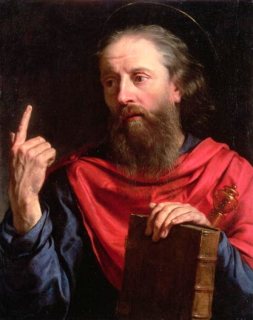
Open Paul of Tarsus's interactive page (graphs of influences, similar and opposing positions, and quotes)
Background
Paul of Tarsus
Born: c. 5 BC to c. 5 AD in Tarsus, Asia Minor
(now Turkey)
Died: c. 64 or c. 67 AD (aged 61–62 or 64–65)
probably in Rome
Main interests: Religion, morality, faith, Torah,
theology, philosophy
School: Pauline Christianity, Middle Platonism,
Stoicism
Influences: Hellenistic Judaism, Jesus, Ananias,
Menander, Epimenides, Aratus, and various
Stoic philosophers
Influenced: Virtually all of Christianity and much
of the Church Fathers, Albertus Magnus,
Anselm, Aquinas, Augustine, Bonaventure,
Calvin, Duns Scotus, Jonathan Edwards, Luther,
Kierkegaard, Malebranche, Nicholas of Cusa,
Ockham, Plantinga, Tillich, Wycliffe
From Wikipedia
Paul, commonly known as Paul the Apostle and Saint Paul, was a Christian apostle who spread the teachings of Jesus in the first-century world. Generally regarded as one of the most important figures of the Apostolic Age, he founded several Christian communities in Asia Minor and Europe…. Paul's influence on Christian thought and practice has been characterized as being as "profound as it is pervasive," among that of many other apostles and missionaries involved in the spread of the Christian faith.
Introductory Comments
The story is familiar, at least to most Christians: Early Christian groups begin proclaiming that Jesus was the Messiah and that the Kingdom of God was at hand. Saul of Tarsus, a zealous Pharisee, regards the movement as both dangerous and heretical and sets about persecuting its followers - with grim determination. But then, one day, on the road to Damascus, Saul experiences a sudden conversion and perhaps the most famous about-face in history, convinced now that Jesus was indeed the Messiah. Moreover, instead of hunting down Christians, Saul now becomes their chief proselytizer and their most effective missionary in the Gentile world. Somewhere along the way, the Hebrew Saul gives way to the Roman Paul, and one of history's great reversals is complete.
And yet Paul's reversal was, in one sense. no reversal at all. Though his allegiance changed, Paul himself remained recognizably the same passionate believer he had been while pursuing the Christians. His religion changed, but not his religiosity - the innate urgency he felt toward religious matters. Which raises an intriguing question: what comes first, the religious belief or the desire to believe? A similar question could be asked about the entire history of ideas. Do big ideas suddenly and unexpectedly ignite the passions of certain individuals, or do certain individuals feel a passionate need to be ignited by big ideas? The fault, dear Brutus, is not in our philosophies, but in ourselves, that we philosophize.
Some of Paul's Key Positions
Salvation comes through faith in Jesus Christ rather than through adherence to the Mosaic Law. Gentile converts need not adopt distinctively Jewish practices such as circumcision, dietary restrictions, or observance of the Sabbath in order to become part of God's people.
Faith in Christ unites the believer with Him and brings justification - that is, a right standing before God. Through this union, believers become part of a new spiritual life in Christ and gain the hope of eternal salvation.
Jesus is the long-awaited Messiah promised beforehand in the Jewish Scriptures. Though descended from David according to the flesh, He was revealed as the Son of God through His resurrection from the dead.
Jesus' crucifixion and death were for the benefit of humanity. His sacrifice frees believers from the bondage of sin and reconciles them to God. Through baptism, believers symbolically participate in Christ's death and resurrection and enter into a new life in Him.
Christ will return in the near future to inaugurate the final stage of history and the fullness of God's kingdom. At that time, the dead will be raised and transformed. The resurrected would not return in ordinary earthly bodies but would receive what can be called a "spiritual body."
Place in the History of Ideas
Paul's Place in History of Ideas
Bouck White: Paul was undeniably sincere. He believed that in reinterpreting the Christian faith so as to make it acceptable to the Romans he was doing that faith a service. His make-up was imperial rather than democratic. Both by birth and training he was unfitted to enter into the working-class consciousness of Galileans. He was in culture a Hellenist, in religion a Pharisee, in citizenship a Roman. From the first strain, Hellenism, he received a bias in the direction of philosophy rather than economics; from the second, his Pharisaism, he received a bias toward aloofness, otherworldliness; and from the third, his Romanism, he received a bias toward political acquiescence and the preservation of the status quo.
Anthony Kenny: St Paul, whose letters are the earliest evidence we possess for the beliefs of the first Christians, saw Jesus’s death on the cross as liberating the human race from a curse which had laid upon it since the first human pair whose creation was described at the beginning of the Hebrew Bible. He saw it also as freeing the disciples of Christ, whether Jewish or Gentile, from the obligation to obey the detailed commands of the law of Moses. Paul’s understanding of the death on the cross became indissolubly linked with the ceremonial meal instituted by Jesus on the night before his death and repeated in his memory by his followers from that day to this.
Random Thoughts on Paul
Perhaps Paul's most important innovation - or, if one is a Christian, his most important realization - is that belief itself, apart from all behavior and all the religious laws governing behavior, can bring about salvation. The idea of salvation through faith is now so familiar that it can be hard to see anything strange in it. Accept Jesus Christ as your savior and you will be saved: But why? If Jesus died for our sins so that we may be saved, why not just just leave it at that? Why add the proviso that one must believe that Jesus died for our sins so that we may be saved? One does not need to believe that Alexander Graham Bell invented the telephone in order to use a telephone. Normally, if something is accomplished, it is accomplished. Belief has nothing to do with it. End of story.
This was certainly the case when God condemned humankind for the disobedience of Adam and Eve: He did not require that anyone believe He condemned humankind in order for the condemnation to take hold. Why, then, should God now require that we believe God sacrificed his Son to free us of this ancient guilty? Either this ultimate act of redemption freed us this guilt or it didn't. How can belief here change that fact? A devout Christian might reply that such questions miss the point entirely: redemption is a miracle, and a miracle that submitted neatly to logical accounting would hardly deserve the name. Fair enough - but this, of course, leads to another question: why believe in miracles?
Influences
Paul of Tarsus was influenced by: Ananias, Aratus, Chrysippus, Epimenides, Jesus, Menander, Seneca
Paul of Tarsus influenced: Albertus Mag., Anselm, Aquinas, Augustine, Barth, Bonaventure, Calvin, Duns Scotus, Edwards, Kierkegaard, Luther, Malebranche, Nicholas of C., Ockham, Plantinga, Suarez, Tillich, Wesley, John, Wycliffe
Similar and opposing positions
Thinkers with similar positions:
- Augustine (The end of all love is union with Christ - not with man or woman.)
- Brunner (Christian faith must focus on the centrality of Christ as Redeemer.)
- Calvin (Jesus Christ suffered crucifixion as an atonement for human sin.)
- Dostoyevsky (The cure to social ills is not socialism, but a true Christianity.)
- Luther (Man's sinfulness is infinitely distinct from God's perfection.)
- Ockham (Faith, not reason, provides the foundation for Christian beliefs.)
- Tillich (Humanism today has too much faith in man & all too little faith in God.)
- Tolstoy (Our greatest hope is in following Christ's original & radical teachings.)
Thinkers with opposing positions:
- Abelard (Reason, not faith, is the foundation of most Christian beliefs.)
- Anselm (The sin of humanity cannot be removed by God's forgiveness alone.)
- Dawkins (Religion teaches us to be satisfied with our lack of understanding.)
- Harris (It's almost certain that spirit or consciousness ends at death.)
- Hitchens (Religion is violent, irrational, intolerant & allied to racism & sexism.)
- Holbach (The foundation of morality is not in Scripture but in happiness.)
- Jefferson (I accept Jesus's precepts but not the corruptions of Christianity.)
- Nietzsche (Christianity has a "slave morality" placing weakness over strength.)
What others said about Paul of Tarsus
- Shaw: No sooner had Jesus knocked over the dragon of superstition than Paul boldly set it on its legs again in the name of Jesus.
- Anthony Kenny: The Pauline teaching on grace and predestination led to centuries of inquiry into the compatibility of free-will and determinism.
- James Tabor: Visit any church service, Roman Catholic, Protestant or Greek Orthodox, and it is the apostle Paul and his ideas that are central - in the hymns, the creeds, the sermons, the invocation and benediction, and of course, the rituals of baptism and the Holy Communion or Mass.
- Russell: The dualism of the spirit and the flesh is to be found in Plato, and was emphasized by the Neoplatonists; it is important in the teaching of Saint Paul; and it dominated the Christian asceticism of the fourth and fifth centuries.
- Jefferson: [Paul was the] first corrupter of the doctrines of Jesus.
- Nietzsche: [Paul was not interested in the teachings of Jesus.] At bottom, he had no use at all for the life of the Redeemer - he needed the death on the cross and a little more....
- Badiou: [Paul argues that through the Resurrection we can] live affirmatively, according to the spirit, rather than negatively, according to the flesh, which is thought of death. For Paul, the Resurrection is that on the basis of which life’s center of gravity resides in life, whereas previously, being situated in the Law, it organized life’s subsumption by death.
- Pope Francis: You cannot be a conscious Christian without St. Paul. He translated the teachings of Christ into a doctrinal structure that, even with the additions of a vast number of thinkers... still exists after two thousand years.
Schools: Christian Theology, Natural Law Theory, Stoicism
Main interests: Ethics, Faith, Religion, Salvation, Theology
Paul of Tarsus's answers to philosophical questions
Ethics
Knowledge of what is good & right does not necessarily result in doing what is good & right. We also need God's grace.
"Owe nothing to anyone, except to love one another: for he that loveth another hath fulfilled the law."
"Love… rejoices with the truth; bears all things, believes all things, hopes all things, endures all things."
"Walk in the Spirit, and ye shall not fulfil the lust of the flesh, for the flesh lusteth against the Spirit…."
History
In the Endtime, when Christ returns, history will end, the dead will be resurrected, and the messianic era commence.
Law
The ruler of the earthly state "is the minister of God to thee for good" but also God's just revenger when thee do evil.
Metaphysics
By ourselves, we are powerless. "For by grace you have been saved through faith, and that not of yourselves...."
Philosophy
"Beware lest any man spoil you through philosophy and vain deceit according to the tradition of men...."
Political Philosophy
Be thankful "for kings and all who are in authority, that we may lead a quiet and peaceable life in all godliness and reverence."
Psychology
Love is our salvation: "If I give all I possess to the poor & surrender my body to the flames, but have not love, I gain nothing."
Know this: "No trial has come to you but what is human. God is faithful and will not let you be tried beyond your strength…."
Religion and Theology
"Rejoice always, pray continually, give thanks in all circumstances; for this is God’s will for you in Christ Jesus."
The invisible things of God are clearly seen in the visible things of this world, including his eternal & abundant power.
Salvation comes through faith alone - particularly the faith that Jesus Christ was the son of God and died for our sins.
To believe that Jesus, the Son of God, died for your sins is to accept Him as your savior and invite Him into your heart.
Sex and Gender
Though sexual relations are proper within marriage, sex outside of marriage is sinful, as is marriage merely for the sake of sex.
"But if [people] cannot contain [their fleshly desires], let them marry: for it is better to marry than to burn."
"Even so husbands should love their wives as their own bodies. He who loves his wife loves himself."
Society
"Render... to all their dues: tribute to whom tribute is due; custom to whom custom is due...; honor to whom honor is due."