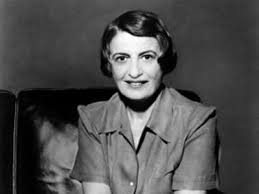
[Rand developed] a philosophical system she named Objectivism…. Rand advocated reason as the only means of acquiring knowledge; she rejected faith and religion. She supported rational and ethical egoism and rejected altruism. In politics, she condemned the initiation of force as immoral and opposed collectivism, statism, and anarchism. Instead, she supported laissez-faire capitalism, which she defined as the system based on recognizing individual rights, including private property rights.
Introductory Comments
When Rand boarded a ship for America in 1926, she was leaving a country that had already shown her collectivism up close. As a girl of 12 or 13, she watched the Bolsheviks seize her father's pharmacy in the name of the people. It was a lesson in Soviet economics that no textbook could match. Her parents and two sisters stayed behind in Leningrad, where the state kept tightening its grip on every corner of daily life. Their letters reached her in America, written with one eye on the censor, and Rand learned to read between the lines. In the late 1930s the letters stopped, and she never saw her parents again.
Yet it would be a mistake to read Rand's philosophy as mere autobiography. Her case for rational self-interest, individual rights, and laissez-faire capitalism rested on something grander than personal grievance. Its foundation was a steely conviction that reason and self-reliance are the only keys to human flourishing. Only when each mind is free to pursue its own happiness, unburdened by altruistic guilt and unbothered by bureaucratic busybodies, do the true creators (scientists, artists, industrialists) produce the progress from which everyone benefits. Property rights, Rand insisted, are not privileges the state hands out. They are the right to keep and use what one has made. Strip them away and you strangle the golden goose of civilization. Government's proper job is simply to guard the goose - not to feed it, and certainly not to cook it.
Some of Rand's Key Positions
Rational selfishness is a virtue to be defended, not a vice to be excused. The great creators (inventors, scientists, industrialists, architects, artists) work for their own vision and happiness, not for others' approval. Such minds drive human progress.
Each person's own life is the ultimate standard of value, and one's own happiness is that life's moral purpose. Reality is objective, existing independently of anyone's wishes or beliefs. Reason is the only means of knowledge and the only reliable guide to action. Faith of any kind abandons reason and must be rejected.
Happiness is not passive contentment. Productive work is a cardinal virtue and the noblest human activity. Others benefit from it, but only as a byproduct; no one has a duty to serve society.
No one should sacrifice himself to others, or others to himself. Altruism, the doctrine that self-sacrifice is the moral ideal, is irrational and hostile to human life. People should deal with one another as traders, exchanging value for value.
No one may initiate physical force against another. Government's only proper function is to protect individual rights through the police, the courts, and the military. Rights belong to individuals alone, and "group rights" are a contradiction. Property rights are fundamental, since without them no other right can be exercised.
Place in the History of Ideas
Rand's Place in History of Ideas
Gore Vidal: This odd little woman is attempting to give a moral sanction to greed and self interest, and to pull it off she must at times indulge in purest Orwellian newspeak of the "freedom is slavery" sort. What interests me most about her is not the absurdity of her "philosophy," but the size of her audience.... She has a great attraction for simple people who are puzzled by organized society, who object to paying taxes, who dislike the "welfare" state, who feel guilt at the thought of the suffering of others but who would like to harden their hearts. For them, she has an enticing prescription: altruism is the root of all evil, self-interest is the only good, and if you're dumb or incompetent that's your lookout.
David Brin: For [Rand] further holds that objective reality is readily accessible by solitary individuals using words and logic alone. This proposition... is essentially a restatement of the Platonic worldview, a fundamental axiom of which is that the universe is made up of ideal essences or "values" (the term Rand preferred) that can be discovered, dispassionately exam- ined, and objectively analyzed by those few bold minds who are able to finally free them- selves from hoary assumptions of the past. Once freed, any truly rational individual must, by simply applying verbal reasoning, ... reach the same set of fundamental conclusions about life, justice, and the universe.
Random Thoughts on Rand
Rand took from Aristotle the idea that happiness is achieved through activity, not idle enjoyment. In her version, the highest form of that activity is productive work. The admirable person doesn't hoard private pleasures. He or she builds and creates, producing work that carries the stamp of personal excellence. Consider Howard Roark, the architect-hero of The Fountainhead. He dynamites a housing project not out of petty spite but because others broke their agreement to build it exactly as he designed it. For Rand, the altered design was a violation of his vision and of his property. The ego is not a dirty word. In her novella Anthem it is a "sacred word," and its highest expression is not consumption but creation.
The trouble is that sacred engines can run people over. However bracing it is philosophically, Rand's celebration of self-interest carries political and moral implications that are hard to ignore. Critics argue that unregulated capitalism tends to produce not a republic of free traders but an oligarchy of entrenched wealth. Rand had a reply ready: monopolies, she said, are created by government favors, not by free markets. Her critics answer that concentrated wealth has a way of buying government. Meanwhile, the worker "freely choosing" between a dangerous job and starvation has about as much liberty as a mouse freely choosing which cat to run from. Rand saw all too clearly how the many could tyrannize the few, but not how the few could tyrannize the many.
Carlyle (The history of the world is but the biography of great men.)
Goethe (The world as a whole grows through continual and internal strife.)
Malthus (The struggle for survival is an immense force at work in our world.)
Nozick (No laws should limit people's consensual acts in economic matters.)
Rothbard (Only free market capitalism is consistent with freedom & democracy.)
Smith, Adam (The common interest requires each seek economic self-interest)
Spencer (Govt. should not interfere in the economic survival of the fittest.)
Thinkers with opposing positions:
Adler (Social connections play a crucial part in a healthy & fulfilled life.)
Hayek (A society with a strong economy can still provide a social safety net.)
Hutcheson (We should act in unselfish ways to increase happiness of others.)
Keynes (Government has an important role in maintaining a good economy.)
Levinas (Philosophy must begin with respect & responsibility for the Other.)
Porphyry (The purely contemplative part of the Soul is its higher & eternal part.)
Rawls (The values of freedom & equality need not be in conflict with each other.)
Shaw (Socialism can cure many of the abuses found in our modern economies.)
Veblen (The leisure class is addicted to wasteful and conspicuous consumption.)
What others said about Rand
Dick Cavett: You can piss away valuable hours of your life reading Ayn Rand - her wretched appeal to the young, her wretched writing….
Rothbard: [Rand's novel "Atlas Shrugged," is] an infinite treasure house [and] not merely the greatest novel ever written, [but] one of the very greatest books ever written, fiction or nonfiction.
Thu-Huong Ha: Rand makes the individual the center, essentially sacred, but this is key: It's a materialistic philosophy, an atheistic philosophy. She does not believe in God. Rand says very explicitly that she's an atheist. This is the crux of Rand, the tension point of why she will never fit easily into conservatism.
Mary Midgley: Rand's guiding vision is clearly what used to be called infantile omnipotence - the childish hope of total control - and her doctrines have great influence because that hope is still always strong [deep] of our hearts.
Adam Weiner: [Through Greenspan,] Rand had effectively chucked a ticking time bomb into the boiler room of the US economy.
Harris: Objectivism - a view that makes a religious fetish of selfishness and disposes of altruism and compassion as character flaws.… Objectivism is basically autism rebranded.
Barack Obama: Ayn Rand is one of those things that a lot of us, when we were 17 or 18 and feeling misunderstood, we'd pick up. Then, as we get older, we realize that a world in which we're only thinking about ourselves..., in which… developing ourselves [is] more important than our relationships to other people… - that that's a pretty narrow vision.
T. Dalrymple: A passionate hater of religion, Rand founded a cult around her own person, complete with rituals of excommunication; a passionate believer in… logic, she was incapable of seeing the contradictions in her own work.
Main interests: Architecture, Art and Aesthetics, Desire, Economics, Epistemology, Ethics, Freedom, Government, Happiness, Human Will, Jurisprudence, Law, Literature, Metaphysics, Personal Identity, Political Activism, Political Philosophy, Political Theory, Politics, Progress, Property, Utopia, Virtue, Will