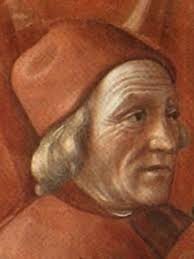
Ficino was an Italian scholar and Catholic priest who was one of the most influential humanist philosophers of the early Italian Renaissance. He was an astrologer, a reviver of Neoplatonism in touch with the major academics of his day, and the first translator of Plato's complete extant works into Latin. His Florentine Academy, an attempt to revive Plato's Academy, influenced the direction and tenor of the Italian Renaissance and the development of European philosophy.
Introductory Comments
As a young man in the 1450s, Ficino wrote a commentary on Lucretius, praising that poet's rapturous embrace of nature. He also composed a treatise saluting Epicurus and the simple pleasures of a well-tempered life. Then, quite suddenly, came a crisis - intellectual, spiritual, or both. Ficino turned on the this-worldly vision of Lucretius and Epicurus and threw in his lot with the other-worldly Plato and Plotinus.
Why the about-face? Was it merely youthful enthusiasm mellowing into a more realistic, pragmatic outlook? But then, what is realistic or pragmatic about Neoplatonism, with its ladders of souls and turning heavens? No, Ficino's reversal sounds less like a man growing worldly and more like Augustine growing heavenly: a turning away from the easy pleasures of this world in order to taste the deeper, truer joy of the spiritual one.
Lucretius and Epicurus, could they speak from the grave, might tell him he had it backwards. The natural world is miracle enough; look no further for wonders than a spring morning or a shared meal. Life is short - do not squander it pining after another. But Plato and Plotinus, speaking from their graves, would likely answer that the world is also a mystery. There are questions that reach past the here and now, and a life spent among surfaces is a life half-lived. Consider what it all means - not just the here, but the transcendent; not just the now, but the timeless.
Some of Ficino's Key Positions
The rediscovery of the ancient classics, above all the dialogues of Plato, has roused philosophy from its scholastic slumber and breathed fresh life into every liberal art - poetry, rhetoric, painting, sculpture, architecture, and music alike. This renewed devotion to Plato has, in turn, worked a kind of rebirth within Christianity itself.
The age is once again quickened by the Platonic and Neoplatonic spirit that once guided the early Church Fathers. The whole cosmos is ensouled by the spirit of God: from the humblest scrap of seemingly inert matter to the turning heavens, all things are shot through with soul. This universal animation is what lends alchemy and astrology their power, since a world knit together by spirit is a world whose parts answer to one another.
The human soul belongs to this cosmic ensoulment, but it occupies a peculiarly central rung on the ladder of souls - the knot that binds the whole together. Being physical, humans are joined to every creature and material thing; yet, unlike the beasts and the stones, they also strain upward toward God and the higher ideals.
Chief among these is love. Human idealism discloses that the highest love is "Platonic" love, which rises above mere bodily craving to seek the perfect union of two souls. "Love and the desire for physical union are not identical impulses, but... opposite ones." True love is wholly spiritual.
Place in the History of Ideas
Ficino's Place in History of Ideas
James G. Snyder: There are prominent Neopla- tonic elements at the core of Ficino's metaphys- ics. He inherited from Plotinus a particular ap- proach to metaphysics that is a hierarchical superstructure, with distinct levels or hyposta- ses, all of which draw their being from an over- flowing singular source. The source of all being is the One for Plotinus, and God for Ficino. He considers all being to be a progressive emana- tion from the divine, and although each hypos- tasis is distinct, what is above serves as a dy- namic bridge to what is below. Everything in Ficino's cosmos has its own unique place....
Cassirer: [Ficino believed] God has bound himself to man without any instrument of mediation ("absque medio"). Similarly, we must recognize that our salvation consists in being related to Him without mediators. With this thought we are on the way to the Reformation: but the transformation has been prepared by a genuine and basic Renaissance motif. It is the self-affirmation of man which now also becomes the affirmation of the world.
Anthony Gottlieb: Like St. Augustine, Ficino believed that Platonism contained important anticipations of Christianity. But Ficino went further. He regarded Plato's writings as no less authoritative than the Bible. Philosophy could be as divinely inspired as Scripture, and Plato's definitely was, or so Ficino believed.
Random Thoughts on Ficino
Ficino's metaphysics, like Plotinus's, comes in tiers. God sits at the top, the fountainhead from which all else pours forth. Below him stand the Angels - bodiless intellects who pass a rather dull eternity contemplating the Platonic Forms. Then come the Souls, changeless in essence yet the source of all the motion in the cosmos. Beneath them lies Quality, the shifting surface of things - heat, color, and the rest, forever coming and going. And at the very bottom, last and least, sprawls Matter: a vast, formless lump at the foot of the cosmic ladder.
By placing Soul at the dead center of this five-tiered universe, Ficino was in effect Christianizing Plotinus. The human soul strains upward toward God, even as the body drags it down toward base matter. This makes man, in Ficino's phrase, the "the knot and bond of the universe." But serving as the link that holds the Great Chain together is, for us, both good news and bad. The good news: the human soul must be immortal, for Soul by its nature is immutable, and what cannot change cannot perish. The bad news: man is not pure soul but embodied soul - and it is the body, some argue, that fences off the individual soul from the universal Soul. If that is right, then a soul stripped of its body at death might lose its very individuality, dissolving back into the great cosmic Soul like a drop returning to the sea. But take heart. Ficino assures us that at death God wraps each soul in a celestial light - to give you a bodiless body, if you will. A glow-in-the-dark you.
Ficino influenced: Bellay, J. du, Bembo, Pietro, Botticelli, Bruno, Castiglione, Cudworth, R., Herbert, E., Michelangelo, More, Henry, Patricius, Pico, Raphael, Ronsard, P. de, Titian
Similar and opposing positions
Thinkers with similar positions:
Aquinas (All causal chains ultimately spring from First un-caused Cause: God.)
Boethius (The purely contemplative part of the Soul is its higher & eternal part.)
Dante (Pursuit of love is a transcendental experience & a test of virtue.)
Edwards (God alone is the only real cause at work in the world - not matter.)
Erasmus (The Christian scripture teaches us the transformative power of love.)
Petrarch (Despite its pagan beliefs, we can learn much from classical antiquity.)
Plato (The soul, being the very likeness of the divine, is pure and immortal.)
Plotinus (The highest form of love transforms the erotic into the ideal & pure.)
Proclus (Though souls descend into the material world, a divine Unity exists.)
Thinkers with opposing positions:
Abelard (Universals don't exist independent of concrete, individual things.)
Barth (There is an infinite qualitative distinction between God & mankind.)
Harris (It's almost certain that spirit or consciousness ends at death.)
Hobbes (All things, including humans and their minds, are entirely material.)
Ovid (Earthly or romantic love is the most appropriate subject for poetry.)
Shakespeare (Nature may guide us, but towards no rational purpose or end.)
Spinoza (God is not transcendent. Everything in Nature is part of God.)
What others said about Ficino
James G. Snyder: Ficino is considered the most important advocate of Platonism in the Renaissance….
Jacques Barzun: [Ficino] provided his fellow Humanists with a system that enabled them to replace the Catholic orthodoxy [with] Platonic mysticism while remaining good Christians.
Cassirer: Ficino's theory of love goes beyond this doctrine [of the complete separation of God and man] in that it conceives of the process of love as a completely reciprocal process. Man's striving towards God, represented in Eros, would not be possible without a counter-striving of God towards man. Thus, Ficino resuscitates the basic notion of Christian mysticism….
Anthony Gottlieb: The true love of a person, [Ficino] argued, is a sort of preparation for the love of God. If... the lover [transcends] bodily desires to focus on the soul, then [his love] becomes a form of religious devotion.
Christopher Warnock: Ficino's writing is truly a joy to read as its elegance and clarity reflects the harmony and beauty of the themes he explores.
James G. Snyder: Ficino thought that philosophy done properly required an ongoing conversation with ancient philosophies. A familiarity with earlier philosophies is therefore necessary in order to fully appreciate [his] arguments....
Richard Tarnas: The Humanists' Neoplatonic conception of man was... exalted.... [Man] was a noble microcosm of the divine macrocosm. Ficino asserted... that man not only was "the vicar of God" in the great extent of his earthly powers, but was of "almost the same genius as the Author of the heavens" in the range of his intelligence.
Robert C. Solomon: Ficino located human beings at the center of the cosmic hierarchy, and he defended this as a basis for the humanistic view that the human being has a special, even cosmic, dignity.
Schools: Christian Humanism, Christian Theology, Emanationism, Humanism, Neoplatonism, Perennial Philosophy, Platonism, Pythagoreanism
Main interests: Art and Aesthetics, Astrology, Classics, Ethics, Immortality, Literature, Love, Magic, Medicine, Metaphysics, Music, Psychology, Religion, Theology