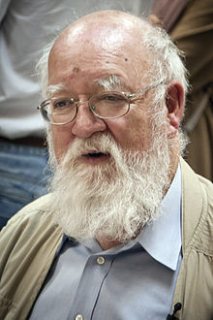
Dennett is an American philosopher, writer, and cognitive scientist whose research centers on the philosophy of mind, philosophy of science, and philosophy of biology, particularly as those fields relate to evolutionary biology and cognitive science.... Dennett is a member of the editorial board for The Rutherford Journal and a co-founder of The Clergy Project. A vocal atheist and secular- ist, Dennett is referred to as one of the "Four Horsemen of New Atheism," along with Richard Dawkins, Sam Harris, and... Christopher Hitchens.
Introductory Comments
Dennett, in his mature compatibilist view, argues that free will isn't some magical power to escape the causal order - it's a sophisticated, evolved capacity for rational self-governance. When facing a decision, our minds run a two-stage process: a "consideration-generator" throws up options, and then we weigh them against our goals, values, and anticipated consequences. That deliberative dance, refined over millions of years of evolution, is what makes us responsible agents - beings who can be moved by reasons, held accountable, and trusted to keep our promises. Free will, on this view, is not a metaphysical miracle but a biological achievement.
Sam Harris and other skeptics respond that Dennett has performed a philosophical sleight of hand. Yes, of course we deliberate, weigh options, and behave in reason-responsive ways - no one disputes that. But the real ques-tion of free will has always been whether we, as conscious agents, are the ultimate authors of our choices, or whether our decisions are sim- ply the downstream output of prior causes we neither chose nor controlled. By redefining "free will" as the two-stage deliberative ma- chinery itself, Dennett's crtitics claim that he hasn't solved the problem; he's simply escorted it out of the room - leaving us alone with Roomba, the robotic vacuum cleaner, to argue whose consideration-generator works best.
Some of Dennett's Key Positions
For most philosophers, consciousness repre- sents an immensely difficult - some say hope- less - problem. But, in fact, consciousness can be explained once we see the mind in terms of information processing: information is continu-ally picked up by our various senses, integrated by the nervous system, and then interpreted by the brain's parallel, multi-track processes. There is no single privileged "Cartesian theater" where it all comes together; consciousness is rather the result of these distributed processes.
Philosophers and neuroscientists who insist that consciousness has a special, subjective "qualia" that can't be explained are working with an incoherent concept. When one careful-ly analyzes what qualia are supposed to be - intrinsic, ineffable, private, directly apprehensi-ble properties of experience - we see that the concept is incoherent and incompatible with a genuinely scientific understanding of the mind.
However, free will is compatible with science. When faced with an important decision, our thinking proceeds in two stages: first, a "consid-eration-generator" within the mind produces possible considerations; second, those consider-ations are weighed and organized in ways that shape the final decision. This process is entirely consistent with causality, yet still explains the moral reflection, self-control, and personal responsibility we associate with free will.
Place in the History of Ideas
Dennett's Place in History of Ideas
Joshua Rothman: In the course of forty years, and more than a dozen books, Dennett has endeavored to explain how a soulless world could have given rise to a soulful one. His special focus is the creation of the human mind. Into his own he has crammed nearly every related discipline: evolutionary biology, neuroscience, psychology, linguistics, artificial intelligence…. In Consciousness Explained, a 1991 best-seller, he described consciousness as something like the product of multiple, layered computer programs running on the hardware of the brain. Many readers felt that he had shown how the brain creates the soul. Others thought that he'd missed the point entirely.
Sam Harris: The disagreement between Dan and myself [regarding free will] is essentially this. We're living in a world where most people be- lieve in Atlantis and… the underwater kingdom. And I want to say Atlantis doesn't exist….. Dan wants to say that Atlantis is really Sicily, and he'll give a whole argument about why Sicily answers to many of the claims that people are making about Atlantis. And I want to say, "No, they're still talking about being underwater. Sicily doesn't do that." ... And [then] he begins to respond to me as though I'm saying Sicily doesn't exist.... Of course Sicily exists, but the people who are talking about an underwater kingdom are, at the very least, confused, and that's the situation we're in with free will.
Random Thoughts on Dennett
In Consciousness Explained, Dennett argues that consciousness is not an ineffable inner glow but a complex set of information-processing activi-ties carried out by the brain. Sensory data is picked up, integrated, and then interpreted by a swarm of parallel, multi-track processes pro- ducing competing "drafts" of experience. There is no inner sanctum, no Cartesian Theater where a tiny homunculus sits watching the show; consciousness simply is whichever drafts win the competition for influence over memo-ry, behavior, and report. As for "qualia" - those allegedly private, "felt" qualities of experience - Dennett argues that the concept lacks both evidence and coherence.
David Chalmers and other defenders of the "hard problem" suspect Dennett has, once again, changed the subject. Mapping neural correlates and information flow addresses what Chalmers calls the easy problem (easy by com- parison). The hard problem is why any of this physical activity is accompanied by subjective experience - why there is something it is like to taste coffee or see red. Dennett's response - that the question itself incoherent - strikes Chalmers as less an explanation than a refusal to look. In both free will and consciousness, then, Dennett's critics claim his strategy is the same: when faced with a mystery he can't solve, Dennett redefines it until it dissolves itself. Not Consciousness Explained, but Explained Away.
Darwin (Our moral instincts are innate and evolved with our social instincts.)
Dawkins (Human minds are to a large extent shaped by cultural memes.)
Fodor (A syntax of representations makes up the language of thought.)
Huxley (Intricate design in the natural world can be explained thru science.)
Pinker (Evolution has created the cognitive tools we use to function & survive.)
Popper (Darwin's view of nature is one where new things emerge on new levels)
Searle (We must posit intentional states to predict & explain human behaviour.)
Shakespeare (Nature may guide us, but towards no rational purpose or end.)
Thinkers with opposing positions:
Chalmers (There's an explanatory gap between physical & phenomenal realms)
Einstein (Free will isn't compatible with determinism. Our wills are determined.)
Malebranche (We have no clear conception of the nature & power of the mind.)
McGinn (Our minds may not be equipped to grasp the causes of mind.)
Moore (The notion of "good" and indeed all human values are indefinable.)
Newton (Intricate design we see in nature proves existence of Great Designer)
Plantinga (Evolution is not an entirely natural process. God helps guide it.)
Searle (Artificial Intelligence will never lead to conscious robots.)
What others said about Dennett
Carole Cadwalladr: [Dennettt] has mined the questions that erupt at the places where science, technology, and consciousness meet.
Joshua Rothman: In "Consciousness Explained," a 1991 best-seller, he described consciousness as something like the product of multiple, layered computer programs running on the hardware of the brain.
David Pearce: In mainstream academia, formal models of mind and a priori philosophizing have triumphed over the experimental method in the investigation of consciousness. [Dennett], for instance, would scarcely be earning a good living on the American academic-philosophy gravy-train if he'd ever dropped some acid; but he'd know a great deal more about the... mind.
Eyal Mozes: [Dennett thinks] free will should be redefined so that it no longer involves a free choice among alternatives and can thus be made compatible with the mechanist/reductionist model of the universe.
Jaron Lanier: Only a zombie like Dennett could write a book called "Consciousness Explained" that doesn't address consciousness at all.
Joshua Rothman: [Many people felt that his explanation of consciousness] left untouched the question of how a three-pound lump of neurons could come to possess a point of view, interiority, selfhood [and yes] consciousness….
Robert Kane: A causal indeterminist view of [Dennett's two-stage] deliberative kind does not give us everything libertarians have wanted from free will. For [the agent] does not have complete control over what chance images and other thoughts enter his mind [in the first stage] or influence his deliberation [in the second stage]. They simply come as they please.
George Gilder: Here we encounter what the atheist and philosopher Daniel Dennet calls the "universal solvent" of natural selection. With its reductionist acids it breaks down all larger systems into components and elements….