Alexander Humboldt, A. (1769 - 1859)
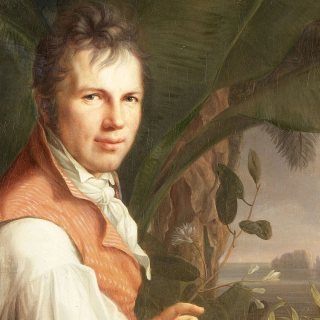
Open Humboldt, A.'s interactive page (graphs of influences, similar and opposing positions, and quotes)
Background
Alexander von Humboldt
Born: September 14 1769 in Berlin
Died: May 6 1859 (aged 89) in Berlin
Main Interests: Biology, botany, geography,
nature, environmentalism
Alma mater: Freiberg School of Mines (1792),
University of Frankfurt, University of Berlin
Known for: Biogeography, Kosmos (1845–1862),
Humboldt Current, Humboldtian science, Berlin
Romanticism, Environmentalism
Influences: Goethe, Schelling, Georg Forster,
Joseph Banks, Luigi Galvani
Influenced: Darwin, A. R. Wallace, Thoreau,
Emerson, Muir, W. Irving, Goethe, Bolivar,
Agassiz, Jefferson, Poe, G. P. Marsh, Ernst
Haeckel, Jules Verne, Whitman
From Wikipedia
Alexander von Humboldt was a German polymath, geographer, naturalist, explorer, and proponent of Romantic philosophy and science. He was the younger brother of the Prussian minister, philoso- pher, and linguist Wilhelm von Humboldt. Hum- boldt's quantitative work on botanical geography laid the foundation for the field of biogeography, while his advocacy of long-term systematic geo- physical measurement pioneered modern geo- magnetic and meteorological monitoring.
Introductory Comments
Expeditions come in several flavors: exploratory, military, mercantile, missionary, spiritual, scientific. The last is the oddest of the lot. The others at least promise something at the end - land, plunder, trade routes, souls, God. The scientific expedition offers heat, hunger, and fever in exchange for interesting rocks, plants, insects, and notes. Alexander von Humboldt did not invent the form, but his predocessors went where they were sent, to do one assigned job. Humboldt spent his own inheritance, chose his own route, and set off 1799 to explore large stretches of South and Central America. He gatherfed an astonishing quantity of data on geography, climate, botany, geology, and almost anything else nature put in his path.
Extreme heat, torrential rain, and tropical disease threatened the party throughout - as did the terrain, some of which Humboldt went well out of his way to confront. His climb up Chimborazo, to 19,286 feet (short of the top, but a record at the time), without ropes or crampons and through altitude sickness and freezing cold. And somehow, between the jaguars, the vampire bats, and the electric eels, he documented the flora, fauna, and landforms of everything he passed through. Out of it came the science we now call biogeography - the study of why living things live where they do. Darwin sailed on the Beagle with Humboldt's Personal Narrative in his cabin, and wrote home from Brazil in 1832: "I formerly admired Humboldt, I now almost adore him."
Some of A. von Humboldt's Key Positions
Nature must be seen whole - from the vast interacting systems of the cosmos down to the intimate traffic of plants and animals in a single valley. Wherever we look, the parts are woven together in a continuous play of cause and effect. The watchword is unity in diversity: the harmony is real, but it emerges through the multiplicity.
To understand nature at any level, in any place, therefore demands a deep grasp of its many parts and, above all, of the relations among them. To learn why particular plants and animals bear the characteristics they do and flourish where they do, one must unravel the tangled connections between biology, meteorology, and geology.
That grasp begins with measurement. Scientists must take great pains to gather data on the things they study and on the environments those things inhabit - barometer, thermometer, and compass in hand, readings compared across continents. Only then does the complex interplay of natural causes and effects come into view. But data alone will not do. Nature must also be felt, and imagination is no mere decoration on scientific work.
Human beings belong inside this web rather than above it, and their effects on it are all too often ruinous. Strip a region of its forests and the damage runs well beyond the missing trees: streams fail, soil washes away, and the local climate itself begins to shift.
Place in the History of Ideas
A. von Humboldt's Place in History of Ideas
Eleanor Jones Harvey: Over the course of his adult life he developed a revolutionary theory that all aspects of the planet, from the outer atmosphere to the bottom of the oceans, were interconnected - a theory he called the “unity of nature.” It is hard to overstate how radical an idea this was in its day.
Andrea Wulf: Humboldt wrote about the destruction of forests and of humankind’s long-term changes to the environment. When he listed the three ways in which the human species was affecting the climate, he named deforestation, ruthless irrigation and, perhaps most prophetically, the "great masses of steam and gas" produced in the industrial centers. No one but Humboldt had looked at the relation- ship between humankind and nature like this before.
Emerson: Humboldt was one of those wonders of the world..., who appear from time to time, as if to show us the possibilities of the human mind, the force and the range of the faculties, - a universal man, not only possessed of great particular talents, but they were symmetrical, his parts were well put together. As we know, a man’s natural powers are often a sort of committee that slowly, one at a time, give their attention and action; but Humboldt’s were all united, one electric chain, so that a university, a whole French Academy, travelled in his shoes.
Random Thoughts on A. von Humboldt
Before Humboldt, most naturalists were collectors and shelvers. They gathered specimens and, after Linnaeus, sorted them into nested ranks by physical resemblance. The result was a picture of nature as a very well-run cabinet: every creature named, labeled, and standing in its appointed place on the Great Chain of Being. There were exceptions - Buffon had noticed that distant continents hold different animals under identical climates, and Cuvier's extinct beasts were already straining the chain. But the center of gravity lay in naming, not relating.
Humboldt asked a different question of the same specimens. Not what is this, but what is it doing here? He saw plants and animals bound to altitude, climate, and soil, and bound to one another - climbing an Andean volcano, he saw that he was in a sense going from equator to pole. What explains his shift in perspective? Training helped. A man who has mapped rock strata and fussed over the calibration of a barometer is well placed to notice that everything touches everything else. But other people mattered more. Goethe taught him to look for underlying form. Georg Forster, who had sailed with Cook, showed him that measurement and rapture could ride in the same sentence. Which leaves a pleasing hall of mirrors. Humboldt made his name connecting the dots of nature; turn the method on him and he becomes a dot himself, wired to Forster and Goethe upstream, to Darwin downstream. Nothing stands alone.
Influences
Humboldt, A. was influenced by: Banks, Joseph, Darwin, E., Forster, Georg, Galvani, L., Goethe, Schelling
Humboldt, A. influenced: Agassiz, Bolivar, S., Coleridge, Darwin, Eisenstein, G., Emerson, Goethe, Haeckel, Ernst, Irving, W., Jefferson, Lyell, Marsh, G.P., Muir, Pfeiffer, I. L., Poe, Schomburgk, R., Thoreau, Verne, Jules, Wallace, A.R., Whitman
Similar and opposing positions
Thinkers with similar positions:
- Bacon, Francis (We must pursue science to further our understanding of nature.)
- Bergson (Life & the world are processes & can't be reduced to brute matter.)
- Goethe (Science & philosophy need to ponder the dynamic character of nature.)
- Herder (Culture springs from geography and represents the genius of a people.)
- Kuhn (Careful observations in science are less important than concepts.)
- Muir (If not careful, humans can do major and lasting damage to nature.)
- Thoreau (Besides being beautiful, Nature is also a moral & spiritual guide.)
- Whitehead (The world is a process and can't be reduced to mere matter.)
- Whitman (Communion with Nature has a moral and spiritual dimension.)
- Wilson, E.O. (We have an instinctive need & love for nature & her creatures.)
Thinkers with opposing positions:
- Berkeley (We never directly perceive material objects but only sense data.)
- Blake (Pursuit of science can lead to a sterile and atheistic worldview.)
- Burke (Laws of commerce are laws of Nature & therefore the laws of God.)
- Descartes (The workings of nature are completely physical and mechanical.)
- Marcel (Science & technology threaten to destroy the mystery of being.)
- Plato (Material things correspond to universal forms in the heavenly realm.)
What others said about Humboldt, A.
- Jefferson: [Humboldt is] the most scientific man of the age.
- Darwin: [Reading Humboldt's "Personal Narrative" stirred in me] a burning zeal to add even the most humble contribution to the noble structure of Natural Science.
- Eleanor Jones Harvey: [Alexander von Humboldt said it] is important to take a holistic view of nature - from the interacting parts of the universe as a whole to the beautiful interplay of plant and animal life here on earth. Everywhere we look we see the parts of nature woven together in an ongoing play of cause and effect.
- Philip Ball: Humboldt’s story reads like a romantic adventure. He braved alligators, giant spiders, jaguars and vicious insects to explore the South American jungles and savanna.
- George Perkins Marsh: [Humboldt was the] greatest of the priesthood of nature.
- Andrea Wulf: Humboldt was the first to relate colonialism to the devastation of the environment. Again and again, his thoughts returned to nature as a complex web of life but also to man’s place within it.
- Philip Ball: Back in the early 19th Century, Alexander von Humboldt... warned that humans had the power to upset the delicate balance of nature. While we are familiar with this concept today, the idea was completely radical at the time, because for centuries it had been presumed that nature was explicitly created for our benefit and use.
- Albert Gallatin: I was delighted [meeting Humboldt] and swallowed more information of various kinds in less than two hours than I had for two years past in all I had read or heard.
Main interests: Biology, Botany, Environment/Conservation, Geography, Meteorology, Mineralogy, Nature, Science
Humboldt, A.'s answers to philosophical questions
Education
A liberal education is not simply a matter of generalities: "Habits of exact observation [must be] cultivated in our schools."
Ethics
"The expression of vanity and self-love becomes less offensive, when it retains something of simplicity and frankness."
Metaphysics
"Time is the wheel-track in which we roll on towards eternity, conducting us to the Incomprehensible…. [D]o not waste it."
Nature
To see how all things in nature are "mutually dependent upon each other exalts our views and ennobles our enjoyments."
When you experience the wilds of nature, "you feel you are carried into a different world from the one you were born into."
We should approach the rich bounty of nature not as a greedy plunderer, but as a grateful and responsible guest.
"Cruelty to animals is one of the most significant vices of a low and ignoble people."
We humans have a profound responsibility to preserve & protect the environment. Too often we are nature's worst enemy.
"Insight into universal nature provides an intellectual delight & sense of freedom that no blows of fate & no evil can destroy."
Political Philosophy
"War seems to be one of the most salutary phenomena for the culture of human nature…."
Psychology
"[C]ommunion with nature [has] a soothing yet… strengthening influence on the wearied mind, [calming] the storm...."
"Our happiness or unhappiness depends more on the way we meet the events of life than on the nature of those events…."
Religion and Theology
Though morality is rooted in the nature of man, religion can play a positive role in encouraging moral behavior.
When studying nature, a scientist must not look for divine or transcendent purposes, but for specific causal interactions.
Science
"Our imagination is struck only by what is great; but the lover of natural philosophy should reflect equally on little things."
Sex and Gender
He who marries is "a fool, because he thereby throws away his freedom, without gaining a corresponding recompense...."