Steven Pinker (1954)
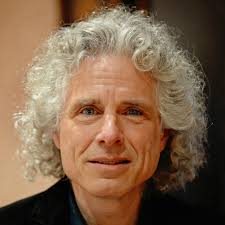
Open Pinker's interactive page (graphs of influences, similar and opposing positions, and quotes)
Background
Steven Pinker
Born: September 18, 1954 in Montreal, Quebec,
Canada
Nationality: Canadian / American
Alma mater: Dawson College, McGill University,
Harvard University
Known for: The Language Instinct, How the
Mind Works, The Blank Slate, The Stuff of
Thought, The Better Angels of Our Nature
Main interests: Evolutionary psychology,
experimental psychology, cognitive science,
linguistics, language, visual cognition, violence
Influences: Noam Chomsky, Thomas Sowell, Leda
Cosmides, John Tooby, Richard Dawkins,
Thomas Schelling, Jerry Fodor, Colin McGinn,
Robert Trivers, Daniel Dennett, Charles Darwin,
Rebecca Goldstein
Influenced: Daniel Dennett, Richard Dawkins,
Colin McGinn, Rebecca Goldstein, Sam Harris
From Wikipedia
Pinker is a Canadian-American cognitive psycholo- gist, psycholinguist, popular science author, and public intellectual. He is an advocate of evolution- ary psychology and the computational theory of mind…. Pinker is the author of nine books for gen- eral audiences. The Language Instinct, How the Mind Works... describe aspects of psycholinguis- tics and cognitive science, and include accounts of his own research, positing that language is an innate behavior shaped by natural selection and adapted to our communication needs.
Introductory Comments
For Pinker, the Enlightenment is less a dusty his-torical period than an ongoing argument - and one we are winning. Its critics have always been loud. The Romantics found its reason cold and its science soulless; throne-and-altar reactionar- ies like de Maistre saw in it nothing but hubris and the guillotine; and in our own time, both the cynical left and the nostalgic right insist that "progress" is a comforting myth that deliv- ered us pollution, alienation, and the bomb. Pinker's reply is to point, simply, at the num- bers. Life expectancy has more than doubled; extreme poverty has collapsed to a small minor-ity; literacy, child survival, and democracy have spread across the globe. These gains were not gifts of fortune. They were wrung out of nature by reason, science, and the radical idea that human flourishing actually matters.
So when we are told the Enlightenment failed, Pinker asks us to mind the gap between the headline and the trend line. Yes, reason gave us the atom bomb - but it also gave us vaccines, anesthesia, and the abolitionist argument that slavery is wrong. The romantic cure for modern-ity, meanwhile, has a poor track record: when reason is dethroned in favor of blood, soil, and feeling, the body count tends to rise. The rele- vant question is not whether reason is perfect, but whether the alternatives - dogma, tribalism, and wishful thinking - have served humanity any better. The scoreboard is not even close.
Some of Pinker's Key Positions
Despite what Locke and the other empiricsits claim, the mind is not empty bucket or blank slate at birth, merely awaiting experience to fill it up or write upon it. Like all animals, we come equipped with an evolved mental organization - faculties and predispositions, some of which later seem the product of reason alone.
An example of this native endowment is the language instinct: children need no urging to learn language, possessing both an inbuilt urge and a native ability to acquire it. Other exam- ples include a moral sense, a grasp of numbers, and an intuitive understanding of other minds. These faculties are present in nascent form early on and mature on a developmental timetable, much like teeth - and, like language, they are not products of reason alone.
Even so, reason plays an essential role in our lives, not least because it lets us correct the very intuitions our evolved minds supply. With- out reason, science and its benefits would be impossible, and we would never learn from our mistakes, as individuals or groups. Without it, we would be at the mercy of every whim, fad, con artist, or demagogue. This is why the Enlightenment values of reason, science, and humanism remain essential to progress - and why the romantic (Herder, Coleridge, etc.) and the cynical (Schopenhauer, Nietzsche, etc.) denial of these values is so dangerous.
Place in the History of Ideas
Pinker's Place in History of Ideas
Richard Pallardy: [Pinker] dismisses tabula rasa notions of human mental development, citing a large body of research indicative of the determinist role played by genes. While acknowledging the ethical quandaries raised by his corollary assertions that people of different genders and ethnicities might have different cognitive abilities due to the disparate evolutionary forces at work upon them, Pinker argued that such revelations need not impede equal treatment. His protestations did little to assuage the concerns of detractors who felt that the claims espoused in the book inevitably created hierarchical relationships between individuals of different backgrounds.
Karen Armstrong: [Pinker believes we] can cultivate the rules of reason and make them normative. And, Pinker insists, it works. Reason has enabled human beings to reach the moon, extinguish smallpox and invent computers, so it puts us in touch with objective truths. Reason also tells us that some people are oppressed, and others privileged, and that measures should be taken to rectify such injustice. As a result, we have... the golden rule, which was... developed independently and rationally by all cultures. But, Pinker points out, we are witnessing a disturbing surge of irrationality. We are living, he explains, in a post-truth era, witnessing dangerous failures in critical thinking and the grounding of truth in evidence.
Random Thoughts on Pinker
Despite the fact that reason and science have led to much progress (see Introductory Com- ments), science has shown us that we are not the rational animals we thought we were. Our prized intellect, evolutionary psychology shows us, is no pristine truth-detector but a survival kit: jury-rigged, bias-ridden, and just clever enough to get our genes into the next genera-tion. Pinker's own work on the language in- stinct made the point early on - we acquire grammar not by reasoning but by an inborn program that runs whether we like it or not. A number of books have recently been written (by Kahneman, Ariely, Haidt and others) to show us just how lame a thing human reason is.
The irony here is obvious: While human reason has created the miracles of the modern world, it has at the same time discovered what a poor specimen it actually is. Not only that, science has also recntly invented an artificial intelli- gence that makes our own "actual" intelligence look quaint. But the question remains: Is the irony here bitter or beautiful? It's natural to find the irony bitter: it feels like a demotion, a loss of human exceptionalism, a story where we are just another animal plus some clever tools. Pinker would, however, probably think the irony beautiful. After all, only a remarkable animal could discover it is not as remarkable as it thought, and only a wise one would take pleasure - even delight - in that discovery.
Influences
Pinker was influenced by: Chomsky, Cosmides, L., Darwin, Dawkins, Dennett, Fodor, Goldstein, R., McGinn, Schelling, T., Sowell, T., Tooby, John, Trivers, Robert
Pinker influenced: Dawkins, Dennett, Goldstein, R., Harris, McGinn
Similar and opposing positions
Thinkers with similar positions:
- Chomsky (An instinctive universal grammar allows us to generate language.)
- Darwin (Evolution has created the cognitive tools we use to function & survive.)
- Dennett (Free will and determinism become compatible through rationality.)
- Durkheim (Language allows us to share in the wisdom & science of the group.)
- Fodor (A syntax of representations makes up the language of thought.)
- Huxley (Mental traits are as much a product of evolution as physical traits.)
- McGinn (Uncaused or random events do not support the concept of free will.)
Thinkers with opposing positions:
- Collingwood (The mind-body "split" is more semantic than metaphysical.)
- Heidegger (Language creates a huge abyss between humanity & animality.)
- Humboldt, W. (The structure of a language affects its speakers' worldview.)
- Huxley (Evolution can't account for the origin of morality in our species.)
- Ibn Tufail (The mind at birth is a blank slate that experience will write upon.)
- Lotze (Universal mechanical laws suggests the work of a universal mind.)
- Piaget (Language develops more from reason than from specialized instincts.)
- Plantinga (Evolution is not an entirely natural process. God helps guide it.)
- Sumner (Survival of the fittest requires we abandon liberal social reforms.)
What others said about Pinker
- R. Pallardy: His early studies on the linguistic behavior of children led him [to assert that we] possess an innate facility for understanding language.
- Karen Armstrong: [Social progress], Pinker insists, is entirely due to our powers of reason. But surely it is also due, at least in part, to em-pathy, a broader, less focused mode of attention than logical analysis and problem-solving.
- Ian Goldin: [Pinker argues that scientific and social progress springs from] the Enlightenment, that period in the eighteenth century when... reason, science, humanism... became the center of intellectual endeavor.... That legacy, he asserts, is ripe for resurrection at a time of political upheaval, the rise of demagoguery, climate skepticism and "fake news."
- Nathan J. Robinson: He thinks many people are very unreasonable, and makes sweeping claims about their irrationality and moral imbecility, but often doesn’t bother to listen to what they actually say.
- Andrew Anthony: [Pinker] makes perfect sense in his defence of rational thinking and why our brains often lead us astray.
- Eliezer Yudkowsky: Pinker’s reasoning on AI was so horrifically bad… that I’m disinclined to believe anything Pinker says about topics I don’t already know about, lest that just be Gell-Mann Amnesia on my own part.
- John Gray: Judged as a contribution to thought, "Enlightenment Now" is embarrassingly feeble. With its primitive scientism and manga-style history of ideas, the book is a parody of Enlightenment thinking at its crudest…. Yet even if Pinker was capable of providing [a richer and more insightful account], intellectual inquiry is not what his anxious flock demands.
- Bill Gates: Pinker is at his best when he analyzes historic trends and uses data to put the past into context.... [H]e understands each subject so deeply that he’s able to articulate his case in a way that feels fresh and new.
Schools: Atheism, Computationalism, Humanism, Innatism, Liberalism, Naturalism, Secular Humanism, Utilitarianism
Main interests: Artificial Intelligence, Communication, Computer Science, Evolution, Evolutionary Psychology, Game Theory, Language, Mind, Progress, Psychology, Semantics, Welfare State
Pinker's answers to philosophical questions
Economics
"[C]ountries that trade more and have more open economies are less likely to fight wars and less likely to have genocides."
"If… most of your relationships are more on an economic exchange basis, then this could leave people feeling less connected."
Education
"People understand concepts only when they are forced to think them through... and to use them to solve problems."
"Any curriculum will be pedagogically ineffective if it consists of a lecturer yammering in front of a blackboard…."
Epistemology
Perceptions are not a simple series of pictures, sounds, etc., but rather part of an internal language of thought (Mentalese).
Like all animals, we're born with specific instincts - some being linked to abilities that may seem the product of reason alone.
Humans have a number of innate abilities that emerge over time: a language ability, a moral sense, a grasp of numbers, etc.
Without reason we'd never learn from mistakes. We'd be at the mercy of whatever whim, fad or con artist came our way.
Finding truth can be tricky: "[T]he conscious mind sometimes hides the truth from itself the better to hide it from others."
"Everyone agrees that [different] aspects of the world... need different kinds of explanations. So yes, we all... are pluralists."
"[The] human mind is vulnerable to many fallacies & illusions because of its reliance on its memory for vivid anecdotes…."
Ethics
"[Morality is a result of] the interchangeability of perspectives & the opportunity the world provides for positive-sum games."
"I think a lot of moral debates are not over what is the basis of justice, but who gets a ticket to play in the game."
"The more you... interact with other people, the more you realize that it is untenable to privilege your interests over theirs."
"Morality [links to] the meaning of life. Moral goodness is what gives each of us the sense that we are worthy human beings."
"[N]othing gives life more purpose than the realization that every moment of consciousness is a precious and fragile gift."
"[Most of us] want to be the kind of person who has the larger view, who takes other people's interests into account…."
History
History shows not only that violence has decreased over time, but also that health and happiness have increased over time.
Despite some backsliding, history shows that Enlightenment values of reason, science & humanism have remade our world.
Language
"Knowing a language... is knowing how to translate mentalese [non-verbal thought] into strings of words and vice versa."
"When people talk, they… do a lot of role playing, sidestep, shilly-shally and engage in all manner of vagueness and innuendo."
Language is a complex, specialized skill, but it's acquired without awareness of the underlying logic that holds it together.
"[We] are very much at the mercy of the particular language which has become the medium of expression for [our] society."
"Language is a complex, specialized skill, which develops in the child spontaneously...." Human language is instinctive.
"Language is a window into human nature, but [also] an open wound through which we're exposed to an infectious world."
Our mind was designed to find actual things & events - and discern kinds of things & events - and then label them accordingly.
Those who say that consciousness depends on language are confused. Certainly babies and many animals are conscious.
A noun need not point to an actual thing, nor a verb to an actual event. Many nouns & verbs are purely conceptual in nature.
Metaphysics
"Time is what life is made of, & one metric of progress is a reduction in the time people [spend] keeping themselves alive."
"[Time is] an inexorable cosmic flow. But the human mind carves this fabric into the discrete swatches we call events."
"All our behaviors are a result of neurophysiological activity in the brain. There is no… magic going on."
Mind
The mind a series of simultaneous processes outshouting one another & later somehow synthesized into some sort of unity.
All thoughts are rooted in the brain: "The... brain is a modular system comprising multiple intelligences, mostly nonverbal."
Plato's cave, where only shadows on the wall are seen: "The skull is our cave, and mental representations are the shadows."
"Consciousness [is] of a maelstrom of events…. [The brain] concocts the impression that a single self was in charge all along."
"Intelligence... is the ability to attain goals in the face of obstacles by means of decisions based on rational… rules."
Nature
"Evolutionary psychology was the organizing framework… that the science of psychology had been missing."
By allowing for the accumulation of knowledge & the coordination of effort, language has given humans tremendous power.
Political Philosophy
"The strongest argument against totalitarianism may be a recognition of a universal human nature; that [we all desire liberty.]"
"Democracy is an imperfect way of steering between the violence of anarchy and the violence of tyranny…."
"[T]otalitarianism [is evil because] all humans have innate desires for life, liberty and the pursuit of happiness."
"No society can be simultaneously fair, free, and equal. [If it is free,] some people will inherit wealth they did not earn."
Psychology
"Even if we do have inclinations toward violence, we also have inclination to empathy, to cooperation, to self-control."
"Cognitive psychology tells us that the unaided human mind is vulnerable to many fallacies and illusions…."
"All human behavioral traits are heritable [&] the effect of being raised in the same family is smaller than the effect of genes."
"[E]motions… were designed to propagate copies of the genes that built them rather than… happiness... or moral values."
"The beauty of reason is that it can always be applied to understand failures of reason."
Religion and Theology
"There's the common veneration (not just by the religious) of faith, namely believing something without a good reason."
"[The] growing movement called Humanism... promotes a non-supernatural basis for meaning and ethics: good without God."
Though the universe may seem to need a creator, figuring "out how things really work is one of humanity's highest callings."
"The doctrine of the sacredness of the soul [is] malignant. It discounts life on earth as just a temporary phase" of little value.
"I never outgrew my conversion to atheism at 13, but at various times was a serious cultural Jew."
"The first step toward wisdom is the realization that the laws of the universe don't care about you."
"[The bible] was compiled over half a millennium from writers with different styles, dialects..., and conceptions of God…."
Science
"As an experimental psychologist, I have been trained not to believe anything unless it can be demonstrated in the [lab]."
"By exposing the absence of purpose in… the universe, science forces us to take responsibility for... ourselves [&] our planet."
Sex and Gender
"The so-called rational animal has a desperate drive to pair up and moan and writhe."
"By all measures men are the more violent gender."
Society
Socialization is instinctive: "There has to be innate circuitry... that acquires the culture, and that responds to socialization."
"We will never have a perfect world, but it's not romantic or naive to work toward a better one."
"But it’s in the nature of progress that it erases its tracks, and its champions fixate on the remaining injustices…."
Language & social contagion: "[Language] is... a fistula, an open wound through which we're exposed to an infectious world."
Equality "is the moral principle that individuals should not be judged or constrained by the average properties of their group."