Gottlob Frege (1848 - 1925)
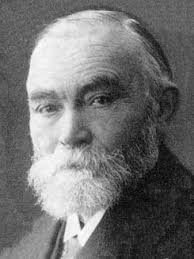
Open Frege's interactive page (graphs of influences, similar and opposing positions, and quotes)
Background
Gottlob Frege
Born: 8 November 1848 in Wismar, Germany
Died: 26 July 1925 (aged 76) Bad Kleinen,
Mecklenburg-Schwerin, Germany
Schools: Analytic philosophy, Logical objectivism,
Logicism, Transcendental idealism, Realism
Main interests: Philosophy of mathematics,
mathematical logic, philosophy of language
Notable ideas: Principle of compositionality,
quantification theory, predicate calculus
Influences: Kuno Fischer, Adolf Trendelenburg,
H. Lotze, Otto Liebmann, Benno Kerry, Ernst
Abbe, Hume, G. W. Leibniz, Bernard Bolzano
Influenced: Giuseppe Peano, Russell, Carnap,
Wittgenstein, Michael Dummett, Husserl,
Gershom Scholem, G. E. Moore, John Searle,
Alfred Tarski, Whitehead, Ian Rumfitt, Saul
Kripke, John McDowell, Robert Brandom, C. J.
F. Williams, Lorenzo Peña, Kurt Gödel
From Wikipedia
Frege was a German philosopher, logician, and mathematician. He was a mathematics professor at the University of Jena, and is understood by many to be the father of analytic philosophy, concentrating on the philosophy of language, logic, and mathematics.... His book the Foundations of Arithmetic is the seminal text of the logicist project, and is cited by Michael Dummett as where to pinpoint the linguistic turn [in British and American philosophy].
Introductory Comments
Few scholars have opened a worse letter than the one Frege received in June 1902. For two decades he had labored to prove that arithmetic is logic in disguise - that every truth about numbers could be derived, without gaps or appeals to intuition, from logical laws and definitions. The second volume of his masterwork, Basic Laws of Arithmetic, was already at the printer. Then the young Russell wrote, politely, to point out a contradiction in its foundations. One of Frege's axioms allowed any concept to define a collection. But consider the collection of all collections that are not members of themselves. Is it a member of itself? If it is, it isn't; if it isn't, it is. The bedrock Frege had laid for all of arithmetic had a crack running through it.
Frege added a hurried appendix conceding the blow, tried a repair that did not hold, and eventually abandoned the project. Yet the story has a twist. The tools he had built along the way - a powerful new logic and the distinction between an expression’s sense and its reference - came through the collapse intact. They were not salvaged from the wreck; they had been forged years earlier, in service of the doomed project itself. Taken up by Russell, Wittgenstein, and Carnap, they helped launch analytic philosophy and its "linguistic turn," the conviction that many philosophical puzzles are best attacked by first getting clear about language. Frege, little read in his lifetime, became the founding father of a movement he never knew he had started.
Some of Frege's Key Positions
Arithmetic rests on logic alone. Its truths can be derived from purely logical laws and definitions. That makes them analytic, not generalizations from experience. Numbers are objects, not ideas in anyone’s head. Geometry, by contrast, depends on spatial intuition.
Logic must be kept free of psychology. Its laws do not describe how people happen to think; they are the laws of truth, binding on anyone who thinks at all. The thought a sentence expresses is objective - graspable by many minds, owned by none.
Traditional logic, built on subject, predicate, and syllogism, is too weak for mathematics. Sentences are better analyzed like mathematical functions. A concept is an incomplete expression with a gap ("_ is a horse"), and an object is what fills it. Nested quantifiers ("all," "some") can then express complex generality, such as "everyone loves someone."
Meaning is therefore central to philosophy. A word has meaning only in the context of a sentence. Every expression has a reference, the thing it picks out, and a sense, the way it presents that thing. "The morning star" and "the evening star" both refer to Venus but differ in sense. That difference is why identifying them was a discovery, not a tautology. Sense is not a layer atop reference but the route to it. A sentence's sense is a thought; its reference is a truth value.
Place in the History of Ideas
Frege's Place in History of Ideas
Stephen Toulmin: Our representative absolutist is Gottlob Frege, whose writings did as much as anything to revive the "mathematizing" approaches of the Platonist tradition around 1900, and did so - quite explicitly - as a means of protecting philosophy from subordination to the facts of history and psychology.... Frege... was rebelling... against the tendency to telescope formal and prescriptive "laws of thought," which were the proper concern of logic, with the empirical and descriptive "laws of thinking," which were the business of cognitive psychologists... [W]e should ignore all merely empirical discoveries, whether about the development of understanding in the individual mind or about the historical evolution of our communal understanding.... Philosophers must concern themselves with "concepts" only as timeless, intellectual ideals, towards which the human mind struggles....
Robert C. Solomon: Frege insisted that the "necessity" of which philosophers were so fond was to be found in one place only, and that was in the field of formal logic and the foundations of mathematics. Moreover, where the idealist philosophers had muddled through the fog of such Kantian notions as "concept" and "constitution," Frege pinned down his analyses to the structure of language. In doing so he opened the way to twentieth-century analytic philosophy....
Random Thoughts on Frege
Frege never set out to change the subject of philosophy. He wanted only to make proofs airtight, and ordinary language kept getting in the way - vague, ambiguous, forever smuggling in assumptions nobody noticed. He compared his formal notation to a microscope: clumsy for everyday seeing, indispensable when precision mattered. But the distinction between sense and reference hinted at something larger and more unsettling. If two names for the same planet can tell us different things, perhaps many of philosophy's oldest puzzles - about existence, identity, what is real - were knots in our words rather than in the world. Untie the language, and the problems might simply fall away.
Russell and the young Wittgenstein ran with this hope. Beneath the untidy surface of everyday speech, they believed, lay a hidden logical structure; dig it out, and centuries of confusion would evaporate. Then the plot twisted. The later Wittgenstein, along with Ryle and Austin, came to suspect that the rigorous logic at work within language was largely a philosopher's fantasy. Formal analysis, they argued, mistook a philosopher's artificial calculus for the real thing, missing the rich, contextual, performative texture of language as people actually speak it. Meaning didn't lurk in some hidden formal structure - it lived in plain view, in its use: to describe, to promise, to persuade, to joke, to do the million and one things that people do with language.
Influences
Frege was influenced by: Abbe, Ernst, Bolzano, Fischer, Kuno, Hume, Kerry, Benno, Leibniz, Liebmann, O., Lotze, Trendelenburg
Frege influenced: Brandom, Carnap, Dummett, Godel, Husserl, Kripke, McDowell, Moore, Peano, G., Pena, Lorenzo, Russell, Scholem, G., Searle, Tarski, Whitehead, Williams, C.J.F., Wittgenstein
Similar and opposing positions
Thinkers with similar positions:
- Abelard (Logic must consider propositional "attitudes" in its explanations.)
- Bolzano (Logic must remain free from any psychological admixture.)
- Carnap (Many philosophical questions abuse language and are meaningless.)
- Husserl (Logic is an autonomous discipline, not a branch of psychology.)
- Russell (Concepts must objectively exist independent of their instantiations.)
- Schlick (Outside logic & math, the truth of statements must rest on evidence.)
- Tarski (The meaning of a sentence is equivalent to its truth conditions.)
Thinkers with opposing positions:
- Bergson (Intuition gives our minds direct access to the nature of reality.)
- Brandom (Much of the meaning of words springs from their inferences and uses.)
- Cassirer (Human expression, not just impression, forms human understanding.)
- Collingwood (Philosophy expresses rational as opposed to causal processes.)
- James (Logic is not an adequate measure of what can or cannot be.)
- Quine (The analytic–synthetic distinction does not hold up under scrutiny.)
- Rorty (Language can't represent reality by "holding a mirror up to nature.")
- Strawson (Language's apparent imperfections are signs of expressive power.)
- Wittgenstein (Words are tools. A word's meaning is its use in the language.)
What others said about Frege
- Simon Blackburn: Frege’s hostility to psychological accounts of meaning led him to regard thoughts and senses as abstract objects akin to Platonic Forms.
- M. Dummett: No one supposes that Frege said the last word on any topic; but there is scarcely a live question in contemporary philosophy of language for whose examination Frege’s views do not form at least the best starting point.
- Robert C. Solomon: Frege rebelled against the obscurity of German idealism, and looked back beyond the Cartesian and Kantian revolutions in philosophy to Aristotle and the medieval scholastics, who agreed that logic, not the theory of knowledge or any grand view of the self, was the foundation of philosophy.
- Dorothea Lotter: ... most of the general philosophical issues upon which Frege reflected… had to do with the nature of thought in general and its relation to logic, to truth, to language, and to the objects it can be about.
- Edward N. Zalta: Moreover, his lifelong project, of showing that mathematics was reducible to logic, was not successful.
- James Conant: ... what occasions Frege’s wonder - the absoluteness of the logical order - seems to him to be such that it cannot possibly be implicated in our dependence upon language.
- Michael J. Beeson: [Leibniz and Boole] did not concern themselves with rules of proof, since their aim was to reach truth by pure calculation with symbols for the propositions. Frege took the opposite track: instead of trying to reduce logic to calculation, he tried to reduce mathematics to logic, including the concept of number.
- Edward N. Zalta: Any student of Frege who wants to understand the full range of his views on language will have to come to grips with how those views are related to Stoic philosophy.
Schools: Analytic Philosophy, Linguistic Philosophy philosophy, Logicism, Rationalism, Transcendental Idealism
Main interests: Language, Logic, Mathematics, Semantics, Semiotics, Universals
Frege's answers to philosophical questions
Epistemology
Profound thought requires logic & math: "A philosopher who has nothing to do with geometry is only half a philosopher."
"Being true is different from being taken as true, whether by one or by many..., and in no case is it to be reduced to it."
"I do not [put concepts] together to form a thought…; I come by the parts of a thought by analyzing the thought."
Language
Reality is not grammatical. The laws of truth "do not bear the relation to thought that the laws of grammar bear to language."
Metaphysics
If identity means equality (A = A) over time: "Equality gives rise to challenging questions which are [difficult] to answer."
Philosophy
Philosophers should return to the rigorous discipline of Aristotle, who saw logic as central to philosophy.
Mathematics grew out of logic and logic is central to philosophy. These three disciplines are inseparable from one another.
Science
Science requires math: "Strictly speaking, it is really scandalous that science has not yet clarified the nature of number."