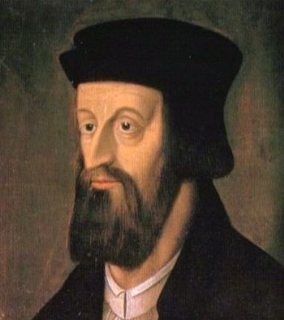
Jan Hus (c. 1372 - 1415)
Open Hus's interactive page (graphs of influences, similar and opposing positions, and quotes)
Background
Jan Hus
Born: c. 1372 in Husinec, Kingdom of Bohemia in
The Holy Roman Empire (now Czech Republic)
Died: July 6, 1415 (aged 45-46) in Konstanz,
Bishopric of Constance in the Holy Roman
Empire (now Germany)
Other names: John Hus, John Huss
Alma mater: University of Prague
School: Hussite
Main interests: Theology, Religion
Influences: John Wycliffe, Conrad Waldhauser,
Paul of Tarsus, Augustine
Influenced: John Wesley, Jerome of Prague,
Savonarola, Martin Luther, Henry VIII, John
Calvin, Ulrich Zwingli, Philipp Melanchthon,
William Tyndale, Thomas Müntzer
From Wikipedia
Hus was a Czech theologian and philosopher who became a Church reformer and the inspiration of Hussitism, a key predecessor to Protestantism, and a seminal figure in the Bohemian Reformation. Hus is considered to be the first Church reformer, even though some designate the theorist John Wycliffe. His teachings had a strong influence, most immediately in the approval of a reformed Bohemian religious denomination and, over a century later, on Martin Luther.
Introductory Comments
The imitation of Christ - perhaps as impossible an ideal as can be imagined - has long held a central place in Christian ethics. And, like most impossible ideals, it has been honored far more in the breach than in the observance. Jan Hus was one of those rare exceptions who took it deadly seriously. Indeed, it was this ideal that drew him into his fatal quarrel with the Church - a quarrel that ended at the stake.
By all accounts Hus was pious and humble, living simply and in service to others. What he asked of himself he asked of the Church's leaders: that they too model their lives on Christ. When he saw them doing the opposite, he did not hold his tongue. In one searing sermon he has Christ look down on the worldly clergy and lament: "I suffer great agony in a sweat of blood while they take delight in luxurious bathing. All through the night I am mocked and spat upon while they enjoy feasting and drunkenness. I groan upon the cross as they repose upon the softest beds."
Such words did not endear him to the powerful, and in 1415 the Council of Constance condemned him to the flames. Hus refused to recant. Instead - like the Christ he had spent his life imitating - he prayed for those who had condemned him, asking God to forgive them. And as the fire rose around him, he prayed aloud and commended his spirit to God: an imitation of Christ that must have transfixed all who watched.
Some of Hus's Key Positions
The Catholic Church has grown materialistic, avaricious, and corrupt. Offices and indulgences are for sale; priests are seduced by greed, lust, and drink; dissent is silenced; vicious crusades are waged; and Scripture is forgotten or twisted to serve power. The Church must be reformed and rebuilt on a sound foundation.
That foundation is Scripture. The Bible - not prelates, popes, or councils - is the ultimate source of religious truth. Christians should therefore know Scripture rather than depend blindly on the clergy to interpret religious truth for them. Preaching and religious instruction should be given in the language ordinary people understand, and Scripture should be made accessible to them.
In spiritual matters we should be guided by neither pope nor king, but by Scripture, and by appeal to Christ and God directly. Country priests and devout laymen may help lead us toward righteousness - but only if they address us as spiritual equals, and in the vernacular.
This respect for spiritual dignity extends not only to men but to women. Women too were made in the image of God, and they have the right to read Scripture, to follow their conscience in matters of faith, and even, when the occasion demands, to admonish an erring priest. (Later Hussites went even further, allowing women to preach and assume prominent religious roles.)
Place in the History of Ideas
Hus's Place in History of Ideas
Harry Emerson Fosdick: Behind all else in Hus's teaching stood his devotion to the Scriptures as the ultimate guide of life and thought. Here we run decisively upon one of the major issues dividing Roman Catholicism from the whole movement which issued in the Protestant Reformation. According to Roman dogma one did not believe in the church because Scriptures say so, but believed in the Scriptures because the church says so.
Herman Hanko: [Wycliffe and Hus] were differ- ent. Wycliffe was first of all a scholar for whom preaching was secondary. Hus was above all a preacher.... The dusty library was Wycliffe's home; the pulpit was Hus's. Wycliffe labored all his life for reform and left no movement that continued to the Reformation. Hus started a movement of reform that not only lasted to the Reformation, but has come down to the pres- ent in almost pure form, primarily in the Mora- vians. Wycliffe's teachings were almost identical to those of Luther and Calvin; Hus, apparently, was never able to condemn the Roman Catholic corruption of the Lord's Supper. Wycliffe re- flected all his life the middle class gentility of his upbringing; Hus, after the pattern of Luther, was of rough peasant stock. Wycliffe, it seems, did not know what it meant to laugh; Hus could banter and joke with his students even while lecturing. Wycliffe went to the grave in peace; Hus was burned to death on a martyr's pyre.
Random Thoughts on Hus
When the Emperor Theodosius I made Christianity the official religion of the Roman Empire in 380, he quietly wed two very different stories: the tale of a humble carpenter devoted to the glory of God, and the tale of a magnificent empire devoted to the glory of man. The marriage was an uneasy one. By joining these seemingly incompatible narratives, Theodosius planted a contradiction at the heart of Christianity - one that theologians have wrestled with ever since. Augustine offered perhaps the most influential settlement: Christians must live and work within the City of Man, but their ultimate allegiance belongs to the City of God.
Others were less confident the two "Cities" could be reconciled at all. Wycliffe looked at the wealth and power of the medieval Church and longed for the simplicity and poverty of its apostolic beginnings. Hus likewise demanded that priests model themselves on Christ rather than pursue wealth and worldly privilege. He also insisted that priests renounce indulgences - both the ones they partake in and the ones they peddle. Then the pendulum swung the other way. Luther dignified ordinary worldly labor as a divine calling, and Calvin's heirs came to read worldly success as a mark of God's favor. Today the pendulum has swung further still, to Prosperity Gospel preachers like Joel Osteen, who cheerfully promote wealth outright - as though Jesus had said never mind squeezing that camel through the eye of a needle, just buy your heaven here on earth.
Influences
Hus was influenced by: Augustine, Paul of Tarsus, Waldhauser, C., Wycliffe
Hus influenced: Calvin, Henry VIII, Jerome of P., Luther, Melanchthon, Müntzer, T., Savonarola, Tyndale, W., Wesley, John, Zwingli
Similar and opposing positions
Thinkers with similar positions:
- Augustine (God is transcendent. He is above everything in nature.)
- Calvin (The only way to obtain knowledge of God is to study scripture.)
- Calvin (The only way to obtain knowledge of God is to study scripture.)
- Erasmus (The Catholic Church should be reformed, not overthrown or destroyed.)
- Hooker (Religion is based on revelation, but also on reason and tradition.)
- Savonarola (Church officials should play a role in the administration of the state.)
- Voltaire (The Catholic Church has often been guilty of oppression & corruption.)
- Wycliffe (The clergy should give up luxury and live in complete poverty.)
Thinkers with opposing positions:
- Bruno (God is not transcendent. Everything in Nature is part of God.)
- Bultmann (We must demythologize Scripture to make God relevant today.)
- Dawkins (We, not God, are responsible for giving life meaning and purpose.)
- Feuerbach (Our concept of God reflects our own traits and deepest wishes.)
- Harris (Religious toleration can't justify beliefs based on no evidence or reason.)
- Holbach (The foundation of morality is not in Scripture but in happiness.)
- Luther (Reason cannot aid faith. It is the greatest enemy that faith has.)
- Nicholas of C. (We gain a mystic unity with God thru intellectual intuition.)
What others said about Hus
- Thomas A. Fudge: Jan Hus was a medieval Catholic reformer rather than a premature Protestant.
- Luther: [On learning of Jan Hus and his execution,] I could not understand for what cause they had burnt so great a man, who explained the Scriptures with so much gravity and skill.
- B. K. Kuiper: Hus taught many ideas which later became the main teachings of the Reformers. He taught that the holy Catholic Church consists of the total number of the predestinated. He distinguished between being in the Church and being of the Church.... Of the universal Church Christ alone is head. Popes and cardinals are not necessary to the government of the Church.
- Tom Schwanda: Hus [says we must] be grounded in Scripture. Writing to his friends in Bohemia the day before he was executed, he declared what was a constant reminder throughout his ministry: "Be diligent in the Word of God."
- Luther: I have taught and held all the teachings of Jan Hus, but thus far did I not know it.... In short, we are all Hussites and did not know it.
- John Herman Randall, Jr.: [Wycliffe and Hus believed that] membership in the visible Church and participation in the sacraments had nothing to do with salvation [and that therefore] the whole Catholic system was... unnecessary.
- Herman Hanko: Hus was not the original thinker that Wycliffe was, and indeed borrowed most of this thoughts from Wycliffe - especially Wycliffe's views of the church as the elect body of Christ and the sole authority of Scripture. But Hus became what Wycliffe never was, a powerful preacher of the gospel. By preaching he moved a nation.
- James R. McGraw: [Wycliffe and Hus] represent the preaching which awakened interest and focused attention upon truths Luther and the others were able to portray during the Reformation times.
Schools: Christian Theology
Main interests: Immortality, Religion, Salvation, Spirituality, Theology
Hus's answers to philosophical questions
Ethics
"He that fears death loses the joys of life."
Law
"The only law that a Christian should listen to and read is the law of God's Commandments."
Psychology
"We should strive to live a life of simplicity and humility, following the example of Christ."
Religion and Theology
Too often the rites and rituals of the church distract us from what is most essential in religion: the divine Scriptures.
Spirituality is an individual and internal matter. It does not require obeying external authorities, other than the Bible.
"For whoso dies for Christ, he is conqueror… and attains the eternal joy to which may it please our Saviour to bring us all."
Wycliffe is wrong about transubstantiation: In the Eucharist, bread and wine do become the flesh and blood of Christ.
"Christ is… the foundation because the edifice of the church begins from him and is finished in him and through him."
"I would rather suffer the penalty of a terrible death than wish to… transgress the commandments of our Lord Jesus Christ."
The Scriptures, not church leaders, are the ultimate source of religious truth. Therefore, each of us must study the Bible.
Sex and Gender
"Has not God himself instituted marriage, as a means to satisfy the craving for love in all men."
On spiritual matters, women should be as free and independent as men, since they too were made in the image of God.