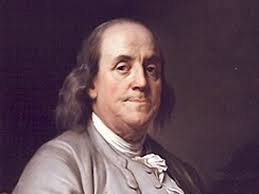
Benjamin Franklin (1705 - 1790)
Open Franklin's interactive page (graphs of influences, similar and opposing positions, and quotes)
Background
Benjamin Franklin
Born: January 17, 1706 in Boston,
Massachusetts
Died: April 17, 1790 (aged 84) in Philadelphia,
Pennsylvania
Main Interests: Public service, politics, political
theory, science, invention, physics, education,
journalism, meteorology, music, international
diplomacy, medicine, social improvement
Influences: Voltaire, David Hume, John Locke,
Cotton Mather, Confucius, François Quesnay,
Emer de Vattel, Pierre Bayle, Hugo Grotius,
Jesus,
Influenced: Thomas Paine, Auguste Comte,
Marquis de Condorcet, Henri de Saint-Simon,
Jefferson
From Wikipedia
Franklin was an American polymath: a leading writer, scientist, inventor, statesman, diplomat, printer, publisher and political philosopher. Among the most influential intellectuals of his time, Franklin was one of the Founding Fathers of the United States; a drafter and signer of the Declaration of Independence; and the first postmaster general…. He pioneered and was the first president of the Academy and College of Philadelphia, which opened in 1751 and later became the University of Pennsylvania.
Introductory Comments
Franklin loved London. He loved its energy and industry, its history and modernity, its architecture and its clubs. Most of all, he relished the opportunity to mingle with the leading scientists, thinkers, and writers of the age. Indeed, he loved London so much that he hoped to settle there permanently, even though he knew his long-neglected wife would never join him. But during the 1770s, the relationship began to sour. As tensions mounted between Britain and its American colonies, Franklin - now serving as the colonial agent for several of them - found himself increasingly caught in the middle.
Then the roof fell in. After admitting that he helped arrange for the publication of private letters written by Thomas Hutchinson, the Royal Governor of Massachusetts, Franklin was hauled before the Privy Council. He was to be subjected to a savage public dressing-down in a room called, aptly enough, the Cockpit. Denounced as unprincipled, unscrupulous, and - worst of all, in 18th-century Britain - ungentlemanly, Franklin just stood there, face blank, giving his tormentors nothing. But when it was over, so too was his love affair with London. A few months later, Franklin sailed home. If he had once imagined himself becoming an Englishman, he now threw his energies behind the American cause. The nation he helped create would look not to inherited privilege but to principles, not merely to tradition but to possibility. This too appealed to Franklin.
Some of Franklin's Key Positions
People should approach the establishment and maintenance of a republic with humility and a willingness to compromise. Though basic human rights and freedoms must be protected, too much insistence on the purity of one's principles is foolish. Not only does such insistence create mutual anger and general deadlock, compromise may in fact lead to the best results.
And concrete results - not abstract principles - are what's most essential in government, as with all human endeavors. From the pursuit of science and invention to the prevention of devastating urban fires and international conflicts to the everyday delivery of mail and cleaning of streets - what counts most are results.
For a republic to flourish, then, it is not enough that our rights and freedoms are secured. We must make the best of our rights and freedoms. A successful republic requires not only good institutions, but also the wisdom, virtue, and industry of the people.
Therefore, it is incumbent on each of us to continually strengthen our virtues and maintain our industry. Each of us should establish a program of self-improvement in which we monitor our behavior, admit our flaws, and improve our ways. However, self-examination that ends in self-satisfaction has missed the target entirely: virtue is measured by the good it does other people.
Place in the History of Ideas
Franklin's Place in History of Ideas
V. L. Parrington: All his life his sympathy went out to whoever suffered in person or fortune from the injustice of society: to the debtor who found himself pinched by the shrinking supply of currency; to the black slave who suffered the most elementary of wrongs; to impressed seamen; to the weak and wretched of earth. He was a part of that emerging humanitarian movement which, during the last half of the eighteenth century, was creating a new sense of social responsibility.... He was concerned not with property or class interests, but with the common welfare; and in his quick sympathy for all sorts and conditions of men, in his convic- tion that he must use his talents to make this world better and not exploit it, he reveals the breadth and generosity of his nature.
Max Weber: In fact, the summum bonum of [Franklin's] ethic, the earning of more and more money, combined with the strict avoidance of all spontaneous enjoyment of life, is above all completely devoid of any eudaemonistic, not to say hedonistic, admixture. It is thought of so purely as an end in itself, that from the point of view of the happiness of, or utility to, the single individual, it appears... absolutely irrational. Man is dominated by the making of money, by acquisition as the ultimate purpose of his life. Economic acquisition is no longer subordinated to man as the means for the satisfaction of his material needs.
Random Thoughts on Franklin
In April 1778, at the Académie des Sciences in Paris, the crowd would not settle until the two old men embraced - Voltaire at 84, Franklin at 72, kissing each other's cheeks while the hall roared. Voltaire blessed Franklin's grandson with the words God and Liberty, and was dead within a month. A good tableau, but a slightly misleading one. The two men came from very different worlds. We can see this, for instance, in their different takes on deism. Voltaire's was born fighting. He wrote in the shadow of a church with tithes, courts, censors, and a very long memory - a France where a Protestant could still be broken on the wheel on the word of a mob, as Jean Calas was in 1762. His deism was dry, combative, and gleefully savage.
Franklin had no such enemy to sharpen him. The colonies had establishments, but they were provincial and mutually cancelling - Anglicans in Virginia, Congregationalists in New England, Quakers and Baptists and Lutherans and Catholics, plus a synagogue in Newport, none strong enough to dominate the rest, all obliged to trade with one another anyway. So his deism, summed up five weeks before he died, is almost comically brief: one God, best served by doing good to others; as for the divinity of Jesus, he had doubts, but expected to learn the truth with less trouble shortly. Voltaire's deism was a weapon aimed at a church; Franklin's was a genial indifference to all religious sects and a warm welcome to all who came into his shop. Not a Quacker, but a Friend nonetheless.
Influences
Franklin was influenced by: Bayle, Confucius, Grotius, Hume, Jesus, Locke, Mather, Cotton, Quesnay, Vattel, E. de, Voltaire
Franklin influenced: Carnegie, Dale, Comte, Condorcet, Jefferson, Paine, Saint-Simon
Similar and opposing positions
Thinkers with similar positions:
- Dewey (Participation, not representation, is the essence of democracy.)
- Habermas (Both democracy & science rely on free & rational communication.)
- MacIntyre (A just and virtuous society needs a reliable set of moral beliefs.)
- Mead (Our knowledge of the world is largely shaped by pragmatic concerns.)
- Orwell (Colonialism is despotic, even when it pretends to be democractic.)
- Paine (The only religion that's at all defensible is pure and simple deism.)
- Rousseau (Education is crucial to the emancipation of all individuals.)
- Sumner (Self-reliance, frugality and perseverance are keys to personal success.)
Thinkers with opposing positions:
- Bentham (Talk of natural rights is mere rhetoric - just "nonsense upon stilts.")
- Bergson (Utility is not a test of truth, but in fact a synonym for error.)
- Calvin (Art is never free of the societal forces at work in its creation.)
- Edwards (God alone is the only real cause at work in the world - not matter.)
- Evola (Liberal democracy represents an ignoble trend towards mediocrity.)
- Hamann (Scientific reason leads to doubts about the reality of the world.)
- Hobbes (The sovereign is not bound by any higher laws: He makes the laws.)
- Maistre (A strong government requires loyality to a strong monarch and church.)
What others said about Franklin
- Turgot: He seized the lightning from Heaven and the scepter from the Tyrants.
- D. H. Lawrence: The perfectibility of man, dear God! When every man... is in himself a multitude of conflicting men. Which... do you choose to perfect...? Old Daddy Franklin will tell you. He'll rig him up for you, the pattern American.
- Twain: Franklin did a great many notable things for his country..... It is not the idea of [his autobiography] to ignore that or cover it up. No; the simple idea of it is to [present again] those pretentious maxims of his, which he worked up with a great show of originality out of truisms that had become wearisome platitudes as early as the dispersion from Babel.
- Galbraith: The prime exponent of paper money in those years was... Franklin. He thought it a good and useful thing, and his advocacy had [a] practical touch. He printed money for the colonial governments on his own printing press.
- H. S. Commager: In Franklin could be merged the virtues of Puritanism without its defects, the illumination of the Enlightenment without its heat.
- Walter Isaacson: [Franklin was] the most accomplished American of his age and the most influential in inventing the type of society America would become.
- Jacques Mallet du Pan: Franklin often told his disciples in Paris, that whoever would introduce the principles of primitive Christianity, into the political state, would change the whole order of society. An absolute equality of condition; a community of goods; a Republic of the poor and of brethren; associations without a Government; enthusiasm for dogmas....
- Hume: America has sent us many good things, gold, silver, sugar, tobacco; but [Franklin was] the first philosopher for whom we are beholden to her. It is our own fault that we have not kept him....
Schools: Deism
Main interests: Abolition of slavery, Autobiography, Commerce, Democracy, Education, Freedom of the press, Government, Invention, Journalism, Law, Meteorology, Music, Physics, Political Activism, Political Philosophy, Politics, Progress, Public Administration, Revolution, Science, Virtue, Will, Wisdom
Franklin's answers to philosophical questions
Art and Aesthetics
"If all printers [decided] not to print anything till they were sure it would offend nobody, there would be very little printed."
Economics
Property "necessary to a Man... is his natural Right.... But all Property superfluous to such purposes [belongs] to the Public."
"It is the working man who is the happy man. It is the idle man who is the miserable man."
Education
"The good education of youth [is[ the surest foundation of the happiness both of private families and of commonwealths."
"Tell me and I forget. Teach me and I remember. Involve me and I learn."
Education leads to obligation: "The more one knows, the more one can do. The more one can do, the more one ought to do."
Ethics
"... vicious actions are not hurtful because they are forbidden, but forbidden because they are hurtful."
Law
"A man compounded of law & gospel [can] cheat a whole country with his religion & then destroy them under color of law."
Metaphysics
"Change is the only constant in life. Ones ability to adapt to those changes will determine your success in life."
Political Philosophy
For a republic to flourish, secured rights & freedoms must be combined with the wisdom, virtue & industry of the people.
"In those wretched countries where a man cannot call his tongue his own, he can scarce call anything his own."
Psychology
"Educate your children to self-control… & [you'll] have done much to abolish misery from their future & crimes from society."
"Your net worth to the world is... determined by what remains after your bad habits are subtracted from your good ones."
"Human felicity is produced not so much by great pieces of good fortune..., as by little advantages that occur every day."
Religion and Theology
For most people, religious belief is needed to behave well towards others, though enlightened thinkers are likely to be deists.
"I [conceive that] the Infinite Father expects or requires no worship or praise from us, but that He is even infinitely above it."
Since we can only conceive that which is comprehensible, we can assume a just God would expect no ritual worship from us.
As Jesus exemplified in his life & indicated in his teachings, "the most acceptable service of God was the doing good to man."
Sex and Gender
"[M]an and woman united... make the complete human being.... Together they are more likely to succeed in the world."
"Keep your eyes wide open before marriage, half shut afterwards."
Society
Religious persecutions can tear a country apart - and most religions have at one time or another persecuted other religions.