Susanne Langer (1895 - 1985)
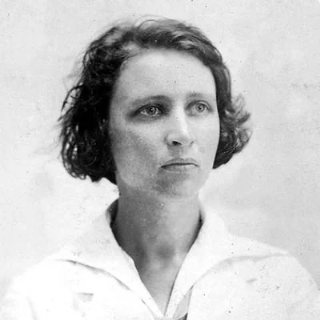
Open Langer's interactive page (graphs of influences, similar and opposing positions, and quotes)
Background
Susanne Langer
Born: December 20, 1895 in Manhattan
Died: July 17, 1985 (aged 89) in Old Lyme,
Connecticut
Alma mater: Radcliffe College (BA, 1920; PhD,
1926)
Era: 20th-century philosophy
School: Process Philosophy
Main interests: Philosophy of mind, aesthetics
Notable ideas: Distinction between discursive
and presentational symbols
Influences: Cassirer, Whitehead, Louis Arnaud
Reid, Kant, Schopenhauer, Carnap, Owen
Barfield, Louis Arnaud Reid
Influenced: Howard Gardner, Robert E. Innis,
Abraham Maslow, Kevin A. Lynch, W. J. J.
Gordon, Louis Arnaud Reid, Clifford Geertz,
Ellen Dissanayake, Janet Murray, Melvin Rader
From Wikipedia
Langer was an American philosopher, writer, and educator known for her theories on the influences of art on the mind. She was one of the earliest American women to achieve an academic career in philosophy and the first woman to be professionally recognized as an American philosopher. Langer is best rembered for her 1942 book Philosophy in a New Key which was followed by a sequel Feeling and Form: A Theory of Art. In 1960, Langer was elected a Fellow of the American Academy of Arts and Sciences.
Introductory Comments
Langer understood what many theorists of art forget: a painting of a bowl of fruit is not art simply because its pears and apples look good enough to eat. If faithful depiction were the essence of art, a police sketch or a passport photo would hang in the Louvre. A theory that ties art to representation mistakes the vehicle for the cargo. It is like praising a love letter for its accurate account of the beloved's eye color. What makes a work art, in Langer's view, is its form, which gives shape to human feeling. Here she parts company with a more familiar view. Art's job, she argued, is not to make us feel. Its job is to show us what feeling is like: to set its rhythms and tensions before us, where they can be perceived and understood.
In doing this, art need not represent anything at all. Langer's model case was instrumental music, which depicts nothing you could point to or photograph yet seems to hold a whole inner world. Music manages this because its rising and falling, building and resolving, share a shape with the ebb and flow of feeling. Langer called music an "unconsummated symbol": its forms carry no fixed, assigned meanings, no obvious links to the world. That openness is not a flaw but the source of music's power, since music articulates what words can only label. For Langer, this was art's unique role: it makes the invisible contours of our inner lives perceptible, giving form to feelings that might otherwise remain beyond the reach of thought.
Some of Langer's Key Positions
Art is the creation of forms symbolic of human feeling. "Feeling" means more than the familiar emotions. It covers the whole felt life of a sentient creature: its tensions and releases, its quickenings and slowings. A melody that builds, hesitates, and resolves shares its shape with an inner experience that does the same. That shared shape, not any likeness to the outside world, makes a work expressive.
Art therefore need not represent anything. Even when a work depicts a thing or event, its power lies in the form, which articulates a feeling much as a sentence articulates a thought.
Nor is art self-expression. A composer writing a lament need not be grieving, and a wailing infant expresses feeling without making art. The artist expresses knowledge of feeling, captured in a form others can perceive. Each art creates a "semblance" set apart from practical life: painting creates virtual space, music virtual time. Freed from everyday concerns, we can contemplate the feeling, and ourselves, as if from a distance.
This form-making is not confined to art. Human beings have a basic need for turning raw experience into symbols - in dream, myth, ritual, and language, as well as art. Language excels at naming and reasoning but falters before the shifting life of feeling. There art takes over, giving shape to what can be felt but not adequately said.
Place in the History of Ideas
Langer's Place in History of Ideas
Lona Gaikis: As philosophical hybrid, not only advancing elements from Whiteheadian process thought but sharing essential roots in Ernst Cassirer’s theory of symbolic form, the disputability in Langer’s theory, spans the continental divide. Langer introduced a “new key” to philosophy by emphasizing musical form in the making of meaning.... Her semiology [the study of signs] conceptualizes language, science, and logic hitherto as discursive form but adds artistic expression as presentational symbol to the semantic toolkit. She aimed to lever culture, religion, and artistic expression as equal mental resources for higher cognition. This emerges from her notion of logical symbolization as form, rather than determined by a concept of truth, which distinguishes her from her contemporaries in logical positivism.
John Dilworth: Langer rejects positivist views of meaning and thinking according to which only literal, scientific language has any objective significance - a view the consequence of which is that any other apparent kinds of meaning are mere subjective expressions of feeling. Instead she argues that there is another kind of objective thinking that has a different kind of symbolic form. In place of the discursive, sequential structure of linguistic statements it uses a presentational symbolic mode, which communicates by showing rather than saying, as do images or pictures.
Random Thoughts on Langer
"Art," Langer wrote," is the objectification of feeling, and the subjectification of nature." It is an impressive reversal, perhaps suspiciously so, and like most reversals it packs two ideas into one. The first is the more familiar. Feeling, left to itself, is a shapeless thing: hard to hold, harder to examine. Art gives it a body, whether a melody, a carved stone, or a splash of pigment, whose form matches the form of the feeling. The feeling need not be the artist's own. A sculptor need not be grieving to carve grief, any more than a mystery writer must commit murder to describe one convincingly.
The second idea is subtler, and it concerns what happens to us afterward. Once art has taught us what feeling looks like, we start finding it everywhere. A bare winter field looks lonely; a mountain peak, triumphant. The world has not changed, but our eyes have. It is a fair trade: the heart gets a shape, and the world gets a soul.
All this unfolds in what Langer called the "virtual" realm of art, an illusion, or semblance, set apart from practical life. At a performance of Othello, nobody calls the police. We may even shed a tear, yet we do not grieve as we would for a friend. What we meet instead is feeling's full design and cadence: its gathering pressure, its breaking point, its slow release. It is a hurricane in a snow globe, with all the turbulence and none of the damage. And that may be art's most paradoxical luxury: passion rendered ponderable.
Influences
Langer was influenced by: Barfield, O., Carnap, Cassirer, Kant, Reid, L.A., Schopenhauer, Whitehead, Wittgenstein
Langer influenced: Dissanayake, Gardner, H., Geertz, C., Gordon, W.J.J., Innis, R.E., Lynch, Kevin, Maslow, A., Murray, J., Rader, Melvin, Reid, L.A.
Similar and opposing positions
Thinkers with similar positions:
- Cassirer (Human expression, not just impression, forms human understanding.)
- Collingwood (Works of art are essentially expressions of emotion.)
- Croce (More than even science or metaphysics, art edifies & enriches us.)
- Deleuze (Philosophy, science, and art are equally creative and practical.)
- Dewey (Art is not just intuition. It's an imaginative integration of experience.)
- Goodman (Art expresses our human experience, our needs, & our aspirations.)
- Saussure (Our understanding of the world is shaped thru symbolic systems.)
- Schleiermacher (Human emotion & the imagination are as important as reason.)
- Whitehead (The world is not a static thing, but an ongoing process.)
Thinkers with opposing positions:
- Descartes (We are fundamentally thinking beings. Our being rests in thought.)
- Parmenides (Reality is one and changeless. Existence is timeless and uniform.)
- Pater (Revealing beauty, not moral or social truth, is how art justifies itself.)
- Plato (Being a copy of a copy of a Form, art removes us even further from truth.)
- Russell (Language that is not verifiable is not true or untrue but meaningless.)
- Schlegel (The individual work of art should create its own criterion.)
- Schlick (Outside logic & math, the truth of statements must rest on evidence.)
What others said about Langer
- William R. Greer: [Langer's] work in esthetics profoundly affected 20th-century thinking in psychology and the social sciences....
- L. Gaikis: She aimed to lever culture, religion, and artistic expression as equal mental resources for higher cognition. This emerges from her notion of logical symbolization as form, rather than determined by a concept of truth....
- Jason Hoelscher: [N]either the flowing water nor the ridge it goes over is the waterfall itself, which exists only as a relation of the two components. Similarly, neither a collection of brushstrokes nor a surface constitutes a painting in its fullness of intensity - rather, [what matters is the] relation of both elements.
- John Dilworth: But if such presentational forms do not communicate or express objective factual information, as do discursive linguistic forms, then what do they express? Langer's answer is that they express feeling....
- Iris van der Tuin: She was also one of the first philosophers to deal with the concept of the virtual, and connected the concept to art.
- Bryan Magee: One of her central theses is that in all the arts... a work is first and foremost a presentational form symbolic of feeling, and this is why what it communicates can never be expressed discursively in words.
- Jason Hoelscher: [Langer thought an artwork is like a waterfall in another way:] [A]lthough the material of a sculpture or painting is a stable and persisting form, the experiences or ideas it triggers can convey an intensely dynamic flow of shifting associations and meanings. Like a waterfall, a work of art is a strange integration of stable form and flowing change.
- John Dilworth: Probably one reason for her current neglect is that she in turn neglects issues of artistic intention and individual expression that generally are thought to be... relevant, if not central, issues in the philosophy of art.
Schools: Analytic Philosophy, Process Philosophy
Main interests: Art and Aesthetics, Beauty, History of Ideas, Language, Literature, Mind, Music, Mythology, Semantics, Will
Langer's answers to philosophical questions
Art and Aesthetics
"Art is the objectification of feeling, and the subjectification of nature."
"Self-knowledge, insight into all phases of life and mind, springs from artistic imagination."
"... the arts we live with - our picture books and stories and the music we hear - actually form our emotive experience."
Many works of art represent nothing at all. They are simply expressive - not of some other thing, but of a feeling.
"... whereas most artefacts are made for an instrumental purpose,... a work of art is made for... [its] expressive value."
By "capturing" emotions, the artist lets us calmly contemplate both the subject of the art & the art's emotional impact on us.
To search for meaning of a work of art by searching for links to the private life of its creator, is to turn away from the work.
Psychology at times has a role in criticism by explaining why a work of art was created, but is irrelevant as to a work's merit.
Language
Language "gives form to our sense-experience, grouping our impressions around those things which have names...."
Words calm us: "What [man] cannot express, he cannot conceive; what he cannot conceive is chaos, and fills him with terror."
"... in the growth of human understanding, ... metaphorical expression plays a vastly greater role than most people realize."
"I believe that in this physical, space-time world... there are things which do not fit the grammatical scheme of expression."
Nature
Unlike other animals, humans have both the need and the ability to use symbols to make sense of their own experience.
Philosophy
"A philosophy is characterized more by the formulation of its problems than by its solution of them."
Unlike scientific questions dealing with the order & nature of events, philosophical questions concern the implications of ideas.
Psychology
"... it is not improbable that intellect is a high form of feeling - a specialized, intensive feeling about intuitions."
Society
Communities are held together largely through their shared symbolic systems - language, myth, art, culture in general.