Georges Sorel (1847 - 1922)
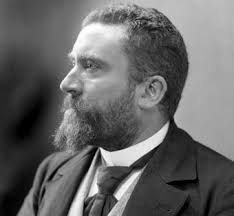
Open Sorel's interactive page (graphs of influences, similar and opposing positions, and quotes)
Background
Georges Sorel
Born: November 2, 1847 in Cherbourg, France
Died: August 29, 1922 (aged 74) Boulogne-sur-
Seine, France
Era: 20th-century philosophy
Region: Western Philosophy
Schools: Continental philosophy, Marxism,
Socialism, Anarchist schools of thought
Main interests: Philosophy of science, Political
philosophy, Syndicalism, Activism, Religion,
History, Economics, Ethics
Influences: Henri Bergson, Karl Marx, Pierre-
Joseph Proudhon, Friedrich Nietzsche,
Giambattista Vico, Benedetto Croce, Juan
Donoso Cortés, Aristotle, James, Enrest Renan,
Hippolyte Taine
Influenced: Antonio Gramsci, Carl Schmitt,
Benito Mussolini, Walter Benjamin, György
Lukács, Giovanni Gentile, Malaparte, Lenin
From Wikipedia
Sorel was a French social thinker, political theorist, historian, and later journalist. He has inspired theories and movements grouped under the name of Sorelianism. His social and political philosophy owed much to his reading of Proudhon, Karl Marx, Giambattista Vico, Henri Bergson... and later William James. His notion of the power of myth in collective agency inspired socialists, anar- chists, Marxists, and fascists. Together with his defense of violence, the power of myth is the con- tribution for which he is most often remembered.
Introductory Comments
Most of us learn early that myths are the stories people told before they knew better. Sorel thought this had things backward. A myth, as he understood it, was not a fairy tale to lull children to sleep but a battle cry to rouse adults. His prime example was the proletarian general strike: every worker downing tools at once, and the whole capitalist order collapsing like a tent with its pole yanked out. Would it actually happen that way? Sorel considered the question beside the point. A myth is judged not by whether it comes true but by whether it gathers a movement's scattered grievances into a single picture and moves people to act. Unlike a prediction that may prove false, a myth expresses and galvanizes a will.
Sorel made the same kind of argument about violence, but drew a careful line. The state and the bourgeoisie use force, the coercion that props up the rule of a minority. The proletariat, striking back, uses violence, which aims to break that rule rather than take it over. Sorel insisted that proletarian violence must not repeat the Terror of 1793, which he saw as the state's brutality wearing revolutionary clothes. Its value was above all moral. Violence kept class lines sharp. It blocked the cozy bargains through which reformist politicians bought off the workers. And it revived the heroic virtues that comfortable modern life had let wither. Sorel even hoped it might jolt a flabby bourgeoisie back into fighting trim, since a revolution needs an enemy worth overthrowing.
Some of Sorel's Key Positions
Workers' own unions, not parties, parliaments, or the state, must be the instruments of revolution and the seeds of the society to come. In that society, workers organized in their workplaces will run production themselves.
Class struggle is not an unfortunate phase to be negotiated away. It is the source of socialism's moral vigor, and the "social peace" bought through reform and compromise corrupts workers and bourgeoisie alike.
Marx's claims to scientific prediction have failed. Capitalism has not collapsed on schedule, and no iron law of history guarantees that it will. Economic forces matter, but they do not decide history alone.
Law, morality, religion, and ideology all shape events, and so do human will and the passions that set masses in motion. Grand systems that reduce this tangle to a single law are the illusions of intellectuals.
Myth and violence are among the forces that drive history. A myth, such as the proletarian general strike, is not a forecast to be tested. It is a cluster of images that gathers a movement's deepest feelings and drives it to act. A myth expresses will, not a belief about the future. Proletarian violence keeps class lines sharp, revives heroic virtues, and may even jolt a decadent bourgeoisie back to life.
Place in the History of Ideas
Sorel's Place in History of Ideas
Wilfried Rohrich: [Though Sorel was a revolu- tionary, he had a] deep-rooted hostility towards the French Republic and the ideology it was founded on.... Himself a member of the bourgeoisie, he detested his class, above all because he found it lacked the political energy and moral seriousness which it had once possessed. Sorel's criticism was directed against Liberalism and parliamentary democracy and he was never tired of reproaching the liberal enlightenment for having initiated the process of decay at the end of which there would be nothing but a void, unless some new faith replaced the old. One may see in this the true meaning of Sorel's attempt to secure for the myth of violence its due role in the dawn of a new age. And it was the latter which was the true concern of Georges Sorel, the "revolutionary conservative."
Arthur L. Greil: ... Sorel was best known for his condemnation of bourgeois society, his critical interpretations of Marxism, and his emphasis on the power of myth and direct action. While his concern for the moral decadence of European society and the prospects for moral renewal represent consistent themes in Sorel's work, many scholars have emphasized his shifting, sometimes inconsistent, political opinions. Some have claimed that Sorel's work was influential in the ideological development of both communism and fascism.
Random Thoughts on Sorel
For a man who spent half his working life in one of the most orderly professions, Sorel had a remarkably disorderly career as a thinker. After two decades as a state engineer building roads and bridges, he retired in his mid-forties to devote himself to ideas. His early writings were conservative. By the mid-1890s he was a Marxist. Soon he was reworking Marx into a creed of will and moral renewal. Next came revolutionary syndicalism, which made his name: workers should act directly through their unions rather than wait for parliament to toss them crumbs. Around 1910, disenchanted with the unions, he drifted toward the far-right, nationalist, and royalist political movement called Action Française. Then, in his last years, he defended Lenin's revolution in print. If friends' reports can be trusted, he also privately admired a rising ex-socialist named Mussolini.
Marxism, syndicalism, royalism, Bolshevism: it is tempting to call the whole thing a weathervane spinning in a gale. Yet a pattern appears. What Sorel hated stayed constant: bourgeois comfort, parliamentary horse-trading, modern decadence. What he most sought was a force capable of making people heroic again. He was less a weathervane than a talent scout, forever auditioning movements for the role of civilization's savior. Perhaps the best word, then, to describe Sorel is quixotic - not because he was impulsive, but because, like the knight of La Mancha, he kept seeing giants where others saw only windmills.
Influences
Sorel was influenced by: Aristotle, Bergson, Cortes, Juan D., Croce, James, Marx, Nietzsche, Proudhon, Renan, Ernest, Taine, H., Vico
Sorel influenced: Benjamin, Berth, Édouard, Camus, de Benoist, A., Evola, Gentile, Gramsci, Hitler, Lagardelle, H., Lenin, Lukács, Malaparte, Mussolini, Orano, Paolo, Schmitt
Similar and opposing positions
Thinkers with similar positions:
- Adorno (Cultural, not just economic, forces drive history & shape society.)
- Bataille (Violence & erotic excess can be liberating & sacramental experiences.)
- Benjamin (Though conceptually distinct, power & violence are often connected.)
- Cassirer (We should think of myths as useful or not, rather than true or false.)
- Evola (Social myths are powerful tools to mobilize a society for action.)
- Godwin (Government by its very nature counteracts creative & original thinking.)
- Goldman (Revolution is a violent process, but also at times a necessary one.)
- Marcel (Science & technology threaten to destroy the mystery of being.)
- Proudhon (All forms of absolutisms are evil: government, capitalism & religion.)
Thinkers with opposing positions:
- Bacon, Francis (We must pursue science to further our understanding of nature.)
- Cicero (Liberty is the power to do that which is permitted by law.)
- Gandhi (Nonviolence & forgiveness are greatly superior to violence & revenge.)
- Gramsci (Societies should be changed by overthrowing ideologies - not violence.)
- Horkheimer (Popular culture can itself be a form of insidious totalitarianism.)
- Rothbard (All services provided by govt. should be given to the private sector.)
- Saint-Simon (Society and economy can be perfected thru science and reason.)
What others said about Sorel
- Wyndham Lewis: Georges Sorel is the key to all contemporary political thought.
- Zeev Sternhell: [Sorel] preached hatred for the heritage of the eighteenth century, for Voltaire and Rousseau, for the French Revolution, for rationalism and optimism, for liberal democracy and bourgeois society.…
- Oswald Spengler: ... Socialists of higher quality and conservative ways of thinking, like Lassalle, supporter of monarchy, and Georges Sorel, who looked upon the defense of fatherland, family, and property as the noblest task of the proletariat are difficult to reconcile with Marx and are therefore never quoted according to their true intent.
- Mussolini: I owe most to Georges Sorel. This master of syndicalism by his rough theories of revolutionary tactics has contributed most to form the discipline, energy and power of the fascist cohorts.
- Eric Brandom: His was not a conservative revolution, but a revolution that would conserve.
- Aldous Huxley: Marx and Sorel have been influential in the modern world, not so much because they were best-sellers..., but because among their few readers were two men, called respectively Lenin and Mussolini.
- Berlin: Sorel was dominated by one "idée maîtresse": that man is a creator, fulfilled only when he creates, and not when he passively receives or drifts unresisting with the current…. He is, for Sorel, in the first place, a producer who expresses himself in and through his work, an innovator whose activity alters the materials provided by nature….
- Jacob Talmon: Sorel the Dreyfusard [defender of Alfred Dreyfus] eventually developed into a bitter anti-semite, calling upon Europe to defend itself against the Jewish peril in the same way as America fought the Yellow peril....
Schools: Anarchism, Continental Philosophy, Marxism, Socialism
Main interests: Economics, Ethics, History, Mythology, Political Activism, Political Philosophy, Politics, Religion, Science
Sorel's answers to philosophical questions
Economics
Both social peace and social justice require that workers' unions be given power over the economy.
Marx's theories of historical determinism don't hold up, because he saw only economic forces and ignored all other forces.
Education
I myself have been hurt by formal education: "For twenty years I strove to free myself from what I retained of my education."
History
History is shaped by the interplay of many forces - economic, cultural, legal, ideological, political - and by powerful leaders.
Great men, like Lenin and Mussolini, do indeed shape history, as we now so clearly in Russia and Italy.
Metaphysics
We're free not because we're exempt from deterministic laws, but because we're able to create causal sequences of our own.
Political Philosophy
"Proletarian violence, [when it is a] manifestation of... class struggle, appears thus as a very fine and heroic thing...."
Society
"Hate is able to provoke disorders [and] ruin a social organization…, but it produces nothing."