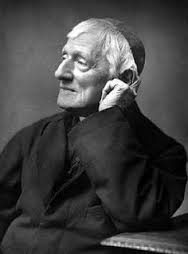
John Newman (1801 - 1890)
Open Newman's interactive page (graphs of influences, similar and opposing positions, and quotes)
Background
John Henry Newman
Born: 21 February 1801 in London, England
Died: 11 August 1890 (aged 89) in Edgbaston,
Birmingham, England
Alma mater: Trinity College, Oxford
Main interests: Faith and rationality, Religious
epistemology, Historical theology, Christian
apologetics, Philosophy of education
Influences: Aristotle, Plato, Socrates, Augustine,
Aquinas, Dante, Thomas More, Cicero, Locke,
Clement of Alexandria, Tertullian, Origen,
Athanasius, Basil of Caesarea, Hume, Burke,
Joseph Butler, Richard Whately
Influenced: M. Arnold, G.M. Hopkins, Pope
Francis, B. Lonergan, Pope Benedict XVI, Joyce,
L. Zagzebski, G.K. Chesterton, J.R.R. Tolkien,
C.S. Lewis, Hilaire Belloc, Wilde, Ronald Knox,
J. Pelikan, MacIntyre, Maurice Baring, Evelyn
Waugh, Graham Greene, Muriel Spark
From Wikipedia
Newman was an English Catholic theologian, academic, philosopher, historian, writer, and poet. He was previously an Anglican priest and after his conversion became a cardinal. He was an impor- tant and controversial figure in the religious history of England in the 19th century and was known nationally by the mid-1830s.... He was instrumental in the founding of the Catholic University of Ireland in 1854, which later became University College Dublin. Newman was also a literary figure….
Introductory Comments
Newman's religious journey was so winding that he ended up in a place that would have horrified him at the outset. As a teenager, he embraced a Calvinist form of Evangelical Christianity within the Church of England, emphasizing personal conversion, salvation, and moral accountability. He also became convinced that the Pope was the Antichrist. At Oxford, Newman gradually moved away from Calvinism - perhaps fire-and-brimstone sermons didn't pair well with tea and biscuits in the common room - and he drifted into mainstream Anglicanism, where he rose steadily through Anglican ranks until he became the most celebrated voice in Oxford's pulpits.
Newman's now believed that standard Anglicanism preserved the faith of the ancient Church while avoiding both Protestant departures and Roman additions. But then, in 1839, at the age of 38, Newman encountered an argument from Augustine in an article by the Catholic theologian Nicholas Wiseman. What struck him was the wider Church's judgment against groups that separated from it. Could Anglicanism claim to preserve the ancient faith while occupying a position uneasily similar to that of ancient schismatics? Finally he decided the answer was no. In 1845, at the age of 44, Newman entered the Roman Catholic Church, shocking much of the Anglican world. The religion he had once called "polytheistic, degrading, idolatrous" had become his spiritual home - and the Antichrist his Holy Father.
Some of Newman's Key Positions
The Church of England must recover its inheritance from the ancient Church - especially as regards to doctrine. The English Church held its authority through apostolic succession, not from Parliament, and only a church so constituted can transmit revealed truth with confidence.
Despite the evangelical and Calvinist emphasis on faith alone, a religion that rests on private feeling leaves doctrine at the mercy of individual sentiment. The believer becomes his own authority, and what he cannot feel he eventually cannot hold. Thus, the emphasis on faith alone leads not only to the doubts regarding revealed doctrine, but also, eventually, to unbelief.
[In 1845 Newman joined the Catholic Church. His later writing reflects this change in allegiance.]
Church doctrine develops as a living idea unfolds under pressure, but development can corrupt as well as mature. Telling the two apart requires a living authority - as found in the Catholic Church. However, authority has its limits: Conscience remains the ultimate Vicar of Christ, a voice no pope may override.
Nor should believers be mindless in their devotion. Knowledge and reason are not the enemies of revelation, and a university - even a Catholic one - must pursue intellectual culture with real latitude rather than under the shadow of censorship.
Place in the History of Ideas
Newman's Place in History of Ideas
Copleston: Newman's approach to philosoph- ical topics which he discussed was that of a Christian apologist. That is to say, he wrote from the point of view of a Christian believer who asks himself to what extent, and in what way, his faith can be shown to be reasonable. Newman made no pretense of temporarily discarding his faith, as it were, in order to give the impression of starting all over again from scratch.... [I]t was a question of faith seeking understanding of itself rather than of an unbelieving mind wondering whether there was any rational justification for making an act of faith.
Anthony Kenny: In the analytic tradition, which is dominant here and in much of the United States, the beginning of modern philosophy is often taken to be the writing, by Gottlob Frege, of an essay entitled Begriffschrift in 1879.... Ten years before Begriffschrift, in the Grammar of Assent, Newman had made many of the same distinctions which Frege was to make, some- times in the same terms, sometimes in different terms. Newman distinguished between the apprehension of a proposition and assent to a proposition, between the notional or logical content of a propositon and the realization of its content in the imagination. But whereas Frege disjoined logic from psychology in order to discard psychology, Newman disjoined the two in order to downgrade the logic.
Random Thoughts on Newman
Newman was not the first Englishman of letters to go over to Rome, but he was by far the most conspicuous, and after him the trickle became a procession: Hopkins, whom Newman received himself; Wilde, who left it to his deathbed; Beardsley, converting at 25 with a year to live; Chesterton; Waugh; Greene; Edith Sitwell; and a remarkable cluster of philosophers - Anscombe, Geach, Dummett, MacIntyre. Why? The step was no mere change of Sunday routine. Into the 1870s it could cost a man his college fellowship, and it reliably cost him something harder to name; Hopkins found himself estranged from his own family. Yet they kept coming.
The usual explanation is aesthetic: the tea-and-toast Protestantism of their upbringing left the soul parched, and Rome offered incense, mystery, drama, and an unembarrassed claim to authority. There is something in this. But it fits Wilde and Beardsley far better than it fits Anscombe, and it sits oddly with the England these converts were actually joining, where the Catholic Church was largely a poor immigrant church of Irish laborers meeting in plain brick chapels. Those who came for the splendor of Rome often arrived somewhere considerably shabbier. So perhaps the draw was not beauty but the paradox Chesterton named: Catholic doctrine and discipline may be walls, he wrote, but they are the walls of a playground. To wit: Without structure, spirituality soon dissipates. And without rules, playfulness has nowhere to go.
Influences
Newman was influenced by: Aquinas, Aristotle, Augustine, Burke, Butler, Joseph, Cicero, Dante, Hume, Locke, More, Origen, Plato, Tertullian
Newman influenced: Arnold, Belloc, H., Benedict XVI, Chesterton, Greene, G., Hopkins, G.M., Joyce, Lewis, C.S., MacIntyre, Pope Francis, Tolkein, Waugh, E., Wilde
Similar and opposing positions
Thinkers with similar positions:
- Averroes (Philosophy & revelation are different means of reaching same truth.)
- King (Man is not sufficient unto himself. We need God’s living Word & guidance.)
- MacIntyre (Society relies on narratives that give coherence & meaning to life.)
- Montaigne (A liberal education develops a capacity to think deeply & broadly)
- More (The Catholic Church should be reformed, not overthrown or destroyed.)
- Seneca (The best way to establish virtue is through a liberal education.)
- Tillich (Humanism today has too much faith in man & all too little faith in God.)
Thinkers with opposing positions:
- Calvin (Salvation is fated. God predestines both the saved & the damned.)
- Diderot (Even if God created laws of nature, he isn't now at work in nature.)
- Edwards (Emotion plays an important part in religion, especially in conversion.)
- Feuerbach (Our concept of God reflects our own traits and deepest wishes.)
- Franklin (The only religion that's at all defensible is pure and simple deism.)
- Goethe (One can be inwardly Christian w/o belonging to any Christian church.)
- Holbach (The foundation of morality is not in Scripture but in happiness.)
- Malebranche (The ideas through which we perceive objects exist in God.)
- Schleiermacher (Religion is above all & essentially an intuition & a feeling.)
What others said about Newman
- Kenny: The words of the young Newman are politer than those of the young Ayer a century later: but the attitude to metaphysics is not dissimilar.
- Fr. Stanley Jaki: ... when Newman explicitly speaks of univesals, he comes very close to denying any real content in them.... He has little use for general man.... For him universals are wholely subservient to indviduals things.
- Anthony Kenny: ... Wittgenstein turned in his last years to the traditional problems of epistemology, seen from a new perspective. His posthumously published "On Certainty" covers many of the same topics as [Newman's] "Grammar of Assent," uses many of the same illustrations, and draws some of the same conclusions.
- Juan R. Vélez: [Newman] may well earn a new title, that of "Doctor amicitiae": Doctor of the Church on Friendship. His biography is a treatise on the human and supernatural virtues that make up friendship.
- Fr. Ian Ker: Newman insists that his purpose is not metaphysical..., but is "of a practical character, such as that of Butler in his 'Analogy'...."
- Copleston: ... Newman... is more concerned with showing the reasonableness of faith as it actually exists in the great mass of believers, most of whom know nothing of abstract philosophical arguments.
- Wilfred Ward: [Newman had] an original force of character which refused to be moulded by circumstances, which was to make its own way, and become a power in the world; a clearness of intellectual perception, a disdain for conventionalities, a temper imperious and willful, but along with it a most attaching gentleness, sweetness, singleness of heart and purpose.
- Fr. Juan Velez: Today his philosophical approach would be described as phenomenology or more specifically Christian personalism with elements of Aristotelian philosophy of the human mind and ethics.
Schools: Aristotelianism, Augustinianism, Christian Theology, Empiricism, Fideism, Personalism
Main interests: Education, Faith, Literature, Religion, Theology, Virtue
Newman's answers to philosophical questions
Education
"There is a knowledge which is desirable, though nothing come of it, as being of itself a treasure...."
By helping students "to detect what is sophistical & to discard what is irrelevant," a university education creates good citizens.
"Liberal Education [helps develop] a cultivated intellect, a delicate taste, a candid, equitable, dispassionate mind...."
Epistemology
Though reason and knowledge can improve our lives in many ways, in religious matters reason requires the aid of grace.
Ethics
Though ethical systems can supply guiding principles, it will always be up to the individual to apply them in particular cases.
"Virtue is its own reward…, but if we cultivate it only for pleasure's sake..., [we] will never gain the pleasure [nor] the virtue."
Conscience is not merely a moral sense: it's an emotional experience. It recognizes our wrong & feels ashamed & frightened.
Friendship is an intimation of God's love - a foretaste of heaven and a glimpse of the perfect love that awaits us in God.
Metaphysics
Universals have little, if any, reality in themselves. If they exist at all, they are completely subservient to individual things.
Mind
We are more than our memories: "A great memory does not make a mind, any more than a dictionary is a piece of literature."
Nature
"I believe in design because I believe in God, not in a God because I see design."
“Evolution is not inconsistent with divine design - It is accidental to us, not to God.”
Unlike inferior animals, human beings begin with "nothing realized" and must progress gradually toward self-perfection.
"There is something so very dreadful in tormenting those who have never harmed us..., who are utterly in our power."
Political Philosophy
Even an unjust "war has its laws; there are things which may fairly be done, and things which may not be done."
Psychology
Have faith in God: "If I am in sorrow, my sorrow may serve Him. He does nothing in vain. He knows what He is about."
"Virtue is its own reward, & brings with it the truest... pleasure; but if we cultivate it only for pleasure's sake, we are selfish."
"There is no rule about what is happy & good; what suits one would not suit another…. Thus God leads us by strange ways…."
Religion and Theology
With religion "every event has a meaning; ... and the world [becomes a] complicated drama, with an [awe-inspiring] moral."
Conscience is in itself an indication of God's exitence, since it "impies that there is One to whom we are responsible...."
"I do not see much difference between [saying] there is no God, & implying that nothing definite can... be known about Him."
"Reason... is subservient to faith, as... explaining [and] defending the truths which faith, not reason, has gained for us...."
"Evil has no substance of its own, but is only the defect, excess, perversion, or corruption of that which has substance."
Religious "apprehension of the unseen is the only known principle capable of subduing moral evil... and organizing society...."
"As God rules the will, yet the will is free, - as He rules the course of the world, yet men conduct it.…"
"To take up the cross of Christ is no great action done once for all; it consists in the continual practice of small duties…."
"All Scripture has its difficulties; but let us not, on account of what is difficult, neglect what is clear" - as are many things in it.
Science
Science "brings before us phenomena, and it leaves us, if we will, to call them works of design, wisdom, or benevolence...."
"Science gives us the grounds... from which religious truths are to be inferred, but it does not set about inferring them...."
Society
The healing power of civility: "We should ever conduct ourselves towards our enemy as if he were one day to be our friend."