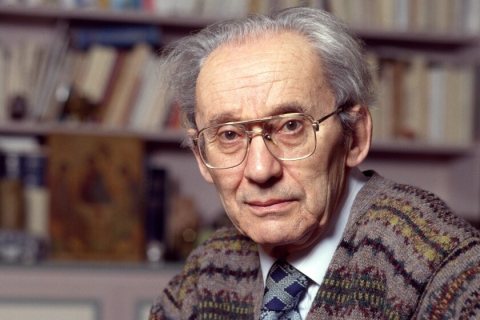
Ricoeur was a French philosopher best known for combining phenomenological description with hermeneutics. As such, his thought is within the same tradition as other major hermeneutic phenomenologists, Heidegger, Gadamer and Marcel. In 2000, he was awarded the Kyoto Prize in Arts and Philosophy for having "revolutionized the methods of hermeneutic phenomenology, expanding the study of textual interpretation to include... mythology, biblical exegesis, psycho- analysis, theory of metaphor, & narrative theory."
Introductory Comments
If "hermeneutic phenomenology" sounds like something a pretentious ass would say at a din- ner party, you're not alone. But it's simpler than it sounds: phenomenology is the study of how things show up in our experience, herme- neutics is the art and theory of interpretation, and together they mean that experience is nev- er raw - it always arrives ready to be read. Ri- coeur took this basic insight and gave it a dis- tinctive twist. Where Heidegger grounded inter- pretation in our sheer being-in-the-world and Gadamer saw it as the"fusion of horizons" be- tween reader and texts, Ricoeur took what you might call the scenic route. He argued that we can't access experience directly through intro- spection, but must pass through the "long de-tour" of language, symbols, myths, and texts.
This matters because Ricoeur's framework speaks directly to how we become who we are. His concept of narrative identity suggests that the self is not a fixed gem waiting to be excavat-ed but an ongoing story we are perpetually drafting and editing. As we encounter new texts, new experiences, and new others, we our- selves change. This has profound implications: it means that self-understanding is never purely introspective but always mediated through culture, language, and the stories we inherit and contest. And of course through other people: "We are always locked in a dialogue with others, even when we are alone."
Some of Ricoeur's Key Positions
The hermeneutical task - that is, interpretation guided by philosophical questions about being, knowing, language, and history - has focused, up until now, on textual analysis. However, it can also help in understanding nonliterary products, such as art, tradition, prejudice, mythology, and psychoanalysis.
Since hermeneutics tries to understand the link between the self and the symbol, its subject matter need not be limited to texts. Hermeneu- tical examination of texts may be particularly useful in bridging the gap between writer and reader, but the gap between self and other is an issue in several cultural forms.
And whenever the gap between self-meaning and other-meaning is bridged, we learn not only more about the other, but also, more importantly, more about ourselves. Individuals are largely the product of culture. Whenever we understand the nature, history, and inher- ent meaning of a cultural product - be it text or non-text - we at the same time learn how that cultural prodcut helped shaped us.
Religious discourse, for example, can take on many different forms: hymns, ritiuals, laws, stories, parables, prophecies, sayings. At heart, though, they are all forms of poetry. And they all shape not only our understanding of God, but also some part of who we are as individuals.
Place in the History of Ideas
Ricoeur's Place in History of Ideas
David Pellauer: A major theme that runs through Ricoeur’s writings is that of a philo- sophical anthropology. Ricoeur came to formu- late this as the idea of the "capable human being." With it he seeks to give an account of the fundamental capabilities and vulnerabilities that human beings display in the activities that make up their lives, and to show how these capabilities enable responsible human action and life together. Though the accent is always on the possibility of understanding human beings as agents responsible for their actions, Ricoeur consistently rejects any claim that the self is immediately transparent to itself or fully master of itself. Self-knowledge only comes through our understanding of our relation to the world and of our life with [others].
Rita Felski: The "hermeneutics of suspicion" is a phrase coined by Paul Ricoeur to capture a common spirit that pervades the writings of Marx, Freud, and Nietzsche. In spite of their obvious differences, he argued, these thinkers jointly constitute a "school of suspicion." That is to say, they share a commitment to unmasking "the lies and illusions of consciousness;" they are the architects of a distinctively modern style of interpretation that circumvents obvi- ous... meanings in order to draw out… less flat- tering truths. Ricoeur’s term has sustained an energetic after-life within religious studies, as well as in philosophy [and] intellectual history.
Random Thoughts on Ricoeur
One of Ricoeur's most enduring contributions is his distinction between two different postures we can adopt when interpreting a text, symbol, or tradition: the hermeneutics of faith and the hermeneutics of suspicion - a philosophical fork in the road that says a lot about your tempera- ment. The hermeneutics of faith is the generous approach: it trusts that meaning is genuinely being offered and that the interpreter's job is to receive restore it. Think of it as showing up to a conversation actually willing to be changed by what you hear - a radical act if there ever was one. It doesn't require naïveté, but rather disciplined humility to let a text or person speak before you start cross-examining it or him.
By contrast, the hermeneutics of suspicion -associated with thinkers like Marx, Nietzsche, and Freud - treats surface meanings as disguises, decoding texts as symptoms of deeper forces such as power, desire, or ideology. The suspi- cious reader treats meaning the way a detective treats an alibi. Yet Ricoeur's genius was in refus- ing to let us pick a side. He argued that mature understanding requires both postures - a "sec- ond naïveté" that passes through the fires of suspicion and emerges with a faith that is chas- tened but not destroyed. This not only allows symbols, stories, and traditions to speak again, but also ensures that while we aren't easily fooled, we also aren't left standing in a perfect-ly deconstructed, but completely empty, room.
Cassirer (Humans are symbolic animals. We comprehend with signs & symbols.)
Dilthey (Our understanding depends on past worldviews and interpretations.)
Gadamer (We inevitably think and speak as part of cultural traditions.)
Levi-Strauss (Culture is fundamentally a system of symbolic communication.)
Marcel (Human life is not self-enclosed. Relationships give birth to meaning.)
Mead (The mind and self emerge from the social process of communication.)
Nietzsche (Life is not self-enclosed. Relationships give birth to meaning.)
Schleiermacher (Human emotion & the imagination are as important as reason.)
Vico (Society relies on narratives that give coherence and meaning to life.)
Thinkers with opposing positions:
Aristotle (Man does not realize himself through emotions, but through reason.)
Ayer (Language that is not verifiable is not true or untrue but meaningless.)
Borges (Attempting to explain the self is a self-defeating quest for integration.)
Comte (All valid knowledge is scientific: Knowledge requires verification.)
Kant (Consciousness is self-constituting, not socio-historically determined.)
Peirce (The truth about an event or thing is the totality of its consequences.)
Schlick (Outside logic & math, the truth of statements must rest on evidence.)
What others said about Ricoeur
Margalit Fox: Dr. Ricoeur's work... ranged over an almost impossibly vast spectrum of human experience.
R. Josselson: Ricoeur distinguishes between two forms of hermeneutics: a hermeneutics of faith which aims to restore meaning to a text and a hermeneutics of suspicion which attempts to decode meanings that are disguised.
Dan Turello: Hermeneutics and phenomenology are two of the labels often associated with Ricoeur’s work.... [P]henomenology pertains to the study of the human experience of consciousness, whereas hermeneutics refers to the process by which we humans interpret all manner of symbolic expression…. Ricoeur was interested in the human experience in all its forms….
David Pellauer: Love is a way of responding… to the tragic dimension Ricoeur sees as inherent in all human action, which never fully achieves what it intends, another reminder that human freedom is always a finite freedom.
Kim Atkins: The theme of redemption runs right through Ricoeur’s work, and no doubt it has a religious origin.
Bernard Dauenhauer: His late writings also reflect a more direct concern for making sense of selfhood and personal identity as something that goes beyond the epistemological subject….
Anne Hunt Overzee: Paul Ricoeur speaks of the theologian as a hermeneut, whose task is to interpret the multivalent, rich metaphors arising from the symbolic bases of tradition so that the symbols may "speak" once again to our existential situation.
Kim Atkins: [Ricoeur believed that the] narrative coherence of one’s life can be lost, and with that loss comes the inability to regard oneself as the worthy subject of a good life; in other words, the loss of self-esteem.