John Calvin (1509 - 1564)
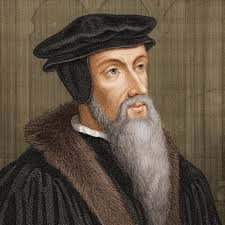
Open Calvin's interactive page (graphs of influences, similar and opposing positions, and quotes)
Background
John Calvin
Born: 10 July 1509 in Noyon, Picardy, France
Died: 27 May 1564 (aged 54) in Geneva,
Switzerland
Education: Collège de la Marche (fr), University
of Paris, Univ. of Orléans, Univ. of Bourges
Occupation: Pastor, author, theologian
Notable work: Institutes of the Christian Religion
Tradition or movement: Reformed, Calvinist
Main interests: Theology, religion, politics
Influences: Jesus, Augustine, Erasmus, Martin
Luther, Huldrych Zwingli, Martin Bucer, William
Farel, Johannes Oecolampadius
Influenced: Jonathan Edwards, John Knox,
Heinrich Bullinger, Theodore Beza, Francis
Turretin, Charles Hodge, Whitefield, Jan Łaski,
John Cotton, John Robinson, William Brewster,
William Bradford, John Winthrop, Roger
Williams
From Wikipedia
Calvin was a French theologian, pastor and re-former in Geneva during the Protestant Reforma-tion. He was a principal figure in the development of the system of Christian theology later called Calvinism, including its doctrines of predestination and of God's absolute sovereignty in the salvation of the human soul from death and eternal damna-tion. Calvinist doctrines were influenced by and elaborated upon the Augustinian and other Chris-tian traditions…. Calvin was a tireless polemicist… who generated much controversy.
Introductory Comments
In the oft-told story of Calvin and Servetus, the two men could hardly be more different. As the tale usually goes, Servetus is the enlightened champion of the new Humanism and the sciences, while Calvin is the tyrant of Geneva, a man who set himself up as God's spokesman and, when needed, His executioner - witness his burning of Servetus alive at the stake, simply for holding "heretical" beliefs. In fact, though, things were not quite so black-and-white.
Both men were serious thinkers, eager to argue. Servetus sent Calvin drafts and letters bristling with challenges to his theology, later built into his book Christianismi Restitutio, and Calvin answered with counterarguments as rigorous as they were unyielding. The temperature rose quickly, and by 1546 Calvin had written that if Servetus came to Geneva, he would not allow him to leave alive. Yet when Servetus fled Catholic authorities in France, who had already condemned him to death for heresy, Geneva was exactly where he went - perhaps to confront Calvin in person. Predictably, he was arrested. But then Calvin, a cautious man, asked the leading churches of four other Swiss cities what to do. Their answer: kill the damned heretic. And so Calvin did - though he reportedly urged that Servetus be spared the flames for a swifter death by the sword, only to be overruled by his council. So, is this really a story of good versus evil? Or is it a story of two stubborn men - one of who did not when to back off?
Some of Calvin's Key Positions
Rome has fallen into grave corruption and doctrinal error, but the task our now is not to invent a new church. Rather, we muxt restore the true one - to reform worship and doctrine according to the pure standard of Scripture.
Church and civil government are distinct spheres, each ordained by God for its own ends, and neither should be swallowed by the other. Yet the two must work in close concert, and in a rightly ordered Christian community the ministry will carry real weight in public life, above all where matters of morality and discipline are at stake.
So the clergy must press the magistrate to restrain worldly amusements - theater, dancing, and the like - lest they corrupt public morals and erode the spiritual life of the community.
But avoiding libertine excess is not enough. Each believer must search Scripture to know God: what He commands, what sins offend Him, and how Christ's death redeems us from them. Scripture is the sole and sufficient foundation of the Christian life and the final measure of all doctrine.
But salvation rests wholly in God's hands; from eternity He has chosen some for grace and passed over the rest. True, we are justified by faith alone - yet even that faith is God's gift, not our achievement. We cannot earn our redemption, nor avert a damnation that God has ordained.
Place in the History of Ideas
Calvin's Place in History of Ideas
Russell: Luther and Calvin reverted to Saint Augustine, retaining, however, only that part of his teaching which deals with the relation of the soul to God, not the part which is con- cerned with the Church. Their theology was such as to diminish the power of the Church. They abolished purgatory, from which the souls of the dead could be delivered by masses. They rejected the doctrine of Indulgences, upon which a large part of the papal revenue de- pended. By the doctrine of predestination, the fate of the soul after death was made wholly independent of the actions of priests. These innovations, while they helped in the struggle with the Pope, prevented the Protestant Churches from becoming as powerful... as the Catholic Church....
Leslie P. Spelman: [Calvin's] was a keen, pene- trating mind, sharpened by legalistic training, which had never gone through the torment of doubt that so affected Luther. Calvin based every thought on the scriptures. He did not speak for himself, but was only the interpreter of the Scriptures. On the one hand this made him very humble, but on the other since he was admittedly the most astute theologian of his day, he could not conceive of anyone doubting the truth and the authority of his interpreta- tions. Little did he realize that he was attempt- ing to set up a new form of religious tyranny, and in many respects succeeding.
Random Thoughts on Calvin
Both Luther and Calvin held to predestination, but they held it rather differently. Luther's version has been called single predestination, though "merciful predestination" would do just as well. The logic runs like this: Given God's absolute sovereignty, and given our inherited sinfulness (thank you, Adam), nobody deserves salvation. Yet God's love overflows, and out of that love He predestines some of us to be saved. Why those particular some? We don't know. But at least we know that salvation rests entirely on God's mercy.
Calvin's version is less soothing. It has been called double predestination, though we might rename it semi-merciless predestination - or, for those who drink from half-full cups, semi-merciful. Here God elects some individuals for salvation, out of mercy, but also condemns others to eternal damnation, out of justice. Worse, we can never be sure which lot is ours. Our faith may be tainted with self-interest, and so may our so-called good works. And even where faith and works are genuine, we sinners can't be certain that God has forgiven us. Calvin's predestination, then, is not a doctrine you can rest in - it is one you squirm under.
This restless, anxious energy is what led Weber to argue that Calvinism helped fuel the rise of eaarly capitalism: unable to know their fate, the faithful threw themselves into disciplined, profitable labor - treating worldly success as a sign of grace they could point to, if never quite cash in.
Influences
Calvin was influenced by: Augustine, Bucer, Martin, Cop, Nicolas, Erasmus, Farel, William, Jesus, Luther, Melanchthon, Paul of Tarsus, Savonarola, Seneca, Zwingli
Calvin influenced: Barth, Beza, T., Bradford, W., Cotton, John, Edwards, Hodge, Charles, Hooker, Knox, John, Laski, Jan, Plantinga, Robinson, J., Whitefield, Williams, R., Winthrop, J.
Similar and opposing positions
Thinkers with similar positions:
- Augustine (Salvation is fated. God predestines both the saved & the damned.)
- Erasmus (True piety consists not in outward ceremonies but inward conversion)
- Jefferson (There should be a wall of separation between Church and State.)
- Jesus (People must repent their sins and devote themselves completely to God.)
- Kierkegaard (Belief in God cannot be based on reason. Faith requires a leap.)
- King (Man is not sufficient unto himself. We need God’s living Word & guidance.)
- Luther (Given God's sovereignty & our own sinfulness, there is no free will.)
- Paul of Tarsus (Our faith must focus on the centrality of Christ as Redeemer.)
Thinkers with opposing positions:
- Adler (We need to overcome our feeelings of inferiority.)
- Bentham (Greatest happiness of greatest number determines right & wrong.)
- Descartes (God's existence is inferable from the mere idea of a Perfect Being.)
- Feuerbach (God is for us the outward projection of a human's inward nature.)
- More (The Catholic Church should be reformed, not overthrown or destroyed.)
- Plantinga (Our free will is compatible with an omnipotent & omniscient God.)
- Savonarola (Church officials should play a role in the administration of the state.)
- Spinoza (God is not transcendent. Everything in Nature is part of God.)
What others said about Calvin
- Cardinal Richelieu: Had Luther and Calvin been confined before they had begun to dogmatize, the states would have been spared many troubles.
- Weber: [Calvin's ascetism led to the useful] "man of a vocation," who neither inquires about nor finds it necessary to inquire about the meaning of his... vocation within [a world] which is not his responsibility but his god's.
- Cassirer: Calvin had appealed to this axiom [that the law derives from God and for a reason which is impenetrable to humans] to show that all law is in the last analysis rooted in divine omnipotence, and that the latter is absolutely unconditional and subject to no limiting rules and norms.
- Horkheimer: Calvin's theocentric irrationalism eventually revealed itself as the cunning [tool of economic and] technocratic reason which had to shape its human material.
- Will Durant: It is remarkable, how much of Roman Catholic tradition and theory survived in Calvin's theology.
- Leslie P. Spelman: Calvin was completely ignorant of any approach to truth except by the way of logic and cold reason. There was nothing of the mystic about him as there was in Luther.
- Voltaire: If [Calvin, Luther and Zwingli] condemned celibacy in the priests, and opened the gates of the convents, it was only to turn all society into a convent. Shows and entertainments were expressly forbidden by their religion; and for more than two hundred years there was not a single musical instrument allowed in the city of Geneva.
- Jae Jerkins: For Calvin, both the Pope and Muhammad seduced potential Protestant Christians away from the true path through false teachings and idolatrous practices.
Schools: Augustinianism, Christian Theology, Deontological Ethics, Determinism
Main interests: Equality, Faith, Fate, Free/Unfree Will, Immortality, Jurisprudence, Politics, Religion, Salvation, Spirituality, Theology
Calvin's answers to philosophical questions
Art and Aesthetics
Music can be a powerful support in church services, particularly hymns that accompany scriptural readings.
Epistemology
We have been given a divine sense or intuition that convinces us that the gospels are absolutely true.
Ethics
"True wisdom consists in two things: Knowledge of God and Knowledge of Self."
Conscience is the inner recognition of our duty to God and to His eternal laws and commandments.
Incontenence blinds us to our own spiritual well-being. It prevents us from seeing an evil in ourselves that in others we see.
Law
God's laws preexist and override human laws. They serve as a kind of mirror in that they reveal to us our many sins.
"The law of God, which we call the moral law, must alone be the scope, and rule, and end, of all laws."
Nature
"There is not one blade of grass, there is no color in this world that is not intended to make us rejoice."
The mind of man "conceives, desires, and undertakes every thing that is impious, perverse, base, impure, and flagitious...."
Political Philosophy
The best form of government combines democracy and aristocracy and includes a system of checks and balances.
In a Christian community, church and state should be separate. However, clerics naturally have political influence.
Economic success is a visible sign of God's grace. We should respect God's decision in this and all other matters.
Psychology
The human will is an intellectual appetite. It is constrained only by the power of our reasoning and understanding.
"Man's mind is [full] of idolatry & superstition; so much so that [he's prone to] forsake God for some idol in his own brain."
"He who has learned to look to God in everything he does is at the same time diverted from all vain thoughts."
"While all men seek after happiness, scarcely one in a hundred looks for it from God."
Religion and Theology
As an institution, religion requires a strict & well organized church government in order to maintain religious discipline.
"Faith is like an empty, open hand stretched out towards God, with nothing to offer and everything to receive."
The awareness of God is imbued in the heart of every man, even the ignorant heathen's. Proof here is not needed.
Though our awareness of God is innate, further knowledge of God requires careful and repeated study of Scripture.
"Is it faith to understand nothing, and merely submit your convictions implicitly to the Church?"
God "sustains the universe, as he once made it, by his infinite power, governs it by his wisdom, preserves it by his goodness."
God's foreknowledge is part of His omnipotence and is linked to both His predetermination and our lack of free will.
Two sacraments are valid under our new covenant with God: Baptism and the Lord's Supper. Both entail the Holy Spirit.
God has predetermined whether or not we will be saved. We are powerless to change our eternal fate.
Christ is a prophet, priest, king, and, most importantly, the only possible bridge between God and men.
"Scripture is like a pair of spectacles which dispels the darkness and gives us a clear view of God."