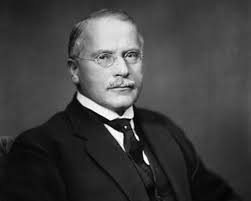
Jung was a Swiss psychiatrist, psychotherapist, and psychologist who founded the school of analytical psychology. A prolific author of over twenty books..., Jung was a complex and convoluted academic, best known for his concept of arche- types. Alongside contemporaries Sigmund Freud and Alfred Adler, Jung became one of the most influential psychologists of the early 20th century and has fostered not only scholarship, but also popular interest. Jung's work has [also influenced] literature, philosophy... and religious studies.
Introductory Comments
Jung’s idea of a collective unconscious grew from a curious brew of private experience and wide reading. There was the lonely, brooding childhood, crowded with vivid dreams, that first drew him to the inner life. There was his doctoral dissertation on "so-called occult phenomena," built on séances held by a teenage cousin who claimed to channel spirits. There were his years among psychotic patients at Zurich’s Burghölzli asylum, whose delusions sometimes seemed to echo ancient myths they could hardly have known. There was the intense, ultimately fractious alliance with Freud, who strengthened Jung’s conviction that dreams carry meaning. And there was a lifelong appetite for mythology, religion, archaeology, and alchemy. Together these persuaded Jung that beneath the thin crust of personal memory lies a vast collective memory shaped by countless generations of human experience.
This collective unconscious was, for Jung, humanity’s shared dream life. It explained, he believed, why people in different cultures dream similar dreams, fear similar shadows, and worship similar gods. It explained why the hero who descends into darkness and returns transformed turns up in myths from Iceland to Indonesia, and why we sometimes feel we are acting out scripts written long before we were born. But is any of this possible? Or is the collective unconscious itself one more myth - a modern one, told by a man who loved myths? (See Random Thoughts.)
Some of Jung's Key Positions
Psychotherapy aims at individuation, the lifelong process of becoming whole by integrating the conscious and unconscious sides of the psyche into a unified Self. Two obstacles stand in the way. The persona, the mask worn for social life, is necessary but becomes dangerous when mistaken for the face. The shadow, the side of the personality the ego refuses to own, cannot be banished, only recognized and integrated. Denied, it gets projected onto others.
Collectives, too, can go mad, as twentieth-century Europe showed. The best defense against such psychic contagion is the individual who has come to terms with his or her own unconscious.
Beneath the personal unconscious, the store of forgotten and repressed experience, lies a collective unconscious shared by all humanity. It is inherited not as images or ideas but as predispositions to perceive and respond in characteristic patterns, much as instincts shape behavior.
These patterns are the archetypes. They are empty forms that take shape in images recurring across cultures and centuries: the hero, the Great Mother, the wise old man, the trickster. They surface in dreams, myths, fairy tales, religious symbols, and alchemical texts. Their recurrence among peoples who never met attests to a common psychic inheritance.
Place in the History of Ideas
Jung's Place in History of Ideas
Mumford: Whereas Freud was for the most part concerned with the morbid effects of uncon- scious repression, Jung was more interested in the manifestations of unconscious expression, first in the dream and eventually in all the more orderly products of religion and art and morals.
Morton Kelsey: It is... Jung's finding that men who try to live without contact with the unconscious and its symbolic and mythological meaning often fall sick both psychologically and physically.... Until Jung could help them find contact with their unconscious roots, from which the rational materialism of today had cut them off, they could not get well.... [T]he real business of religion, as Jung maintained, is to keep men in touch with this level of reality, and this is done largely through the use of myths.
Gary Valentine Lachman: The importance of Jung's discovery bears considering. Since the seventeenth century, we've been taught that what is "in our heads" is only "subjective," that we are all island universes, separate worlds, and that everything in those worlds has been fur- nished with material taken from outside, from the senses, as if our minds began as empty rooms, waiting for the mental equivalent of a trip to Ikea. Yet anyone, like myself, who has had precognitive dreams or experienced syn- chronicities or telepathy or other "paranormal" phenomena knows this isn't quite true.
Random Thoughts on Jung
The phrase "collective unconscious" is something of a double paradox. Unconscious thoughts are odd enough. How can we think something without knowing we’re thinking it? Still, Freud had already made the idea respectable, or at least fashionable. Jung goes further, asking us to imagine an unconscious that is neither personal nor acquired - something simply waiting for us at birth. The obvious objection is that myths and symbols can’t be inherited. Instincts, yes; the hero and the Great Mother, surely not. But Jung saw this one coming. What we inherit, he insisted, are not images but tendencies to form them. Archetypes are to the imagination what instincts are to behavior.
Fair enough. But the more modest the claim, the less mysterious it becomes. If all we inherit is a disposition, a simpler story lies close at hand. We all run roughly the same neural hardware, shaped by millions of years of evolution. We all face the same great occasions: birth, childhood, love, failure, death. Add the fact that good stories travel, and it would be strange if certain patterns did not recur. Jung, however, rarely stayed modest for long. In later years he suggested that archetypes were not merely inherited patterns of the mind but might reach into the structure of reality itself. Having started out digging beneath the personal mind, Jung kept on digging - until he seemed to be excavating the universe itself. It is an admirable ambition. Whether a shovel made for dreams can dig that deep is another question.
Jung influenced: Bowie, David, Campbell, Fellini, Hesse, Hillman, J., LeGuin, Ursula, Lucas, George, Neumann, E., Nichols, R., Pauli, W., Watts, Alan, Wilson, W.G.
Similar and opposing positions
Thinkers with similar positions:
Bourdieu (Social, cultural, & symbolic capital are also at work in our world.)
Cassirer (Humans are symbolic animals. We comprehend with signs & symbols.)
Durkheim (Collective consciousness produces a society & holds it together.)
Emerson (The human self is always becoming, always partially in the future.)
Fromm (Freud overstated role of sexual impulses and motives in psychology.)
Kafka (Dark and repressed aspects of our ourselves must occasionally surface.)
Lacan (Symbols shape both our psychology and our culture.)
Levi-Strauss (Social structures spring in large part from symbolic structures.)
Sorel (Social myths are powerful tools to mobilize a society for action.)
Thinkers with opposing positions:
Adler (The personal, not collective, unconscious is most determinant.)
Borges (Attempting to explain the self is a self-defeating quest for integration.)
Brentano (There is no such thing as an unconscious mental act.)
Freud (The social realm plays a minimal role in shaping human psychology.)
Gentile (The state is the source of all authority and the object of all loyalty.)
Skinner (Behavior is a matter of stimuli & responses, not psyche or inner states.)
Smith, Adam (Humans are consistently rational & narrowly self-interested.)
What others said about Jung
James Hollis: Jung observed that everyone has a pathological secret, something so scary, so shameful..., that one will protect it at nearly any cost.
Christopher Bryant: Jung was very conscious of the mysteriousness of the human personality and the difficulty of penetrating the outward appearance and discovering the real individual.
Morton Kelsey: According to Jung dreams have many functions for the individual. They first of all compensate for the one-sided conscious attitude of the individual.... [They] tend to balance a person's conscious, outer life. They also reveal those things of which the individual wishes to remain unaware, confronting him with desires he has not faced up to.
Colin Wilson: Jung fiercely resented the [claim] that he was a hypocritical, self-seeking Judas.... Yet there was just enough truth in it to strike home. He was undoubtedly a man who liked his own way, no matter what the cost to others.
Megan McCafferty: According to Jung, synchronicity is an unpredictable moment of meaningful coincidence.
Morton Kelsey: [Acccording to Jung, dreams also] give intimations of meaning and reality which the individual has not yet touched, and they can even give directions for achieving this meaning and reality.
F. David Peat: Feeling, for Jung, is what assesses the inherent value of things.... If thought is not balanced by feeling, then it can become obsessive and one-tracked, giving no attention to the overall meaning of what one is doing. Conversely, if feeling is not tempered by thought, then we are in danger of rushing into events... without making proper plans....
Anthony Storr: [Jung's] variety of analysis is not simply concerned with the relief of neurotic symptoms; it promises a secular form of salvation. Jung was a spiritual teacher as well as a physician.
Schools: Essentialism, Historicism, Mysticism
Main interests: Astrology, Communication, Consciousness, Dreams, Eroticism, Health, Human Will, Literature, Metaphors, Mind, Mythology, Perception, Personal Identity, Power, Psychoanalysis, Psychology, Religion, Salvation, Semiotics, Sexuality, Social Philosophy, Time, Will, Wisdom