Protagoras (c. 490 BC - c. 420 BC)
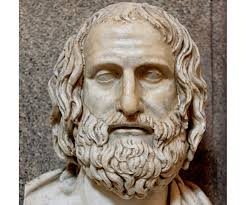
Open Protagoras's interactive page (graphs of influences, similar and opposing positions, and quotes)
Background
Protagoras
Born: c. 490 BC in Abdera, on coast of Thrace
(now part of Greeece)
Died: c 420 BC (aged around 70)
Era: Pre-Socratic philosophy
Region: Western philosophy
School: Sophistic Movement
Notable ideas: 'Sophist' as teacher for hire,
'Man is the measure of all things'
Main Interests: Language, semantics, relativism,
rhetoric, agnosticism, ethics, politics
Influences: Democritus, Parmenides, Zeno of
Elea, Anaxagoras
Influenced: Socrates, Plato, Jeremy Bentham,
Friedrich Nietzsche, F.C.S. Schiller
From Wikipedia
In his dialogue "Protagoras," Plato credits him with inventing the role of the professional sophist. Protagoras also is believed to have created a major controversy during ancient times through his statement that, "Man is the measure of all things," interpreted (possibly wrongly, since he disagreed) by Plato to mean that there is no objective truth; Protagoras seems to have meant that each person's own personal history, experiences and expectations... determine their judgments, opinions, and statements regarding "truth."
Introductory Comments
Protagoras made his living in ancient Athens as a sophist - a paid teacher of well-heeled young men. Plato ridiculed the sophists for peddling "wisdom" for money, though that was an easy charge for the wealthy Plato to level. Still, Plato was probably right that the sophists' emphasis on rhetoric, especially in politics and law, nudged many of them toward relativism. After all, the goal of rhetoric is not to discover whether a position is true or sound, but to win others over to it, true or not. Push that logic far enough and truth will come to seem irrelevant - or worse, nonexistant. And when that happens, things begin to fall apart. For then, as Yeats warned: "The best lack all conviction, while the worst are full of passionate intensity."
But at this point one imagines Protagoras rising indignantly from his grave: "The engine that keeps democracy running - yes, erratically at times - is debate. (Read what your man Habermas says on the public sphere.) The machine that keeps the courts moving - yes, too slowly - is advocacy. In teaching rhetoric, I was preparing young men to play their part in the public arena, not to advance their own interests but to serve the common good. As for objective, capital-T Truth in moral and political matters - whether it exists or not, we haven't found it yet. And we can't put democracy and justice on hold until we do. (And read Mill and Arendt, too, before bothering me again.)"
Some of Protagoras's Key Positions
"Man is the measure of all things." In moral and political matters, at least, no absolute truths have come to light. The only truth we can rely on is our own individual truth, and what is true for one person here need not be true for another. This holds across the board - from small local disputes to large social problems to entire worldviews.
This does not mean, however, that all views are equally good. Some beliefs produce better results than others - healthier cities, juster laws, more flourishing lives - and it is the sophist's job to help students tell the difference. Teaching virtue is not a matter of handing down eternal truths; it was a matter of cultivating the practical wisdom to recognize which views work and which do not.
Practical life also requires us, at times, to win others over to our own truth. This is why rhetoric - the art of persuasion - is so valuable. Rhetoric is not mere trickery but a genuine civic skill, essential in the courts, the assembly, and the marketplace. In law, politics, and business, rhetorical skill is indispensable.
On some questions, though, agnosticism is the wiser course. About the gods, for instance, we can know little: the subject is obscure, and life is short. On such matters it is best to remain intellectually humble - and silent.
Place in the History of Ideas
Protagoras's Place in History of Ideas
Johann Erdmann: In short, Protagoras maintains that every assertion may be opposed by its direct opposite with an equal amount of truth, since one thing is true for one man, another thing for another, and existence as such is not found anywhere at all. This subjectivism is adequately formulated in the dictum, that every individual man is the measure of all things. This means, on the theoretical side, that what is true to me, is true; on the practical, that what is good for me, is good. Thus probability takes the place of truth, and utility that of goodness.
C. M. Gillespie: The dictum of Protagoras, "Man is the measure of all things," was, according to Mr. Schiller, the first statement of the fundamental principle of Pragmatism, or as he prefers to call it, Humanism. No one has ever doubted that Protagoras was a humanist in the older sense of the word: he was a sophist, and insisted perhaps more emphatically than any of his colleagues that the true aim of education is not the acquisition of learning but the training of the citizen. But Mr. Schiller asks us to believe that the greatness of Protagoras lay in his epistemology.... [Unlike the other philosophers of his time, Protagoras made] utility..., and not correspondence with an independent archetype, the test of [a claim's] validity. Truth is essentially a value. Protagoras' theory of reality was not, as is commonly supposed, relativist, but pragmatist.
Random Thoughts on Protagoras
Consider how many ways one can read Protagoras's claim "man is the measure of all things":
- The cocky reading: Our values and moral beliefs occupy a privileged place in the cosmos.
- The humble reading: Our values and moral beliefs are not mandates from heaven, but merely our earthly take on things.
- The existential reading: Since the universe has no inherent meaning, it falls to us to supply it.
- The relativist reading: moral truths vary from person to person or culture to culture.
- The objectivist reading: Our moral beliefs are objective facts - not about the world, but about who we are as a species.
- The pragmatic reading: Whatever truth turns out to be, we sometimes need to bring others around to our version of it.
So which reading did Protagoras himself intend? Probably at least three of the above, operating in uneasy combination: The relativist one, clearly: he held that each of us carries his or her own set of truths. Yet, like all sophists, he also stressed the pragmatic importance of persuading others to accept our version of the truth. And to pull that off, he leaned - contradictorily enough? - on something like the objectivist reading: objective not in the sense that human arguments can be objectively true, but that it is an objective fact about our species that we share certain intuitions - else our arguments would not resonate with others.
Influences
Protagoras was influenced by: Anaxagoras, Democritus, Parmenides, Zeno of Elea
Protagoras influenced: Bentham, Margolis, J., Nietzsche, Plato, Schiller, Socrates
Similar and opposing positions
Thinkers with similar positions:
- Derrida (Truth is relative and contextual - not objective and autonomous.)
- Hamann (Faith and belief, rather than knowledge, determine human actions.)
- Huxley (The most rational approach to religious belief is an agnostic one.)
- James (Truth is merely that which works or proves useful in our endeavors.)
- Kierkegaard (Philosophy must embrace subjectivity as an essential resource.)
- Rorty (The philosophic search for some objective basis of truth is fruitless.)
- Schlegel (There are no first principles that can guide us to the truth.)
- Sextus Empiri. (Since perceptions disagree, knowledge is not possible.)
- Vaihinger (If beliefs are useful, we should accept them as if they were true.)
Thinkers with opposing positions:
- Ayer (Language that is not verifiable is not true or untrue but meaningless.)
- Frege (Logic is the appropriate measure of what can or cannot be.)
- Habermas (We must not give up on Enlightenment ideals of reason & science.)
- Nussbaum (Truth exists and reason is our best tool for finding it.)
- Popper (The search for truth should be completely fact-based and objective.)
- Santayana (Judgments are true if & only if they faithfully reproduce existence.)
- Schiller (Utility is the great idol of the age, to which all demean themselves.)
What others said about Protagoras
- Plato: … if virtue were other than knowledge, as Protagoras attempted to prove, then clearly virtue cannot be taught, [though Protagoras claims it can].
- Strauss: The Sophist, [unlike] the philosopher, is not set in motion and kept in motion by the sting of the awareness of the fundamental difference between conviction or belief and genuine insight.
- F. C. S. Schiller: [Regarding the battle between the Platonic "Socrates" and Protagoras as to the nature of truth,] the appeal to the future leads to a triumphant vindication of [Protagoras'] Humanist interpretation. For how does the future decide between two rival theories of truth? By the value of the consequences to which they severally lead.
- Goethe: We may watch nature, measure her, reckon her, weigh her, etc. as we will. It is yet but our measure and weight, since man is the measure of all things.
- Schlegel: Whoever does not philosophize for the sake of philosophy, but rather uses philosophy as a means, is a Sophist.
- Russell: The disbelief in objective truth makes the majority, for practical purposes, the arbiters as to what to believe. Hence Protagoras was led to a defence of law and convention and traditional morality.
- Plato: [Protagoras] says, doesn't he, that what is believed by each person is so for him who believes it?...Well, gratifying as it is to be told that what each of us believes is true, I am surprised that he does not begin his Truth by saying that of all things the measure is the pig, or the dog-faced baboon.
- A. Kenny: Protagoras is sometimes described as a skeptic. In one way this is an odd description. A skeptic is someone who thinks the discovery of truth is difficult…. For Protagoras it is all too easy: [just] frame a belief and… it is true.
Schools: Agnosticism, Pre-Socratic Philosophy, Skepticism
Main interests: Ethics, Justice, Language, Perception, Politics, Rhetoric, Semantics, Virtue
Protagoras's answers to philosophical questions
Epistemology
Perceptions are forever changing. Therefore, they reveal no immutable or universal truth.
Regarding moral and political matters, we have yet to find absolute truth. The only truth we have is our own personal truth.
Though everyone's truths differ, some truths have beneficial consequences, while other truths can be quite harmful.
Ethics
We haven't yet discovered any objective moral truths. Yet, it's an objective fact that we as a species share many moral beliefs.
Though ethical views are subjective, virtue springs from learning which views lead to good results and which do not.
"[Nobody] willingly does base & evil deeds; [everyone is] well aware that all who do base & evil things do them unwillingly."
We are the only yardstick for determining what is good and bad, valuable and worthless: "Man is the measure of all things."
Political Philosophy
Democracy is culmination of the Greek political tradition in that it best enables the views of all to be heard and considered.
Religion and Theology
Since we have little ability to know whether or not the gods exist, it is best to remain silent on the subject.
Society
To thrive, a society requires public discourse, for only by hearing and considering a wide array of views can a society progress.