Milton Friedman (1912 - 2006)
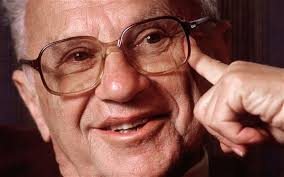
Open Friedman's interactive page (graphs of influences, similar and opposing positions, and quotes)
Background
Milton Friedman
Born: July 31, 1912 in Brooklyn, New York, U.S.
Died: November 16, 2006 (aged 94) in San
Francisco, California, U.S.
School or tradition: Chicago School of
Economics
Main interests: Economics
Influences: Keynes, Adam Smith, Mises, Joseph
Schumpeter, Alfred Marshall, Mill, Irving Fisher,
Thomas Paine, Frank Knight, Knut Wicksell,
Simon Kuznets, Popper, Henry Hazlitt, Jacob
Viner, Harold Hotelling, Arthur F. Burns, Hayek,
Henry George, Homer Jones, Rose Friedman
Influenced: Thomas Sowell, Rothbard, Gary
Becker, Robert Lucas Jr., George Stigler, Anna
Schwartz, Harry Markowitz, Walter E. Williams,
Walter Block, Myron Scholes, J. Bradford
DeLong, John B. Taylor, Andrei Shleifer, Niall
Ferguson, William Easterly, Robert Nozick
From Wikipedia
With George Stigler and others, Friedman was among the intellectual leaders of the Chicago school of economics, a neoclassical school of economic thought associated with the work of the faculty at the University of Chicago that rejected Keynesianism in favor of monetarism until the mid-1970s, when it turned to new classical macroeconomics heavily based on the concept of rational expectations…. His ideas concerning monetary policy, taxation, privatization, and deregulation influenced government policies....
Introductory Comments
Keynes begins from a simple but unsettling ob- servation: markets do not reliably heal them- selves, at least not on any humane timetable. In times of crisis, demand collapses, confidence evaporates, and the economy can settle into a stubborn malaise. His remedy: government must step in, spend when others won’t, and jolt the system back to life. If classical economics trusted the invisible hand, Keynes was willing to lend it a visible nudge. This was not because he did not think the economy would self-correct in the long run, but because, as he memorably put it, "in the long run, we are all dead."
Friedman, armed with data and a libertarian's suspicion of government, mounted a powerful counteroffensive. Where Keynes saw a market economy crying out for a guiding hand, Fried- man saw a resilient, self-regulating system rou- tinely undermined by clumsy government med- dling. He argued that inflation is "always and everywhere a monetary phenomenon," and that central banks, not fiscal spenders, hold the real levers of economic stability. Friedman championed free markets, minimal regulation, floating exchange rates, and - his signature con- tribution - monetarism, the idea that control- ling the money supply is the key to taming the business cycle. Or as Friedman might have put it: Government stimulus is as effective as trying to steer a ship by tugging at its sails. Why not just get control of the rudder?
Some of Friedman's Key Positions
The "naive Keynesian theory" of economics focuses too much on consumption. In turn, it gives government too big a role in stimulating the economy when consumer consumption falls during a recession. The problem here is that government stimulus programs and price controls interfere with the self-regulating mechanism that directs resources to places where they are most needed or valued.
Instead of focusing on consumption, govern- ment should aim at creating a steady and small expansion of the money supply. The steady and gradual increase of the money supply leads to a more steady and predictable economy - espe- cially when compared to the sudden and rapid changes associated with Keynesian economics. And a more steady and predictable economy is, all things considered, the healthiest economy.
However, a free market econonmy, as first set out by writers like John Locke and Adam Smith, does need some rethinking. Besides playing a bigger role in regulating the money supply, the government should play some role in helping underprivileged citizens. This is best done not through government programs - which often reduce the incentives of those helped to help themselves - but through supplementing incomes up to some fixed minimum amount. And this, in turn, is best done by creating a negative income tax for those most in need.
Place in the History of Ideas
Friedman's Place in History of Ideas
Robert Barro: In fact, the only person to rival Friedman for policy influence in the twentieth century is John Maynard Keynes, who had a strikingly different view of the role of govern- ment. Keynes was influential because he advocated more government intervention into what he perceived as poorly functioning private economies caught up in the Great Depression. In contrast to Keynes, Friedman put the main blame for the Depression on government failures, especially of monetary policy. Hence, the Depression did not make Friedman a fan of big government.... As the world evolved - with low inflation becoming the major mission of central banks and free markets and secure property rights becoming the main policies to promote economic growth - Friedman surely won the intellectual battle.
Kenneth Arrow: His idea of somehow equating the market with freedom, well, I don’t think they’re unconnected but to assume it’s a simple matter - as he seemed to assume - is to my mind disregarding the facts of life.... Now Friedman did make some exceptions. He thought extreme poverty was a subject of government policy, but by and large I think this emphasis on freedom is misplaced because it has very little to do with the freedom of the individual, with the individual employee. It was the freedom of the employer, of a minority, that really he was pushing.
Random Thoughts on Friedman
In 1970, Friedman declared in the New York Times Magazine that the one and only social responsibility of a company is to increase prof-its for its shareholders - full stop, no asterisk, no fine print. His logic was elegant in its ruthless- ness: corporate executives are hired hands of the shareholders, and when they spend compa- ny money on social causes, they're playing Rob- in Hood with someone else's wallet. Taxation and public spending, Friedman insisted, belong to democratically elected governments, not to CEOs suffering bouts of conscience. Let the mar-ket do what markets do, let government do what governments do, and never confuse the two - that was the gospel according to Milton.
Most people, however - and a growing number of economists - reject this shareholder-only creed in favor of stakeholder capitalism, argu- ing that corporations thrive only when they nurture the workers who build their products, the communities that grant them operating licenses, and the environment that underpins long-term viability. Pure profit maximization, they counter, ignores externalities like inequal- ity and pollution that eventually boomerang as regulation, boycotts, and talent flight, turning companies into isolated engines optimized for speed while chewing up the very roads they travel on. In the end, if a company is to thrive in its neighborhood, it must first think of itself as a neighbor, not simply a money maximizer.
Influences
Friedman was influenced by: Fisher, Irving, George, Henry, Hayek, Hotelling, H., Keynes, Knight, F., Kuznets, S., Marshall, A., Mill, Mises, Paine, Popper, Schumpeter, Smith, Adam, Wicksell, K.
Friedman influenced: Becker, Gary, Block, Walter, DeLong, B., Markowitz, H., Nozick, Rothbard, Scholes, M., Schwartz, Anna, Shleifer, A., Sowell, T., Stigler, George
Similar and opposing positions
Thinkers with similar positions:
- Hayek (A centrally planned economy will always be inefficient and unstable.)
- Mill (Government interference in an economy is usually counterproductive.)
- Montesquieu (Commerce tends to reduce prejudice and increase freedom.)
- Nozick (Rights are best secured by minimal state limited to narrow functions.)
- Rothbard (Govt. should protect our freedom - not improve the general welfare.)
- Saint-Simon (Society ought to strive to improve conditions of the poorest class.)
- Smith, Adam (The common interest requires each seek economic self-interest)
- Spencer (Collectivist social reforms usually have unintended consequences.)
Thinkers with opposing positions:
- Chomsky (Workers must unite to influence the economy and greater society.)
- Engels (From each according to his ability, to each according to his needs.)
- Galbraith (Govt. should play an assertive role in improving general welfare.)
- George, Henry (People should own the value produced through their own labor)
- Marcuse (Capitalism can lead to a dehumanizing objectification of ourselves.)
- Ortega (Modern capitalism has demoralized humanity & weakened morality.)
- Proudhon (Property is theft when it in effect steals the profits from laborers.)
- Rothbard (Economics requires a priori reasoning, not statistical analysis.)
What others said about Friedman
- Paul Krugman: On the whole, the monetarism for which Friedman first became famous seems clever, brilliantly argued, but shallow….
- Alan Greenspan: His views have had as much, if not more, impact on the way we think about monetary policy and many other important economic issues as those of any person in the last half of the twentieth century.
- Hayek: Our general views on what is desired and what is not are almost identical until we get on to money. But if I told him what I said before, that I very much doubt whether monetary policy has ever done anything good, he would disagree. He personally is convinced that a good monetary policy is a foundation for everything.
- David Cay Johnston: Friedman argued that the sole duty of a company is to its shareholders, not to the interest of workers and surrounding communities…. The idea was radical. It was not supported by… the advancement of civilization.
- Gary Becker: He was by far the greatest living teacher I have ever had. He really opened my eyes to economics as a powerful engine of analysis.
- Paul Krugman: Milton Friedman may well be the world's best-known economist. He has turned his unprepossessing stature and manner into a trademark persona; a feisty conservative David battling the Goliath of Big Government.
- Kenneth Arrow: I think Friedman let himself make rather absurd statements, like for example he opposed the licensing of physicians on the grounds that it was a restriction on freedom. So this is an illustration of how his narrow conceptualization of what freedom means led him to kind of absurd statements.
- Paul Samuelson: Today we see how utterly mistaken was the Milton Friedman notion that a market system can regulate itself... Everyone understands now, on the contrary, that there can be no solution without government.
Schools: Classical Liberalism, Libertarianism, Utilitarianism
Main interests: Commerce, Economics, Property, Wealth, Welfare State
Friedman's answers to philosophical questions
Economics
One of the key determinants of a healthy economy is the wise governmental management of money supply.
"Is there [a] society you know that doesn’t run on greed?... The world runs on individuals pursuing their separate interests."
"The invisible hand in politics operates in the opposite direction to the invisible hand in the market."
"[I]f you want efficiency and effectiveness [in the economy], you have to do it through the means of private property."
"I think that nothing is so important for freedom as recognizing in the law each individual’s natural right to property…."
History
History reveals "that there is no [better] way… of improving the lot of the ordinary people [than] a free enterprise system."
Political Philosophy
Government has three primary functions: providing military defense, enforcement of contracts, protection from crime.
"Underlying most arguments against the free market is a lack of belief in freedom itself." A free society requires free trade!
Government should not try to the restrict behavior of consenting adults - such as homosexual acts, drug use, and prostitution.
Government should play some role in helping underprivileged citizens. This is best done through a negative income tax.
"A society that puts equality [of outcome] ahead of freedom will end up with neither equality nor freedom."
A negative income tax, not welfare programs, is the best type of state aid, since it involves little economic interference.
"A society that puts equality before freedom will get neither. [One] that puts freedom before equality will get [much] of both."
Society
"The problem of social organization is how to set up an arrangement under which greed will do the least harm…."