Sam Harris (1967)
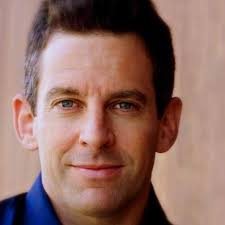
Open Harris's interactive page (graphs of influences, similar and opposing positions, and quotes)
Background
Sam Harris
Born: April 9, 1967 in Los Angeles, California,
United States
Alma mater: Stanford University, University of
California, Los Angeles
Main interests: Neuroscience, cognitive science,
religion, atheism, spirituality, ethics, free will
Notable works: The End of Faith, Letter to a
Christian Nation, The Moral Landscape, Lying,
Free Will, Waking Up: A Guide to Spirituality
Without Religion, Islam and the Future of
Tolerance (co-author)
Influences: Richard Dawkins, Christopher
Hitchens, Daniel Dennett, Steven Pinker, Peter
Singer, Gautama Buddha, David Hume, Terence
McKenna, Ludwig Wittgenstein, Derek Parfit,
John Stuart Mill, Richard Rorty, David Chalmers,
Thomas Nagel
From Wikipedia
Harris is an American philosopher, neuroscientist, author, and podcast host. His work touches on a range of topics, including rationality, religion, ethics, free will, neuroscience, meditation, psyche- delics, philosophy of mind, politics, terrorism, and artificial intelligence. Harris came to prominence for his criticism of religion, and Islam in particular, and is known as one of the "Four Horsemen" of New Atheism, along with Richard Dawkins, Christopher Hitchens, and Daniel Dennett.
Introductory Comments
For Harris, free will is the grandest illusion we never we can never completely escape. Our thoughts, intentions, and actions arise from a chain of causes - genes, upbringing, brain states, the mood of the moment - that we did not author and cannot control. The popular notion that we are the conscious CEOs of our own minds, able to have chosen otherwise under identical conditions, simply doesn't survive inspection. You can, as Schopenhauer noted, do what you want - but you cannot want what you want. And since every choice rests on desires and beliefs you didn't ultimately create, the free will assumed by religion and common sense quietly evaporates.
Though Harris does not say this, the question of free will here curls back on itself in a rather vicious way. If universal causation holds, then we cannot be the ultimate authors of our deeds - and so cannot be ultimately responsible for them. But the only escape would be a genu- inely uncaused act, a choice springing from no- where. And an uncaused act is hardly some- thing to pin a medal or a blame on; randomness is no more "yours" than determinism is. Either way, ultimate responsibility slips through our fingers. Perhaps the wisest move is to step back from this paradoxical rabbit hole, where re- sponsibility seems to vanish the moment you step into it - and the philosophical Cheshire cat disappears, leaving only its naughty grin.
Some of Harris's Key Positions
Spirituality does not require religion, supernat-ural beliefs, or doctrinal frameworks. Instead, it arises from direct investigation of consciousness through practices such as meditation, and occa- sionally through the careful use of psychedelics. These tools help reveal that the sense of a sepa- rate, enduring self is an illusion - a discovery that can profoundly reduce suffering and transform one’s experience of life.
For Harris, spirituality is fundamentally about attention, insight, and the cultivation of well‑being, not about belief. Compassion, awe, and a sense of connection to the world are natural consequences of understanding the mind. Some religions can hinder this process by encouraging dogmatism, tribalism, or an exces-sive focus on salvation and the afterlife - all of which obscure rather than clarify the nature of spiritual experience.
Science, especially neuroscience and psycholo-gy, can illuminate the mechanisms behind spiritual experiences, helping to demystify them without diminishing their significance. Although science cannot answer every existential ques- tion, disciplines such as neuroscience and psy- chology can illuminate the mental processes underlying spiritual experiences, helping to explain how practices like meditation transform human consciousness. In this way, science and true spirituality are completely compatible.
Place in the History of Ideas
Harris's Place in History of Ideas
Graig Graziosi: Mr. Harris is perhaps best known for his writings on faith and religion, but he has delved into other topics, all of which seem to center on understanding morality and ethics from both a philosophical and physiological perspective. He is not just a prolific thinker and writer; he's also an outspoken commentator who says things that make lots of people angry and which get him a lot of attention. He initially employed this tactic by enraging Christians online, and continued it when he shifted his focus to Muslims. In 2017, he featured race "scientist" Charles Murray on his podcast. Mr Murray is the author of The Bell Curve, a book that attempts to link race and intelligence and intelligence to one's genetics.... His appearance on Mr Harris's podcast was met with a mix of revulsion on the left and nodding approval on the right.
David Bentley Hart: He more or less explicitly states that every episode of violence in Christian history is a natural consequence of Christianity's basic tenets (which is obviously false), and that Christianity's twenty centuries of unprecedented and still unmatched moral triumphs - its care of widows and orphans, its alms-houses, hospitals, foundling homes, schools, shelters... and so on - are simply expressions of normal human kindness, with no necessary connection to Christian conviction (which is even more obviously false).
Random Thoughts on Harris
Harris not only denies that the character we each call "self" is free, he even denies that this so-called "self" exists at all. Yes, we all feel cer- tain there's a permanent I lodged behind our eyes - a thinker behind thoughts, a watcher behind perceptions, a little pilot at the controls. Harris argues this feeling, however vivid, is mis- taken - a view drawing on both Buddhist anatta (no-self) and modern neuroscience. Look closely through meditation and you find thoughts, sensations, emotions, and memories bubbling up and dissolving. What you never quite catch is the one supposedly having them. The control room is entirely empty; there is only the thea-ter of awareness itself.
The same investigation dissolves free will. Watch your mind and you'll notice that thoughts and intentions simply appear; you don't manufacture them backstage before they arrive. One thought surfaces, another com- ments on it, an action follows - all unauthored. So if no independent self is directing the mental traffic, none is exercising free will either; the two illusions stand or fall together, roommates sharing the same lease. In the end, Harris's spirituality is less about discovering a soul than about seeing through one: the ego loses its crown, free will misplaces its throne, and what remains is a little more humility, a little less judgment, and a little more compassion for the bewildered creatures we all are.
Influences
Harris was influenced by: Buddha, Chalmers, Dawkins, Dennett, Hitchens, Hume, McKenna, T., Mill, Nagel, Parfit, Pinker, Rorty, Singer, Peter, Wittgenstein
Similar and opposing positions
Thinkers with similar positions:
- Bayle (People’s behaviour reflects their character, not their religious beliefs.)
- Darwin (Our moral instincts are innate and evolved with our social instincts.)
- Holbach (Religion is an impediment to the moral advancement of humanity.)
- Jung (Spiritual experience is essential to our well-being and personal growth.)
- Singer, Peter (There's no evidence that God exists nor that belief in Him is good)
- Wolff (Human reason is able to reach moral truth by its own efforts.)
Thinkers with opposing positions:
- Berlin (Meaningful rational activity rests on the concept of human free will.)
- Collingwood (The mind-body "split" is more semantic than metaphysical.)
- Durkheim (Until recently religion was needed to bind communities together.)
- Edwards (Intricate design in the natural world is the work of God alone.)
- Einstein (The sense of wonder at the mysteries of the universe is religious.)
- Ficino (The soul is immortal and seeks to ascend to a spiritual union with God.)
- Gandhi (God is an indefinable mysterious power that pervades everything.)
- Huxley (The most rational approach to religious belief is an agnostic one.)
- Lotze (Universal mechanical laws suggests the work of a universal mind.)
- Machiavelli (Religion is essential for keeping a republic in order.)
What others said about Harris
- Dawkins: "The End of Faith" is one of those books that deserves to replace the Gideon Bible in every hotel room in the land.
- T. Sayeed: For a man who likes to badger Muslims about their "reflexive solidarity" with Arab suffering, Harris seems keen to display his own tribal affections for the Jewish state. The virtue of Israel and the wickedness of her enemies….
- Graig Graziosi: Despite the allegations of Islamophobia, his interview with a race scientist and his apparent membership in the anti-cancel culture Avengers, Mr. Harris considers himself a liberal. Not just a liberal, but an outspoken liberal who did not hide his - admittedly begrudging - support for Hillary Clinton in the 2016 election.
- Frank Bruni: [Harris's book is] so entirely of this moment, so keenly in touch with the growing number of Americans who are willing to say that they do not find the succor they crave, or a truth that makes sense to them, in organized religion.
- Robert Wright: [T]he famous proponent of New Atheism is on a crusade against tribalism but seems oblivious to his own version of it.
- Andrew D. Huberman: Sam describes [in my podcast] several meditation techniques and their benefits, including how meditation fundamentally changes our worldview and how it can be merged seamlessly into daily life.
- Stephanie Merritt: [Harris's] central argument in "The End of Faith" is sound: religion is the only area of human knowledge in which it is still acceptable to hold beliefs dating from antiquity and a modern society should subject those beliefs to the same principles that govern scientific... inquiry - particularly if they are inherently hostile to those with different ideas.
- Sharon Salzberg: His passion was for deep philosophical questions, and he could talk for hours and hours... Sometimes you'd want to say to him, "What about the Yankees?" or "Look at the leaves, they're changing color!"
Schools: Atheism, Humanism, Liberalism, Naturalism, Post-analytic Philosophy, Secular Humanism, Secularism, Social Liberalism
Main interests: Artificial Intelligence, Bioethics, Biology, Computer Science, Consciousness, Democracy, Ethics, Free/Unfree Will, Meditation, Mind, Personal Identity, Political Theory, Politics, Progress, Psychology, Religion, Science, Spirituality, Technology
Harris's answers to philosophical questions
Economics
"Wherever we can have an impact on the well-being of others, questions of morality apply."
Epistemology
"The only thing that permits human beings to collaborate with one another… is their willingness to [embrace] new facts."
"If someone doesn’t value logic, what logical argument could you provide to show the importance of logic?"
"Man is manifestly not the measure of all things. This universe is shot full with mystery. The very fact of its being is a mystery."
"[I]f faith is the link between your beliefs and the world at large, your beliefs are very likely to be wrong."
Ethics
"If there are... effective ways... to seek happiness [& avoid pain], then there are right & wrong answers to [moral] questions."
We don't need religion to be moral: Religion just "gives people bad reasons to help [others] when good reasons are available."
"We should reserve the notion of 'morality' for the ways in which we can affect one another's experience for better or worse."
Happiness is a shift in perception. That's why "changing your perception of the world is often as good as changing the world."
Mental & spiritual health is key: "Our minds are all we have. They are all we have ever had [and ] all we can offer others."
Love is "shift in perspective…. Love [is] - as advertised by mystics and crackpots through the ages - a state of being."
"All are going to lose [all] they love in this world. Why would one want to be anything but kind to them in the meantime?"
Morality is discipline, not freedom: "You can do what you decide to do - but you cannot decide what you will decide to do."
Metaphysics
Time is how we meet life: "How we pay attention to the present moment largely determines the character of our experience."
"From my point of view, compatibilism is a little like saying: a puppet is free so long as it loves its strings."
"The fact that one can lose one's sense of self in an ocean of tranquility doesn't mean that one's consciousness is immaterial."
Mind
Our minds color the world. With certain minds, good fortune is still misery - while other minds find joy in the simplest things.
As Buddhists teach, our sense of self is illusory. Realization of this selflessness brings not only insight, but also happiness.
"I don’t know what the relationship between consciousness and the physical world is. I don’t think anyone does know."
Philosophy
"Science is totally beholden to philosophy. There are philosophical assumptions in science [that must be found & considered]."
Political Philosophy
"We have a choice between conversation and war. That's it. Conversation and violence. And faith is a conversation stopper."
"While religious tolerance is surely better than religious war, tolerance is not without its liabilities."
"[A] culture that can't tolerate free speech [robs itself of many] positive human experiences that [don't exist] in that culture."
Psychology
Forming friendships, eating specific foods, reading books - "everything we do is for the purpose of altering consciousness."
As practicing meditation shows, "there is more to... the human condition than science and secular culture generally admit."
"You are not controlling the storm, and you are not lost in it. You are the storm."
Peace of mind transcends self: "[I]t is a fact that a condition of selfless well-being is there to be glimpsed in each moment."
The ingredients of well-being: desire for truth, compassion for others, oneness with the world, awe for the richness of life.
Religion and Theology
"[T]here is nothing we need to believe on insufficient evidence in order to have deeply ethical and spiritual lives."
God is a strange invisible person, "who created the universe to have a relationship with one species of primates - lucky us."
"The problem with faith, is that it really is a conversation stopper…. It is a reason, why you do not have to give reasons…."
"If God exists, either He can do nothing to stop… calamities, or He does not care to. God, therefore, is either impotent or evil."
"As a source of objective morality, the Bible is one of the worst books we have. It might be the very worst, in fact…."
"I don’t know what I believe about death. And I don’t think it’s necessary to know in order to live [a sane and moral life]."
"Jesus Christ - who... was born of a virgin… and rose bodily into the heavens - can now be eaten in the form of a cracker."
To question all forms of dogmatism is the first step to opening our mind to the joy and wonderment of intelligent inquiry.
Atheism can increase spirituality by encouraging an openness towards others and an appreciation of our temporal existence.
Science
As a way of seeing the world, science is relevant to all other disciplines. There is even a science of morality and of spirituality.
"Science is the most durable and nondivisive way of thinking about the human circumstance. It transcends [all] boundaries."
"[Science] is interested in questions that are, [if not currently, at least] potentially verifiable (or, rather, falsifiable)."
Society
Many countries and communities have been - and still are being - fractured on the basis of conflicting religious doctrines.
Our reluctance to criticize the beliefs of others has more consequence to civilization than perhaps anything else in our power.