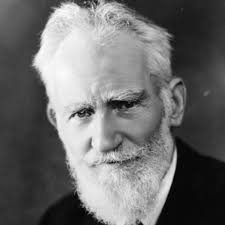
Occupations: Playwright, critic, political activist,
theater
Notable awards: Nobel Prize in Literature (1925),
Academy Award for Writing Adapted Screenplay
(1938): Pygmalion
Main Interests: Literature, Socialism, Politics,
Music, Eugenics, Theatre
Influences: Ibsen, Nietzsche, Dickens, Marx, G.
K. Chesterton, Stalin, Thoreau, Schopenhauer,
Richard Wagner, William Morris, William
Schwenck Gilbert, Henry George, Oscar Wilde,
Leo Tolstoy, Maxim Gorky, Sidney Webb
Influenced: Albert Einstein, Noël Coward, T. S.
Eliot, Tom Stoppard, Eugene O'Neill, Elmer
Rice, William Saroyan, S. N. Behrman
From Wikipedia
Shaw was an Irish playwright, critic, polemicist and political activist. His influence on Western theatre, culture and politics extended from the 1880s to his death and beyond. He wrote more than sixty plays, including major works such as Man and Superman (1902), Pygmalion (1913) and Saint Joan (1923). With a range incorporating both contemporary satire and historical allegory, Shaw became the leading dramatist of his generation, and in 1925 was awarded the Nobel Prize in Literature.
Introductory Comments
Max Beerbohn, who succeeded Shaw as drama critic of the Saturday Review, said of him: "when seriousness and frivolity thus coexist inseparably in a man, the seriousness is nullified by the frivolity." Shaw had an answer ready, though he gave it to one of his characters. "My way of joking is to tell the truth," says the defrocked priest Keegan in John Bull’s Other Island. "It’s the funniest joke in the world." For Shaw, laughter was not a distraction from the argument but its delivery system. It was a Trojan horse that slipped radical ideas past an audience’s defenses while the audience was busy enjoying itself. Major Barbara is the classic case. Its earnest heroine discovers that her Salvation Army shelter depends on money from a whisky distiller and an arms manufacturer, who happens to be her own father. The audience laughs throughout, then leaves with an uncomfortable thesis: poverty, not sin, is the real crime, and a munitions maker who pays decent wages may save more souls than charity ever could. The jokes sweeten the medicine, but they don’t dilute the dose.
Still, Beerbohm had a point. Shaw's relentless paradoxes, provocative exaggerations, and sheer delight in contradicting received opinion could make it difficult to distinguish conviction from cleverness. And it is no doubt true that the philosopher who jokes walks a tightrope: too much levity and the argument floats away, too much gravity and it plummets. Shaw wobbled now and then, but he usually made it across.
Some of Shaw's Key Positions
We must think anew and for ourselves about the social, political, and religious institutions we have inherited. Many survive by habit alone and do more harm than good. The churches have hardened religion into dogma when it should be a living faith.
Honest rethinking leads to socialism. Poverty is the worst of crimes, degrading rich and poor alike, and only public ownership and, ultimately, equal incomes can abolish it. Henry George and Karl Marx diagnosed the disease correctly.
Yet the working classes will not lead, and violent revolution is the wrong road. Educated reformers must transform existing institutions gradually, from within. Democracy, which hands power to an uninformed majority, is a poor instrument for the job.
Behind all progress stands the Life Force, a purposive drive in nature working through human will toward higher forms of life. Humanity is not yet fit to govern itself, so the Life Force must evolve a Superman. The term is Nietzsche’s, but the idea owes as much to Lamarck and Samuel Butler.
Art is a moral calling before an aesthetic one. Rejecting art for art’s sake, the serious artist writes to provoke a complacent public, as Ibsen did, and takes a clear social or political stand.
Place in the History of Ideas
Shaw's Place in History of Ideas
The Times Literary Supplement: [Shaw] was no originator of ideas. He was an insatiable adopt- er and adapter, an incomparable prestidigitator with the thoughts of the forerunners. Nietz- sche, Samuel Butler (Erewhon), Marx, Shelley, Blake, Dickens, William Morris, Ruskin... and Wagner all had their applications and misappli- cations. By bending to their service all the facul- ties of a powerful mind, by inextinguishable wit, and by every artifice of argument, he carried their thoughts as far as they would reach - so far beyond their sources that they came to us with the vitality of the newly created.
Max Beerbohm: ... even when he is really engrossed in some process of serious argument, or moved to real eloquence by one of his social ideals, he emits involuntarily some wild jape which makes the whole thing ridiculous - as ridiculous to himself as to us; and straightway he proceeds to caricature his own thesis till everything is topsy-turvy; and we, rolling with laughter, look up and find him no longer on his head, but on his heels, talking away quite gravely; and this sets us off again. For, of course, when seriousness and frivolity thus co-exist inseparably in a man, the seriousness is nullified by the frivolity. The latter is fed by the former, but, graceless and vampire-like, kills it. As a teacher, as a propagandist, Mr. Shaw is no good at all, even in his own generation. But as a personality he is immortal.
Random Thoughts on Shaw
Shaw's intellectual journey presents a curious spectacle: a passionate advocate of social justice who came to admire dictators, a champion of human improvement who embraced eugenics, and a lifelong socialist whose impatience with democratic gradualism sometimes bordered on contempt. These positions might seem to suggest a succession of ideological reversals, but perhaps the deeper problem was not that Shaw kept changing his mind. Perhaps it was that he remained remarkably consistent in one conviction: society could be transformed for the better if only sufficiently intelligent and determined people were put in charge. By valuing results over method, the Fabian reformer became the admirer of Stalin.
Therein lies the troubling paradox. Shaw's faith in reason, progress, and human perfectibility could lead him toward enlightened reform - but also toward the conviction that those who knew what was best for humanity had the right to impose it. Democracy was admirable when it produced sensible results; when it didn't, the temptation to dispense with its inconveniences grew stronger. Eugenics offered another shortcut to human improvement, substituting the judgment of supposedly enlightened planners for the choices of ordinary people. Perhaps Shaw's greatest failing was not that he abandoned his humanitarian ideals, but that he sometimes valued humanity's improvement more than the freedom of actual human beings.
Jesus (Morality can be effectively taught through stories and parables.)
Keynes (Government has an important role in maintaining a good economy.)
Murdoch (Literature can help us clarify and improve our moral perspective.)
Orwell (Literature at its best enlightens the reader, both morally & politically.)
Rawls (Social justice requires a fair, though not equal, distribution of wealth)
Ruskin (Most importantly, govt. should promote economic and social justice.)
Saint-Simon (Society ought to strive to improve conditions of the poorest class.)
Schiller (Works of art are both aesthetic experiences and moral statements.)
Socrates (Politics should be guided by morality. Might does not make right.)
Thinkers with opposing positions:
Chesterton (If we are incapable of true progress, we should abandon progress.)
Hayek (Socialism requires central planning which in turns leads to oppression.)
Niebuhr (Utopianism is always out of place in our sinful and imperfect world.)
Nozick (Rights are best secured by minimal state limited to narrow functions.)
Oakeshott (Radical changes in govt. are dangerous & undermine social stability.)
Proust (Art is justified by revealing to us the beauty and charm of everyday life.)
Rothbard (Only free market capitalism is consistent with freedom & democracy.)
What others said about Shaw
H. G. Wells: [Shaw behaves like] an idiot child screaming in a hospital.
Jacques Barzun: Seeing clearly within himself and always able to dodge around the ends of any position, including his own, Shaw assumed from the start the dual role of prophet and gadfly.
Beatrice Webb: His argument seems to be that either the Haves or the Have-Nots must seize power and compel all to come under the Fascist or the Communist plough. It is a crude and flippant attempt at reconstruction.... [T]his naïve faith in a Superman before whose energy and genius all must bow down is not a new feature in the Shaw mentality.
C. S. Lewis: He was a comedian, in his own time, of the very highest order.... He was a humorist of the more intellectual kind, a master of satire, art and fantasy like... Aristophanes. In that class no one had more continuous vitality.
Salvador de Madariaga: [Shaw was] a pole of negative electricity set in a people of positive electricity.
Leonard Feinberg: Shaw was a poseur and a puritan; he was similarly a bourgeois and an antibourgeois writer, working for Hearst and posterity; his didacticism is entertaining...; he supports socialism and is tempted by fascism.
Chesterton: I never read a reply by Shaw that did not leave me in better and not worse temper or frame of mind; which did not seem to come out of inexhaustible fountains of fairmindedness and intellectual geniality; which did not savor somehow of that native largeness which the philosophers attributed to Magnanimous Man.
Fred Crawford: [Today] we recognise [Shaw] as second only to Shakespeare in the British theatrical tradition... the proponent of the theater of ideas [who struck a death-blow to nineteenth century melodrama.]
Schools: Social Liberalism, Socialism
Main interests: Equality, Evolution, Free/Unfree Will, Freedom of the press, Immortality, Journalism, Literature, Music, Political Activism, Politics, Power, Psychology, Public Administration, Punishment, Social Criticism, Theatre, Wealth, Welfare State, Will, Wisdom