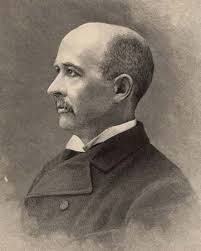
William Sumner (1840 - 1910)
Open Sumner's interactive page (graphs of influences, similar and opposing positions, and quotes)
Background
William Graham Sumner
Born: October 30, 1840 in Paterson, New Jersey
Died: April 12, 1910 (aged 69) Englewood, New
Jersey, United States
Alma mater: Yale College
Notable works: What the Social Classes Owe To
Each Other (1883), Folkways (1907)
Notable ideas: Diffusion, folkways, social mores,
ethnocentrism
Schools: Social Darwinism, Classical Liberalism
Main interests: Sociology, economics, politics,
religion, history, anthropology
Influences: Auguste Comte, Herbert Spencer,
Charles Darwin, Henry Thomas Buckle, Adam
Smith, Thomas Reid, Dugald Stewart, Thomas
Malthus
Influenced: Albert Galloway Keller, Thorstein
Veblen, Irving Fisher, Kate Claghorn
From Wikipedia
Sumner was an American clergyman, social scientist, and neoclassical liberal. He taught social sciences at Yale University, where he held the nation's first professorship in sociology and became one of the most influential teachers at any major school…. He supported laissez-faire economics, free markets, and the gold standard, in addition to coining the term "ethnocentrism" to identify the roots of imperialism, which he strongly opposed…. He had a prolonged influence on American conservatism.
Introductory Comments
Sumner preached before he lectured, and his lectures never entirely stopped sounding like sermons. As a young Episcopal clergyman, according to the sociologist Robert Bierstedt, he "stressed without surcease the Puritan virtues of hard work, self-reliance, self-denial, frugality, prudence, and perseverance." In 1872 he traded the pulpit for a Yale professorship in political and social science, but the sermon came with him. What changed was its authority. The old virtues now rested on the new science of evolution, which Sumner absorbed mainly through Herbert Spencer. The result was a full-throated defense of laissez-faire. If the state tampers with competition to rescue the poor, Sumner argued, it rewards improvidence, punishes thrift, and promotes the survival of the unfittest.
Sumner's hero in all this was a figure he named the Forgotten Man. He is the quiet, self-supporting worker who asks nothing of the state and receives nothing from it but the bill. Half a century later, in a 1932 radio address, Franklin Roosevelt borrowed the phrase and turned it nearly inside out. His forgotten man stood "at the bottom of the economic pyramid" and needed the government's help. So the same title came to mean both the man who pays and the man who is paid for. And what about the unforgotten man - the rich? Sumner certainly didn't forget him. Businessmen who bought tariffs and favors from the state were, in his book, simply beggars in better suits
Some of Sumner's Key Positions
Government should keep its hands off the economy, even when its motives are generous. The state has a narrow job: to keep order and protect liberty and property, so that each person keeps the fruits of his own labor. Beyond that, intervention does more harm than good. This applies to poor relief and labor legislation, and just as much to protective tariffs and special favors for business.
Life is a struggle. It begins as a "struggle for existence" against nature, which yields a living only to labor and self-denial, and continues as a "competition of life" among people. That competition drives progress. It rewards industry, thrift, and prudence, spurs efficiency and invention, and builds up the capital on which civilization rests.
Competition produces winners and losers, and we must not pretend otherwise. Society faces a stark choice: liberty, inequality, and the survival of the fittest, or unfreedom, equality, and the survival of the unfittest. By "fittest" this meant the industrious and self-disciplined, not a superior breed. Schemes that transfer wealth from the prudent to the improvident, socialism above all, reward the very habits that breed poverty. They leave society as a whole poorer and weaker. The reformers also overlook the person who pays for their benevolence. When A and B decide what C must do for D, C is "the Forgotten Man."
Place in the History of Ideas
Sumner's Place in History of Ideas
Amy Tikkanen: Like the British philosopher Herbert Spencer, Sumner, who taught at Yale from 1872 to 1909, expounded in many essays his firm belief in laissez-faire, individual liberty, and the innate inequalities among men. He viewed competition for property and social status as resulting in a beneficent elimination of the ill adapted and the preservation of racial soundness and cultural vigor. For him the middle-class Protestant ethic of hard work, thrift, and sobriety was conducive to whole- some family life and sound public morality. Foreseeing the drift toward the welfare state, but considering poverty the natural result of inherent inferiorities, he opposed all reform proposals that smacked of paternalism because they would impose excessive economic burdens on the middle class, his “forgotten man.”
Matt Zwolinski: But there is a... problem with the charge of social Darwinism as applied to Sumner: it is the very essence of the system of laissez faire he championed to prohibit the violence and plunder that characterize the Darwinian "law of the jungle." For Sumner, ... the peaceful economic competition that exists within industrial society is an evolutionary advance from earlier forms of more violent competition. As culture and commerce advance, they tend to ameliorate the effects of the struggle for existence, even going so far as to replace it with a more benign process....
Random Thoughts on Sumner
Laissez-faire capitalism may have made some sense in a pre-industrial, overwhelmingly agricultural economy, where government meddling was more often a favor to the rich than a rescue for the poor. But the Industrial Revolution changed the equation entirely. Workers crowded into factories, stripped of bargaining power, while rapid urbanization bred a whole catalogue of miseries: unsafe working conditions, brutally long hours, festering slums, child labor, and inequality on a scale the agrarian world had never seen. Left to its own devices, the market proved unable - or unwilling - to protect the people caught inside it. Without government intervention, these problems would have ground on indefinitely, at staggering human cost.
One might expect that Sumner, as America's first professor of sociology, would have grasped these consequences better than anyone. Instead, he explained them away. Steeped in Social Darwinism and the ideas of Herbert Spencer, he waved off slums and poverty as mere collateral damage in the grand, zero-sum game of social evolution - regrettable, perhaps, but no business of government to fix. The reformers who thought otherwise, in his eyes, weren't easing suffering; they were meddling with nature itself.
Sumner had a name for the man who paid for reform. He never found one for the child who paid for its absence.
Influences
Sumner was influenced by: Buckle, H.T., Comte, Darwin, Malthus, Reid, Smith, Adam, Spencer, Stewart, D.
Sumner influenced: Claghorn, Kate, Fisher, Irving, Keller, A.G., Rothbard, Veblen
Similar and opposing positions
Thinkers with similar positions:
- Benjamin (Talk of natural rights is mere rhetoric - just righteous nonsense.)
- Dewey (Academic freedom, at least in college, is essential in a democracy.)
- Franklin (Self-reliance, frugality & perseverance are keys to personal success.)
- Hayek (A centrally planned economy will always be inefficient and unstable.)
- Heraclitus (All is strife - a constant process of building up & tearing down.)
- Malthus (The struggle for survival is an immense force at work in our world.)
- Spencer (Govt. should not interfere in the economic survival of the fittest.)
Thinkers with opposing positions:
- Berlin (Certain values, like liberty, are universal and qualify as "natural laws.")
- Dawkins (Humans can opt out of survival contests since we are conscious of self.)
- Galbraith (Govt. should play an assertive role in improving general welfare.)
- Green (The state should foster & protect the social & econonic environment.)
- Hayek (A society with a strong economy can still provide a social safety net.)
- Ortega (Modern capitalism has demoralized humanity & weakened morality.)
- Proudhon (Property is theft when it in effect steals the profits from laborers.)
- Rawls (Govt. should provide greatest benefit to those least advantaged.)
- Seneca (We should accept calmly and dispassionately whatever happens.)
What others said about Sumner
- Miles Kimball: Sumner argued that attempts to overrule evolution - as by alleviating the plight of the poor - were both immoral and imprudent.
- Amity Shlaes: Applying his own elegant algebra of politics, Sumner warned that well-intentioned social progressives often coerced unwitting average citizens into funding dubious social projects.
- James G. Leyburn: [Sumner] believed the economic, political, and social worlds to be governed by natural laws. According to these laws, perfect competition results in a struggle for existence, and the fittest survive in the social, as in the natural, order. To the extent that the social order is... beneficent, interference [with it] is pernicious.
- Matt Zwolinski: [Sumner believed that] the survival of the fittest is a constraint within which men and laws must operate, not a goal to be pursued. And it is an inescapable constraint. We could not avoid it if we wanted to.
- Kimball: He was a polymath with numerous books and essays on American history, economic history, political theory, sociology, and anthropology.
- James G. Leyburn: He was constantly engaged in controversy, and his drastic, uncompromising language not only revealed his impatience with any suggestion of sentimentality, but even implied that he regarded tact as hypocrisy.
- M. Zwolinski: Unfortunately, Sumner's intellectual legacy suffered essentially the same fate as that of his contemporary Herbert Spencer, and for much the same reason. From near-ubiquity and respectability, Sumner's ideas have descended into obscurity and disrepute. To the extent he is remembered at all today, it is mostly for his alleged "social Darwinism."
- James G. Leyburn: After 1890 he increasingly deserted economics for sociology; polemics gave way to research, and the rostrum to the study. Consequently, his public reputation waned.
Schools: Classical Liberalism, Individualism, Social Darwinism
Main interests: Anthropology, Economics, History, Politics, Religion, Social Theory
Sumner's answers to philosophical questions
Economics
It is folly to interfere with natural, economic competition, since competition is a requisite of many sorts of social gains.
To attack capitalism "is to undermine civilization, for capital is the first requisite of every social gain...."
"Socialism is a philosophy of failure, the creed of ignorance, and the gospel of envy."
Education
"Education in the critical faculty is the only education of which it can be truly said that it makes good citizens."
Ethics
"There is no device whatever to be invented for securing happiness without industry, economy, and virtue."
History
"History is only a tiresome repetition of one story. Persons and classes [try] to live luxuriously out of the earnings of others."
Law
Belief in natural rights is absurd. It leads to the "socialistic doctrine that a man has a natural right to whatever he needs."
Nature
"There is no boon in nature. All the blessings we enjoy are the fruits of labor, toil, self-denial, and study."
If we try to interfere with the competitve process of nature, we will in effect be favoring the survival of the unfittest.
"Nature is entirely neutral.... She grants her rewards to the fittest... without regard to other considerations of any kind."
Political Philosophy
"[The] danger of democracy is that the classes which have the power under it will assume all the rights & reject all the duties."
"It is the greatest folly of which a man can be capable to sit down with a slate and pencil to plan out a new social world."
"Nine-tenths of our measures for preventing vice are really protective towards it, because they ward off [it's natural] penalty."
Reformers who prioritize the needs of the poor and unfit end up placing financial burdens on the hard-working middle class.
There are unintended costs in the redistribution of wealth - particuraly the burden it puts on the hard-working middle class.
Psychology
"Hunger, love, vanity, and fear. There are four great motives of human action."
Society
Don't rely on society's help: "Every man and woman in society has one big duty. That is, to take care of his or her own self."
Don't burden "the Forgotten Man. He works, he votes, generally he prays - but he always pays - yes, above all, he pays."