Thomas Malthus (1766 - 1834)
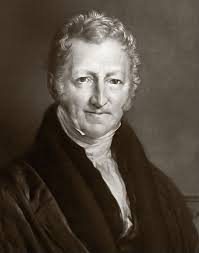
Open Malthus's interactive page (graphs of influences, similar and opposing positions, and quotes)
Background
Thomas Robert Malthus
Born: 13 February 1766 in Westcott, Surrey,
England
Died: 29 December 1834 (aged 68) in Bath,
Somerset, England
Nationality: British
Field: Demography, macroeconomics
School or tradition: Classical economics
Alma mater: Jesus College, Cambridge
Main interests: Polulation, economics, politics,
religion
Influences: David Ricardo, Jean Charles Léonard
de Sismondi, Adam Smith, Marquis de
Condorcet
Influenced: Charles Darwin, John Maynard
Keynes, Alfred Russel Wallace, William Graham
Sumner, David Ricardo, Thomas Chalmers,
William Whewell
From Wikipedia
Malthus was an English economist, cleric, and scholar influential in the fields of political econo- my and demography. In his 1798 book An Essay on the Principle of Population, Malthus observed that an increase in a nation's food production im- proved the well-being of the population, but the improvement was temporary because it led to population growth, which in turn restored the original per capita production level…. Populations had a tendency to grow until the lower class suf- fered hardship, want…, war, famine, and disease.
Introductory Comments
Malthus came from a line of royal apothecaries. On his mother's side he was the grandson and great-grandson of men who mixed medicines for George I, George II, and George III; on his father's side, the great-grandson of an apothecary to William III and Queen Anne. Five consecutive monarchs, dosed and purged by Malthus's relations. And yet Malthus himself can seem remarkably cool about sickness - and about the other things that carry people off, such as war, famine, and unneighborly violence. His theory required them. Population grows geometrically while the food supply grows only arithmetically, so something must give, and and that something is human lives.
It sounds heartless, as though he were tallying rats in a cage. But Malthus was, by training and inclination, an Anglican clergyman. His objection to the Poor Laws rested not on indifference to suffering but on a claim about consequences: relief that adds mouths without adding harvests only multiplies misery later. The remedy he urged, with mounting emphasis in the later editions, was the preventive check - prudence, moral restraint, marriage postponed until a family can actually be fed - so that fewer people would be handed over to the terrible checks of famine, disease, and war. His proposal to abolish public relief struck many as cruel. But from his perspective, Malthus was not unlike his royal apothecary ancestors - except that instead of dispensing pills to the elite, he prescribed prudence to the masses.
Some of Malthus's Key Positions
Whatever benefit comes from an increased food supply will be temporary. More plentiful food means more children survive and couples marry earlier, so the population rises to meet the new abundance - and presses against its limits once again. The trap has no exit, because the two quantities grow by different arithmetic. Left unchecked, population can increase geometrically - 2, 4, 8, 16 - while food production, can increase only arithmetically - 2, 3, 4, 5. Thus, population has a persistent tendency to outrun food supply.
The result is that population is forever pressed against the limits of subsistence. The forces that hold it there are of two kinds. Positive checks raise the death rate: famine, disease, war, overcrowding, and the general grinding of poverty. Preventive checks lower the birth rate: late marriage, smaller families, and what some call "moral restraint" - postponing marriage until one can feed a family, and staying chaste in the meantime.
Against this arithmetic, the utopians look naive. When Godwin promised that social progress and wise legislation would abolish human misery, he deceived his readers and himself along with them. The Poor Laws are particularly useless. Relief allows the poor to marry earlier and raise more children without adding a single bushel to the nation's harvest, so the same food is divided among more mouths and its price climbs. The laws thus dull the very prudence that might have helped the poor.
Place in the History of Ideas
Malthus's Place in History of Ideas
Henry-James Meiring: Malthus is now best re- membered as a political economist whose Essay was primarily about the relations between pop- ulation and food subsistence. His main thesis was that population - under favorable condi- tions - tended to increase geometrically as op- posed to agricultural production, which in- creased arithmetically. This disparity in the ratio of increase between population and sub- sistence could hypothetically lead to food shortage and eventual famine. This was Mal- thus’s principle of population, a principle that would prove to be a major influence on the domestic policies of nineteenth-century Britain as well as on the work of naturalists such as Charles Darwin and Alfred Russel Wallace.
Scott Gordon: Until the work of John Maynard Keynes in the 1930’s, which revived interest in Malthus as a precursor of the Keynesian theory of unemployment, the only role Malthus was accorded in the history of economics was as the originator of the classical theory of population. Malthus himself regarded the main point of the Essay to be his critique of the utopianist theo- ries of Godwin and Condorcet, which occupied more than a third of its length. He was sur- prised to find, upon its publication, that he had won fame as a social scientist, not just as a trenchant critic of speculative writers on the perfect social order.
Random Thoughts on Malthus
Both Charles Darwin and Alfred Russel Wallace credited the same book with their "Aha!" moment: Malthus's An Essay on the Principle of Population. What each saw was that Malthus's arithmetic does not stop at the species that produced it. Every organism breeds beyond what its food supply can carry. Most of the offspring must therefore die young, and if the ones that survive to breed differ even slightly from the ones that don't, then a selection process is grinding away everywhere, all the time, with no one operating the machinery.
But why did two naturalists have to wait for a clergyman's book on poor relief to connect the dots? The long tradition of artificial selection - the breeding of faster horses, plumper pigeons, sweeter apples - had shown for centuries that heritable traits can be shaped over generations. Why did nature's version stay invisible? Scripture surely got in the way for some, though by the early 1800s plenty of naturalists had stopped reading Genesis literally. Perhaps the harder hurdle was the missing selector. Breeders select for something; they have a goal in mind, and a goal seems to require a mind. To see natural selection, one had to accept a process with no goal at all, indifferent to our notions of good and evil and to the fates of the creatures caught up in it. If that was the sticking point, the irony is delicious: creatures who cannot help thinking in moral categories found it nearly impossible to believe that the process which made them moral was itself supremely amoral.
Influences
Malthus was influenced by: Condorcet, Darwin, E., Lamarck, Priestley, Ricardo, Sismondi, Smith, Adam
Malthus influenced: Chalmers, T., Darwin, Keynes, Ricardo, Sumner, Wallace, A.R., Whewell, W.
Similar and opposing positions
Thinkers with similar positions:
- Darwin (The struggle for existence is both a destructive & constructive force.)
- Hayek (A centrally planned economy will always be inefficient and unstable.)
- Heraclitus (All is strife - a constant process of building up & tearing down.)
- Huxley (The struggle for survival is an immense force at work in our world.)
- Marx (Economic, rather than cultural, forces drive history and shape society.)
- Rand (Struggle and competition shape our lives and determine our destinies.)
- Spencer (Govt. should not interfere in the economic survival of the fittest.)
- Sumner (Humans will always be in a struggle for survival with one another.)
Thinkers with opposing positions:
- Condorcet (Enlightenment principles can lead us toward the perfect society.)
- Diderot (Enlightenment and the creation of a better world lie within our power.)
- Godwin (Mankind is perfectible if freed from repressive social structures.)
- Keynes (Govt. interference in an economy is at times needed as a stimulus.)
- Ricardo (Protectionist duties on imports are always counterproductive.)
- Rousseau (With proper education & government, society will progress greatly.)
- Saint-Simon (A scientfic study of society can lead to social progress for all.)
- Shaw (Socialism can cure many of the abuses found in our modern economies.)
What others said about Malthus
- Scott Gordon: It was Malthus’s Essay that really ignited interest in the population question.
- Russell: In [Malthus's] comfortable parsonage, he contemplated the misery of the great majority of mankind with equanimity, and pointed out the fallacies of the reformers who hoped to alleviate it.
- Darwin: In October 1838..., I happened to read for amusement Malthus on Population, and being prepared to appreciate the struggle for existence which everywhere goes on..., it at once struck me that... favorable variations would tend to be preserved, and unfavourable ones to be destroyed. The result would be the formation of a new species.
- Henry-James Meiring: Malthus brings us one step closer towards the view of humans as animals prone to irrationality, a view that would become part of Darwinian and later Freudian notions of the mind.
- Samuel M. Levin: Malthus wove the threads of a theory of mind, colored by his theological preconceptions into... his discourse on population.
- Hazlitt: It may be almost doubted whether Mr. Malthus was... serious in many things that he threw out, or whether he did not hazard the whole as an amusing and extreme paradox, which might puzzle the reader as it [did him].
- Engels: If, then, the problem is not to make [Malthus's] "surplus population" useful, ... but merely to let it starve to death in the least objectionable way,... this, of course, is simple enough, provided the surplus population perceives its own superfluousness and takes kindly to starvation.
- Matt Rosenberg: Malthus argued that [the Poor Laws] only encouraged the poor to give birth to more children as they... have no fear that increased numbers of offspring would make eating any more difficult.
Schools: Classical Economics
Main interests: Economics, Politics, Religion
Malthus's answers to philosophical questions
Economics
We need the struggle for survival: "[M]an [is] inert, sluggish, and averse from labor, unless compelled by necessity.”
Class struggle cannot be resolved. The poor will always exists and will always suffer the most in the struggle for survival.
"The rich, by unfair combinations, contribute frequently to prolong a season of distress among the poor."
History
"The histories of mankind are histories only of the higher classes."
Nature
Nature isn't helpful: Given that population growth outpaces food supply, struggle is the inevitable plight of most creatures.
The human race is subject to the same natural laws and biological principles that apply to other life forms on earth.
Political Philosophy
"[A]ny great interference with the affairs of other people is a species of tyranny…."
Given that food supply never keeps up with population growth, the poor will always suffer. Government can't prevent this.
Religion and Theology
"Evil exists in the world not to create despair but activity."
Without soul we are lost: "The original sin of man is the torpor and corruption of the chaotic matter in which he [was] born."
The world is the "process of God… to awaken inert, chaotic matter into spirit, to [transform] the dust of the earth into soul."
Science
"Each pursues his own theory, little solicitous to correct or improve it by an attention to what is advanced by his opponents."
Society
Society can be improved through reason: "Man is perfectible, or in other words, susceptible of perpetual improvement."