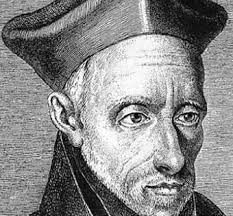
Francisco Suárez (1548 - 1617)
Open Suárez's interactive page (graphs of influences, similar and opposing positions, and quotes)
Background
Francisco Suárez
Born: January 5, 1548 in Granada
Died: September 25, 1617 (aged 69) in Lisbon
School: Scholasticism
Main interests: Religion, Theology, Law,
Natural law, Political philosophy, Metaphysics,
Philosophy of mind, Ethics, Just war
Influences: Alonso Rodriguez, Thomas Aquinas,
Luis de Molina, William of Ockham, Duns
Scotus and medieval Scholasticism in general;
Aristotle, Avicenna, Martin Luther, Jean Bodin
Influenced: Descartes, Leibniz, Christian Wolff,
Hugo Grotius, Matthew Hale, Martin Heidegger,
Mário Ferreira dos Santos, Samuel von
Pufendorf, Arthur Schopenhauer, Francis
Turretin, David Hollaz, Pedro Hurtado de
Mendoza, Rodrigo de Arriaga, John Norris,
Bartholomaeus Keckermann, Johann Heinrich
Alsted
From Wikipedia
Suarez was a Spanish Jesuit priest, philosopher and theologian, one of the leading figures in the School of Salamanca movement. His work is con-sidered a turning point in the history of second scholasticism, marking the transition from its Renaissance to its Baroque phases. According to C. Shields and D. Schwartz, "figures as distinct from one another in place, time, and philosophical orientation as Leibniz, Grotius, Pufendorf, Scho-penhauer and Heidegger, all found reason to cite him as a source of inspiration and influence."
Introductory Comments
Suárez stands at a hinge in intellectual history, one foot in medieval Scholasticism and the other edging toward the modern world. The devout Schoolman in him slotted phenomena neatly into two categories: natural events, consistent with rational explanation, or charismata - spiritual gifts or talents bestowed by the Holy Spirit. On this view, for example, speaking in tongues made perfect sense. In the Church's first years the Spirit had been especially active, urgent to spread the Good News; whatever survives of the gift today is a faint echo of that Pentecostal dawn.
Yet Suárez was also a rigorous analyst who refused to reach for the supernatural too quickly. As a rule, he insisted that an apparent miracle be tested against natural causes first. Applied to tongues, that discipline cuts two ways. A true charism might indeed be at work - but so, in a given case, might something more ordinary, whether learned behavior or the effect of intense emotions. Suárez does not dissolve the miraculous into psychology; he simply demands that we rule out the natural before crediting the divine. It is a proto-scientific instinct housed within a Scholastic frame.
Alternating between faith and reason, Suárez was not unlike his fellow Spaniard Don Quixote, who also straddled the medieval and the modern - though the Knight of the Sorrowful Countenance grasps his own predicament only at the book's bittersweet end.
Some of Suárez's Key Positions
In God, essence and existence are strictly identical. In creatures they are not really distinct either - despite what the Thomists claim - but differ only conceptually. Each human being fully is its own act of existing. The "shared essence" we call humanity is thus a mental construct: what exists in the world is never humanity-in-general but always this or that particular person.
The universal nature of humanity expresses itself differently in each person, and in the order of real existence it is the individual who counts as the basic, irreducible reality. What individuates a thing is not its matter alone (as Aquinas held) but its whole entity - its entitas tota. And so it goes for all existing things: the individual comes first.
However indispensable universals are to metaphysics, they enjoy no independent existence outside the mind. In the world as it actually is, they must give way to the individual beings that supposedly "share" in them. Universality is the mind's contribution; singularity is reality's.
On moral responsibility the individual again holds center stage, even under an omnipotent God. Human freedom remains compatible with the efficacy of divine grace, because grace works precisely by being suited, or congruent, to the recipient's own dispositions and circumstances. God's power does not override the will; it meets it.
Place in the History of Ideas
Suárez's Place in History of Ideas
Copleston: [I have tried to show] that there is a Suarezian synthesis, that the key to it is the idea of "participation" or dependence in being, and that it was this idea above all which must, Suarez was convinced, be the distinguishing mark of a Christian philosophy. To say this is not, of course, to suggest in any way that the idea is absent from Thomism.... Suarezians do not set Suarez against St. Thomas. What they believe is that Suarez carried on and developed the work of St. Thomas in building up a meta- physical system in profound harmony with the Christian religion.
Sydney Penner: However much uncertainty there may be about the extent of Suárez’s influ- ence, it is certain that Hobbes, Descartes, Male- branche, Leibniz, and Berkeley all mention Suárez explicitly at least once and say a variety of things that might well be thought to borrow from or be inspired by Suárez. Wolff, too, cites Suárez and thought highly of him, to the extent that Wolff has been characterized as begotten of Suárez. Insofar as there is a path from Wolff to Kant, there might, then, reasonably be thought a path from Suárez to Kant as well. The story of influence just told... omits, however, Suárez’s main influence. Due to the vagaries of academic fashion..., large swaths of early mod- ern philosophy receive virtually no attention today. Yet Suárez was most influential in these neglected realms....
Random Thoughts on Suárez
Aquinas, the greatest of the medieval Schoolmen, lived in a world that felt settled. Suárez, the greatest of the "modern" Schoolmen, lived in a world coming apart at the seams - or perhaps knitting itself into something new. Around him great forces jostled for advantage: Reformation and Counter-Reformation, a swelling commercial capitalism, the first stirrings of nationalism, and the young, ambitious sciences. Suárez tried to make sense of these currents, and to do more besides: to throw a bridge across the widening gap between the medieval and modern worldviews. His writings on natural law and individual rights, his probing of knowledge and cognition - all of it helped lay the footings on which modern philosophy would rise.
We are too fond of the story in which Descartes, the "Father of Modern Philosophy," breaks cleanly with everything behind him. Philosophy has no such clean breaks. Its history is like a river - not a Heraclitean river, forever new and never twice the same. Rather, an old-fahioned river - with currents that run for a good while, that overlap, that nudge and pull at one another. They swell and slacken and sometimes reverse. But none of this prevents you from stepping into the same river twice. That is to say, the currents in philosophy last - for a time, anyway. And so, if there are no sudden breaks in the history of ideas, there can be no lone "Father of Modern Philosophy." Let's call Descartes and Suárez what they were: benefactors, both.
Influences
Suárez was influenced by: Abelard, Aquinas, Aristotle, Avicenna, Bodin, Jean, Duns Scotus, Luther, Molina, L. de, Ockham, Paul of Tarsus, Rodriguez, A.
Suárez influenced: Alsted, J.H., Descartes, Ferreira, M., Grotius, Hale, Matthew, Heidegger, Hollaz, David, Hurtado, P., Keckermann, Leibniz, Norris, John, Pufendorf, Schopenhauer, Turretin, F., Wolff
Similar and opposing positions
Thinkers with similar positions:
- Anselm (God's existence is inferable from the mere idea of a Perfect Being.)
- Averroes (The essence of a thing is not ontologically prior to its existence.)
- Cicero (Natural laws are universal due to their rationality and moral worth.)
- Duns Scotus (In our concept of things, essence & existence are inseparable.)
- Grotius (International disagreements should be settled via law, not via war.)
- Hooker (Religion is based on revelation, but also on reason and tradition.)
- Molina (Predestination is just God's foreknowledge of our acts of free will.)
Thinkers with opposing positions:
- Avicenna (The essence of a thing is ontologically prior to its existence.)
- Bentham (Natural laws are nothing more than "nonsense on stilts.")
- Bergson (Universals or essences do not actually exist in the real world.)
- Bruno (God is not transcendent. Everything in Nature is part of God.)
- Hart (There is no necessary connection between law and morals.)
- Ockham (Universals are just concepts. Only concrete individual things are real.)
- Pseudo-Denys (God is beyond reason. We know what He isn't, not what He is.)
- Sartre (Existence precedes essence: Humans GIVE meaning & purpose to life.)
- Spinoza (God is not transcendent. Everything in Nature is part of God.)
What others said about Suárez
- Schopenhauer: [Suárez's “Metaphysical Disputations” is an] authentic compendium of the whole of scholastic wisdom.
- John Herman Randall Jr.: [Suarez believed] [t]he law of nature is that law implanted in the human soul through which right is distinguished from wrong. Its source is God the Creator, its end the good of man.
- Randall Collins: Suárez formulated metaphysics as the science of being.... [However,] [b]reaking with Scotus, Suarez held that being is not univocal but is a concept derived by analogy from various kinds of being. Suarez shaped the heritage of philosophy that was to be passed along to the modernists, who believed they were breaking with medieval thought.
- Christopher Shields: ... figures as distinct from one another in place, time, and philosophical orientation as Leibniz, Grotius, Pufendorf, Schopenhauer, and Heidegger, all found reason to cite [Suarez] as a source of inspiration....
- Robert C. Solomon: ... Suarez stressed the importance of God's authority in all matters. Human reason, again, had to be put in its place.
- Anthony Kenny: [For Suarez, each individual being has a unique essence:] There is in Peter a real formal element, a "differentia individualis," in addition to the specific nature of humanity, which makes him Peter and not Paul.
- Wilhelm Windelband: Suarez was an important writer, clear, acute, accurate, and with a great capacity for a luminous disposition of his thoughts; he surpasses also, to a considerable degree, most of the older Scholastics in the form of his expression; but in the content of his doctrine he is bound by tradition....
- Copleston: ... by refusing to admit a "real" distinction between essence and existence... Suarez avoided the danger of turning existence into a kind of essence. Cancel the creature's existence, and its essence is cancelled too.
Schools: Christian Theology, Natural Law Theory, Scholasticism
Main interests: Chain of Being, Ethics, Free/Unfree Will, Immortality, Just War, Law, Metaphysics, Mind, Political Philosophy, Religion, Theology, Universals, Wisdom
Suárez's answers to philosophical questions
Ethics
To know what is good and right, we must first know what is natural to man.
Law
Natural law is implanted in us by God so that we may distinguish right from wrong. It is the basis of all human law.
Though in theory human law springs from natural law, in reality human law is primarily an act of will, not of reason.
"The end of punishment is not revenge, but the correction and improvement of the offender."
Metaphysics
The question of being is central to metaphysics: what are the essential properties of something that make it what it is.
Though universals embrace many individuals, the individual remains the fundamental reality in the world of existence.
Aristotle is right: Causation can be broken down into four interrelated types - material, formal, efficient and final.
The human will is naturally a free will. And "a free will is one moved solely by the inclination of its will."
Nature
The beauty of the universe and the marvelous connections between all things within it can only be attributed to God.
"Man is a rational animal, and therefore like God."
Political Philosophy
Law and government are based on natural law, but they are the creations of man, who God made free and responsible.
Because the people gave the sovereign his power, when the sovereign misuses his power, the people can take it away.
Religion and Theology
God's being is uncaused yet necessary. God's being flows from his perfection, though this relation is not a causal one.
God is infinite, eternal, omniscient, but divine simplicity means that all such attributes are merely conceptual, not real.
Free will is consistent with the efficacy of God's grace, since his grace is congruent with the dispositions of the elect.