W. E. B. Du Bois (1868 - 1963)
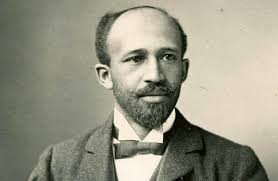
Open Du Bois's interactive page (graphs of influences, similar and opposing positions, and quotes)
Background
W. E. B. Du Bois
Born: February 23, 1868 in Great Barrington,
Massachusetts, U.S.
Died: August 27, 1963 (aged 95) in Accra, Ghana
Alma mater: Fisk University, Harvard University,
University of Berlin
Known for: The Souls of Black Folk, Black
Reconstruction in America, The Crisis
School: Pluralism
Main interests: Civil Rights, Fight against Racism
Influences: Alexander Crummell, William James,
Karl Marx, Hegel, George Santayana
Influenced: Cornel West, Kwame Anthony
Appiah, Aldon Morris, Aberjhani, Maurice
Berger, Xavier Briggs, Robert D. Bullard, Leon
Litwack, Robert Dentler
From Wikipedia
Du Bois was an American sociologist, writer, historian, and Pan-Africanist civil rights activist.... Du Bois was a prolific author. He primarily targeted racism with his writing, which protested strongly against lynching, Jim Crow laws, and racial discrimination in important social institutions. His cause included people of color everywhere, particularly Africans and Asians in colonies…. Du Bois believed that capitalism was a primary cause of racism and was sympathetic to socialist causes.
Introductory Comments
Most of us know the small jolt of catching our reflection in a shop window and wondering how we look to others. Now imagine that glimpse never ending, with the onlookers' verdict already settled, and hostile. That, roughly, is what Du Bois meant by "double consciousness," the idea at the heart of The Souls of Black Folk (1903). It is the experience of always measuring oneself by the standards of a world that looks on with contempt. For Black Americans of his era (and, tragically, long after), it meant living with "two souls, two thoughts, two unreconciled strivings; two warring ideals in one dark body." This was no abstract paradox but a daily ordeal.
Whether that doubleness haunted Du Bois personally is a matter of interpretation. What is certain is that his life traced a long and widening arc. He was a sociologist, historian, and novelist. He co-founded the NAACP and edited its magazine, The Crisis, for nearly a quarter century. Through it all, he insisted that Black Americans must never accept second-class citizenship as the price of opportunity. His politics grew steadily more radical, toward socialism, Pan-Africanism, and finally, in 1961, membership in the Communist Party. That same year, at ninety-three, he moved to Ghana at President Kwame Nkrumah’s invitation to direct an Encyclopedia Africana. When the U.S. government refused to renew his passport, he became a Ghanaian citizen. He died in Accra in 1963, on the eve of the March on Washington.
Some of Du Bois's Key Positions
The problem of the 20th century is the problem of the color line: the division of humanity by race, in America and across the globe. For Black Americans it produces a "double consciousness." We are forced always to see ourselves through the eyes of a world that looks on us with contempt, and we carry two identities, American and Negro, that are at war within a single self.
Until the color line is broken, democracy for Black Americans is a promise, not a fact. The remedy is not patience but protest. We must frankly and insistently demand the rights the Constitution and its amendments already guarantee: above all the vote, equal treatment under the law, and education according to ability.
Booker T. Washington’s bargain must therefore be rejected. He would accept political powerlessness and segregation, and confine Black ambition largely to industrial training, in return for economic opportunity and white goodwill. No people can hold on to property, or to self-respect, after surrendering the vote and its civil rights.
Leadership must come from a college-educated vanguard, the "Talented Tenth." They are trained not merely to earn a living but to think, teach, and lead. Their task is to set standards, organize resistance, and lift the whole race with them. In the end, a leadership class that serves only itself betrays this mission.
Place in the History of Ideas
Du Bois's Place in History of Ideas
Elliott Rudwick: Although Du Bois had originally believed that social science could provide the knowledge to solve the race problem, he gradually came to the conclusion that in a climate of virulent racism, expressed in such evils as lynching, peonage, disfranchisement, Jim Crow segregation laws, and race riots, social change could be accomplished only through agitation and protest. In this view, he clashed with the most influential Black leader of the period, Booker T. Washington, who, preaching a philosophy of accommodation, urged Blacks to accept discrimination for the time being and elevate themselves through hard work and economic gain, thus winning the respect of whites.... Du Bois charged that Washington’s strategy, rather than freeing the Black man from oppression, would serve only to perpetuate it. This attack crystallized the opposition to Booker T. Washington among many Black intellectuals, polarizing the leaders of the Black community into two wings....
Aberjhani: Added to the shock of the routine violation of their bodies was the trauma of having to relinquish their children to unknown slave-holders. Du Bois considered this physical, mental, and spiritual abuse of black women - with its inevitable result being the destruction of the traditional African family - the highest crime committed by slave-holders and the one thing for which... he could not forgive them.
Random Thoughts on Du Bois
There’s an old quip that anyone who isn’t a radical at twenty has no heart, and anyone who still is at forty has no head. Du Bois ran the experiment backward. He began as a sober scholar with a Harvard doctorate and a faith that careful facts could cure prejudice. He ended, at ninety-three, as a card-carrying Communist. The path between was less a conversion than a slow erosion of hope: a long series of bets on American democracy that kept failing to pay off.
The bets started early. In 1912 he broke with the Socialist Party to back Woodrow Wilson, who promised fair dealing for Black Americans and then segregated the federal workforce. Later endorsements of reformers and third-party candidates brought little more. In 1926 Du Bois toured the Soviet Union. He saw the poverty and disorder plainly, yet came home declaring that if this was Bolshevism, he was a Bolshevik. Even so, he kept American Communists at arm’s length for decades. He doubted that white workers would ever make common cause with black ones, and in the early 1930s he quarreled bitterly with the party. What finally pushed him over was his treatment at home. In 1951, at eighty-two, he was indicted as an unregistered foreign agent for his work in the peace movement. His passport was taken away for most of the decade. In October 1961, six days before departing America to live in Ghana, he finally joined the Commjunist Party. It was less an epiphany than a parting shot.
Influences
Du Bois was influenced by: Crummell, A., Hegel, James, Marx, Santayana
Du Bois influenced: Aberjhani, Appiah, K. A., Berger, Morris, Briggs, Xavier, Bullard, R. D., Dentler, R., Litwack, Leon, Morris, Aldon, West, Cornel
Similar and opposing positions
Thinkers with similar positions:
- Buber (Morals improve along with our improved perspective on people.)
- Fanon (The black person's use of a colonizer's language is self-destructive.)
- Foucault (Though conceptually distinct, power & violence are often connected.)
- Habermas (Both democracy & science rely on free & rational communication.)
- King (Social injustice is an inherently religious problem for Christians.)
- Orwell (Colonialism is despotic, even when it pretends to be democractic.)
- Said (Colonization is an attack on the dignity and self-worth of the colonized.)
- Said (Cultural stereotypes in literature can encourage political aggression.)
- Shaw (Socialism can cure many of the abuses found in our modern economies.)
Thinkers with opposing positions:
- Arendt (Only rights granted by the state matter, not "inalienable human rights.")
- Dostoyevsky (The cure to social ills is not socialism, but a true Christianity.)
- Evola (Mixing with inferior non-European races leads to cultural decline.)
- Gentile (The state is the source of all authority and the object of all loyalty.)
- Hegel (Freedom springs not from within, but from our belonging to a state.)
- Maistre (Authority in politics does not derive from reason, but from religion.)
- Schmitt (A strong leader must at times be above the law for the general good.)
What others said about Du Bois
- Robert Paul Wolff: At every stage in [Du Bois’s] career, he combined rigorous scholarship with social and political action....
- Elliott Rudwick: [Du Bois] wielded an unequaled influence among middle-class Blacks and progressive whites as the propagandist for the Black protest from 1910 until 1934.
- Aberjhani: He was at once a scientist in his skillful use of history as a tool for comprehending the present, and a prophet in the application of his gift for analyzing the present as an indicator of the future. Because he lived simultaneously firmly entrenched within his time and decades ahead of it, the light of his wisdom..., is one that never diminishes.
- Maya Angelou: We were singing for Dr. Du Bois' spirit, for the invaluable contributions he made, for his shining intellect and his courage. To many of us he was the first American Negro intellectual.
- Helen Andrews: It is no coincidence that the two most prominent Reconstruction revisionists, Du Bois and Eric Foner, are both Marxists.
- Patricia Smith: Between the tenets of those two men [Du Bois and Booker T. Washington], a race strived to untangle its convoluted root, urged its whole self forward, and hurtled toward the door America had fought so hard to keep closed.
- Elliott Rudwick: Du Bois’s Black nationalism took several forms - the most influential being his pioneering advocacy of Pan-Africanism, the belief that all people of African descent had common interests and should work together in the struggle for their freedom. [He also] encouraged the development of Black literature and art....
- Donald J. Morse: So long as racist white privilege exists…, so long will Du Bois be relevant as a thinker, for he, more than almost any other, employed thought in the service of exposing this privilege, and worked to eliminate it....
Schools: Pluralism
Main interests: Alienation, Anthropology, Autobiography, Civil Rights, Communication, Cultural Criticism, Equality, Fate, History, Human Will, Industrialism, Journalism, Justice, Labor, Power, Progress, Punishment, Racism, Social Criticism, Social Theory, Virtue, War
Du Bois's answers to philosophical questions
Economics
By placing the races in economic competition with one another, capitalism has become a primary cause of racism.
Marx's economy and historical analysis helps explain the injustice and cruelty African Americans have experienced.
Education
"I insist that the object of all true education is not to make men carpenters, it is to make carpenters men."
The university functions, above all, as "the organ of that fine adjustment between real life and the growing knowledge of life."
Law
"Daily the Negro is coming more and more to look upon law and justice… as sources of humiliation and oppression."
"Rule-following, legal precedence & political consistency are not more important than right, justice & plain common-sense."
Political Philosophy
Imperialism does not have justice on its side, but only brutal force. No people should be deprived of their right to self-rule.
African Americans know that until racism is eliminated, democracy for them can be no more than a wonderful dream.
We must avoid wars at all costs, yet "we [Americans] are leading the world... to a third World War which will ruin the world."
We African Americans should never submit to current discrimination just so that we may be given certain opportunities.
Communism can plan for "the production of wealth and work [in a way that promotes] the highest welfare of [the] people."
Religion and Theology
Though Jesus's teachings should inspire us to fight for social justice, black churches too often try to reconcile blacks to racism.
Society
In the "Talented Tenth" of the African American race rests the strength and hope of their race and to some extent the nation.
By studying the injustices and inequalities that have plagued African American, we as a country can begin to lessen both.
African Americans & all people of color can embrace their heritage while at the same time contribute to American society.