Francis Bradley (1846 - 1924)
Open Bradley's interactive page (graphs of influences, similar and opposing positions, and quotes)
Background
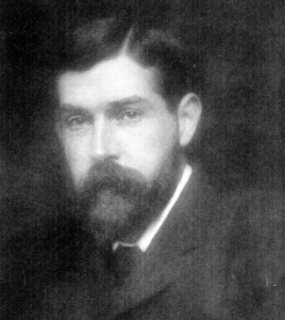
F. H. Bradley
Born: 30 January 1846 in Clapham, Surrey,
England
Died: 18 September 1924 (aged 78) in Oxford,
Oxfordshire, England
Alma mater: University College, Oxford
Era: 19th-century philosophy
Region: Western Philosophy
School: British idealism
Main interests: Metaphysics, Ethics, Philosophy
of history, Logic
Influences: Immanuel Kant, Johann Gottlieb
Fichte, Friedrich Wilhelm Joseph von Schelling,
Georg Wilhelm Friedrich Hegel, Thomas Hill
Green, Christoph von Sigwart, Hermann Lotze
Influenced: T. S. Eliot, Alfred N. Whitehead, R. G.
Collingwood, G. E. Moore, Michael Joseph
Oakeshott, Samuel Alexander, Bertrand Russell,
Bernard Bosanquet, William James
From Wikipedia
Bradley was a British idealist philosopher. His most important work was Appearance and Reality…. He was famous for his non-pluralistic approach to philosophy. His outlook saw a monistic unity, transcending divisions between logic, metaphysics and ethics. Consistently, his own view combined monism with absolute idealism. Although Bradley did not think of himself as a Hegelian philosopher, his own unique brand of philosophy was inspired by, and contained elements of... Hegel's dialectical method.
Introductory Comments
Every great idealist, it seems, builds an Absolute in his own image. Fichte's rested on the restless activity of the "absolute I," the self that posits its own world. Schelling's was the primal identity in which nature and spirit turn out to be one and the same. Hegel's, as befits that consummate dialectical showman, was reason itself, unfolding through history and thought. But where the German Absolutes strive, develop, and march onward, Bradley's just sit there: His was a static, harmonious Absolute in which all partial appearances and relations dissolve into a perfect unity - a stable, self-possessed, and, if you will, very British Absolute that sits serenely outside of time and process, sipping tea.
How does one come to know such a thing? Not by building up from experience, but by noticing where experience breaks down. Look hard at the ordinary world, with its things and qualities, relations, space, time, and selves, and contradictions appear at every turn. For Bradley, this incoherence is not a defect to be patched but a clue. It shows that the world as we piece it together is appearance, not ultimate reality. Yet appearance is not illusion. Every fragment, from a passing sensation to a law of physics, belongs to the Absolute, transformed in ways we can never fully trace. What waits on the far side of all that contradiction is not a blank and simple Oneness but a single, all-embracing whole in which every scattered piece of experience at last fits.
Some of Bradley's Key Positions
Reality cannot contradict itself, and the everyday world fails that test. Relations, in particular, can't be real. If two things are related, the relation must connect to each, which requires further relations, and so on without end. Neither, then, can a world of separate things be ultimately real.
What remains is the Absolute: a single, all-inclusive experience in which appearances are not abandoned but transformed. Truth and reality thus come in degrees. No judgment is wholly true or wholly false; it is truer the more comprehensive and coherent it is. Thought, which works by relating, can't grasp this unity. A hint of it lies in "feeling," which is not emotion but the undivided awareness that precedes the split between subject and object. Reality is not an "unearthly ballet of bloodless categories." Nor is the mind a heap of sensations glued together by association, as empiricist psychology supposes.
The moral end is self-realization. Hedonism fails, since passing pleasures never add up to a self, and so does Kant's "duty for duty's sake," since a purely formal duty is empty. Much of morality lies in the duties of one's station within a community, but the self aspires beyond them toward an ideal "good self." Because that ideal can never be fully achieved, morality points beyond itself to religion, where the ideal is embraced as already real. Even goodness, like truth and beauty, is finally transcended in the Absolute.
Place in the History of Ideas
Bradley's Place in History of Ideas
S. Candlish: Bradley was the most famous, orig- inal and philosophically influential of the British Idealists. These philosophers came to promi- nence in the closing decades of the nineteenth century, but their effect on British philosophy and society at large - and, through the positions of power attained by some of their pupils in the institutions of the British Empire, on much of the world - persisted well into the first half of the twentieth. They stood out amongst their peers in consciously rejecting some main as- pects of the tradition of their earlier compatri- ots, such as Hume and Mill, and responding, albeit in an original and critical fashion, rather to the work of Kant and Hegel.... [They] revital- ized British philosophy by making it permeable to a rich variety of continental ideas.
H. B. Acton: Like Bernard Bosanquet, Bradley was influenced by T. H. Green. Like Bosanquet, too, he read and admired G. W. F. Hegel, but was less in sympathy with Hegelianism than Bosanquet was. Bosanquet was active in social reform, as Green had been, whereas Bradley was a Tory who hated liberalism and sometimes thought along the lines of Thomas Carlyle's later writings. Bradley was, and intended to be, a highly polemical writer. His Ethical Studies and Principles of Logic are a sustained attack on the utilitarianism and empiricism of John Stuart Mill and his followers and upon the positivist outlook of the times.
Random Thoughts on Bradley
Consider the humble relation "taller than." Everest is taller than a molehill; nothing could be plainer. But ask what "taller than" actually is, and Bradley will make you regret the question. If the relation is nothing in itself, it cannot connect the terms. If it is something to them, it must be related to each, and those relations must be related in turn, forever. It is an endless queue of middlemen, with nobody ever closing the deal. Bradley did not conclude that relations simply don't exist. They are appearance: real enough to live by, but incoherent at bottom. What they point toward is the Absolute, a single whole that is "supra-relational," above relations rather than merely lacking them.
The irony is that Bradley's most famous rebels began as his admirers. Russell and Moore were both idealists before turning on the doctrine in the late 1890s. Russell insisted that relations are external: being taller than a molehill adds nothing to Everest's inner nature. A generation later, A. J. Ayer held up a sentence from Appearance and Reality as a specimen of nonsense: "the Absolute enters into, but is itself incapable of, evolution and progress." The textbook verdict hardened: Bradley had mistaken a puzzle of language for a discovery about the world, tripping over his own intellectual shoelaces. Yet the verdict has not entirely held. Ayer's verification principle struggled to pass its own test, and metaphysicians still ask what makes a fact more than a list of its parts. Bradley may have tripped, but perhaps it was over a real knot.
Influences
Bradley was influenced by: Fichte, Green, Hegel, Kant, Lotze, Schelling, Sigwart, C. von
Bradley influenced: Alexander, S., Bosanquet, Collingwood, Eliot, T.S., James, Moore, Oakeshott, Russell, Whitehead
Similar and opposing positions
Thinkers with similar positions:
- Al-Farabi (Humans are social creatures and need others to develop properly.)
- Bosanquet (Reality is ideal, whole and one. There are no real separate things.)
- Gentile (Mind is the Absolute and thinking creates the phenomenal world.)
- Hegel (The finite world is a reflection of mind, which alone is truly real.)
- Mead (The mind and self emerge from the social process of communication.)
- Parmenides (Reality is one and changeless. Existence is timeless and uniform.)
- Proclus (Though souls descend into the material world, a divine Unity exists.)
Thinkers with opposing positions:
- Ayer (Language that is not verifiable is not true or untrue but meaningless.)
- Bentham (Our ultimate motive is always to experience pleasure and avoid pain.)
- Freud (The social realm plays a minimal role in shaping human psychology.)
- Hobbes (All things, including humans and their minds, are entirely material.)
- Hume (We only really know the immediate impressions of our senses.)
- Mill (Moral worth derives solely from the consequences of one's actions.)
- Moore (Objects exists & are defined in part by their relations to other objects.)
- Putnam (How we conceive the world is all we mean by how world "really is.")
- Royce (Even idealistic postulates must rest ultimately on pragmatic grounds.)
What others said about Bradley
- Collins: Bradly wields [his] skepticism to clear the ground for something positive... the Absolute [which somehow] reconciles our difficulties....
- Ayer: In England, the leading Hegelian was F. H. Bradley, whose devotion to the Absolute exceeded that of his master in that it led him to deny the reality of matter, space and time.
- H. B. Acton: Bradley argued... that men themselves are what they are because the society in which they are born and bred is what it is. The "individuals" of liberal and utilitarian social theory do not exist. The community is not, as the liberals assumed, a mere collection of individuals who are logically prior to it, but... "can be regarded... only as the one in the many."
- Copleston: It was in the philosophy of Francis Herbert Bradley that emphasis on the subject-object relationship was decisively supplanted by the idea of of the supra-relational One, the all-embracing Absolute.
- Stewart Candlish: ... Bradley’s contributions to moral philosophy and the philosophy of logic were far more influential than his metaphysics.
- H. B. Acton: His views were at their maximum influence during the first decade of the twentieth century, and the philosophical analysis of Russell and G. E. Moore arose largely in the attempt to refute them.
- D. L. C. Maclachlan: Bradley had a very different view of logic from that prevalent today.... [He] took logic to be the discipline through which we give an account and explanation of the special function of thought through which we transcend immediate experience. Bradley believes logic covers topics that would fall today under the heading of theory of knowledge.
- Copleston: [Bradley's skepticism] is combined, however, with a firm belief that reality in itself, transcending our powers of comprehension, is a comprehensive, completely harmonious totality, an all-embracing... eternal experience.
Schools: British Idealism, Hegelianism, Metaphysical Idealism, Objective Idealism, Rationalism, Skepticism
Main interests: Ethics, History, Logic, Metaphysics
Bradley's answers to philosophical questions
Epistemology
The real is the rational. Hence we can gain real, though partial, knowledge of the Ultimate through rational thinking.
Judgments are not sense perceptions: They are conclusions based on reason and reveal some part of the Ultimate.
Ethics
"Love is an idea of the fulfilment of an habitual longing, a fixed idea individualized in an object."
Law
"... if punishment is inflicted for any other reason whatever than because it is merited by wrong, it is a gross immorality...."
Metaphysics
Reality is ideal: Truth, beauty, life, and goodness are fundamental realities and actual parts of the Absolute.
"Everything less than the Universe is an abstraction."
"Metaphysics is the finding of bad reasons for what we believe upon instinct; but to find these reasons is no less an instinct."
Mind
"The Self has turned out to mean so many things, to mean them so ambiguously… that we do not feel encouraged."
Psychology
"The secret of happiness is to admire without desiring. And that is not happiness."
Religion and Theology
"Religion is rather the attempt to express the complete reality of goodness through every aspect of our being."
"The world is the best of all possible worlds, and everything in it is a necessary evil."
Sex and Gender
"When I hear that 'Possession is the grave of love,' I remember that a religion may begin with the resurrection."