Johannes Kepler (1571 - 1630)
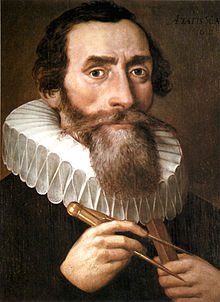
Open Kepler's interactive page (graphs of influences, similar and opposing positions, and quotes)
Background
Johannes Kepler
Born: December 27 1571 in Weil der Stadt,
Wurttemberg-Baden, Germany
Died: November 15, 1630 (aged 58) in
Regensburg, Germany
Alma mater: Tubinger Stift, University of
Tubingen (M.A. 1591)
Main Interests: Astronomy, astrology, optics,
mathematics, geometry, religion, cosmology,
physics
Influences: Plato, Aristotle, Pico, Copernicus,
Tycho Brahe, Galileo, Hasan Ibn al-Haytham,
William Gilbert, Proclus, Pythagoras
Influenced: Newton, Edmond Halley, Benoit
Mandelbrot, Thomas Browne, Pierre Gassendi,
Hobbes
From Wikipedia
Kepler was a German astronomer, mathemati- cian, astrologer, natural philosopher and writer on music. He is a key figure in the 17th-century Scientific Revolution, best known for his laws of planetary motion, and his books... influencing among others Isaac Newton, providing one of the foundations for his theory of universal gravitation. The variety and impact of his work made Kepler one of the founders and fathers of modern astronomy, the scientific method, natural and modern science.
Introductory Comments
Robert Louis Stevenson likened growing older to a ship whose bow is already cutting into new waters while a wake of old folly and misunderstanding trails behind. The same holds for the history of ideas. Transitional thinkers, feeling their way into a new picture of the world, rarely make a clean break with the old one. They sail into a new understanding of the world while dragging plenty of old assumptions, mistakes, and superstitions behind them. Johannes Kepler is a case in point. Even as he was revolutionizing astronomy, he cast horoscopes, dabbled in a kind of mystical numerology, and held that the planets were spaced so as to sound a cosmic music - the ancient "harmony of the spheres."
But the deepest of Kepler's unscientific convictions was religious: that in uncovering the laws of planetary motion he was tracing the plan of the Creator. The belief was unprovable, yet for Kepler it was hardly unnecessary. It was, in fact, what drove him to the work in the first place. In discovering those laws, he said, he "as merely thinking God's thoughts after Him." And why merely? There is nothing mere about thinking God's thoughts. The word was simply Kepler's way of insisting that science is done not "for the glory of our own minds," but "for the glory of God." By understanding the ingenious math of Creation, we are mere scribes. All glory goes to the Mathematician who set down the laws of motion - the laws that now animate the universe.
Some of Kepler's Key Positions
God reveals himself not only in Scripture but in the elegant architecture of the cosmos and the physical laws that govern it. Astronomy therefore offers a privileged glimpse into the divine mind - into the very nature and method of God's thinking.
In Aristotelian terms, the formal cause of the universe is geometric: the five Platonic solids (cube, tetrahedron, dodecahedron, icosahedron, octahedron), nested one inside another, fix the spacing of the planetary orbits and so give the Copernican heavens their structure. The material cause is physical matter. The efficient cause - which joins form to matter and brings the universe into being - is of course God.
Purpose, or final cause, matters too. The sun sits at the center because its office is to spread light, warmth, and life throughout the planetary system - and to drive the planets along their orbits by an invisible force.
Science, however, cannot rest on philosophical considerations alone. Its theories must answer to careful observation and take mathematical form. Thus, working from Tycho Brahe's precise observations, we now must amend Copernicus's theory itself: the planets travel around the sun not in perfect circles but in ellipses, each moving faster as it nears the sun and slower as it recedes. When beautiful theory and stubborn observation collide, we must side with observation.
Place in the History of Ideas
Kepler's Place in History
Edward Rosen: Kepler's clarion call, trumpeted to receptive ears, echoed... down the corridors of the seventeenth century and thereafter. It demonstrated how unswerving allegiance to the scientific quest for truth could be combined in one and the same person with unwavering loyalty to religious tradition: accept the authority of the Bible in questions of morality, but do not regard it as the final work in science.
Carl Sagan: As a boy Kepler had been captured by a vision of cosmic splendour, a harmony of the worlds which he sought so tirelessly all his life. Harmony in this world eluded him. His three laws of planetary motion represent, we now know, a real harmony of the worlds, but to Kepler they were only incidental to his quest for a cosmic system based on the Perfect Solids, a system which, it turns out, existed only in his mind. Yet from his work, we have found that scientific laws pervade all of nature, that the same rules apply on Earth as in the skies, that we can find a resonance, a harmony, between the way we think and the way the world works.
Einstein: What a deep faith in the rationality of the structure of the world and what a longing to understand even a small glimpse of the reason revealed in the world there must have been in Kepler and Newton to enable them to unravel the mechanism of the heavens in long years of lonely work.
Random Thoughts on Kepler
Did Kepler's religious convictions (see Introductory Comments) merely spur him to study how the planets orbit the sun? Or did those convictions themselves amount to a genuine insight into the mind of God? For Kepler, the answer was plainly both - and a surprising number of later scientists agreed. Their piety (or mysticism, if you prefer) supplied a conceptual frame that guided their inquiries, serving at once as a motive for the work and an expression of what they believed.
Newton's faith in a divine Lawgiver shaped his search for the laws of motion and universal gravitation. Michael Faraday, the great student of electromagnetism, took the investigation of nature to be a way of appreciating God's handiwork. James Clerk Maxwell, who gave us the theory of electromagnetic radiation, likewise saw the physical laws of the universe as the expression of a divine order. Nor is the pattern confined to Christianity. David Bohm, whose thinking was colored by a lifelong interest in Eastern thought, proposed a holistic reading of quantum mechanics - one that gestured, at least, toward bridging science and spirituality.
Is there a moral to this recurring story? Perhaps only a cautionary one. Science tells us much about how scientists test their ideas, but rather less about where those ideas come from. And this is how it should be. What makes an idea scientific is not its parentage but its proof.
Influences
Kepler was influenced by: Aristotle, Copernicus, Euclid, Galileo, Gilbert, Ibn al-Haytham, Pico, Plato, Proclus, Pythagoras, Tycho Brahe
Kepler influenced: Browne, T., Gassendi, Halley, E., Hobbes, Mandelbrot, Newton
Similar and opposing positions
Thinkers with similar positions:
- Albertus Mag. (The pursuit of science is consistent with religious devotion.)
- Aristotle (Final Causes or purposes are at work everywhere in our world.)
- Bacon, Francis (Progress in science springs from careful observation.)
- Epicurus (Only believe what's tested thru direct observation and deduction.)
- Galileo (The Bible should be followed for its moral teaching, not cosmology.)
- Newton (Intricate design we see in nature proves existence of Great Designer)
- Pythagoras (The key to understanding the workings of nature is mathematics.)
Thinkers with opposing positions:
- Aristotle (Final Causes or purposes are at work everywhere in our world.)
- Blake (Pursuit of science can lead to a sterile and atheistic worldview.)
- Edwards (God alone is the only real cause at work in the world - not matter.)
- Einstein (Despite Newton's claims, absolute space and time do not exist.)
- Feyerabend (There is no universal methodological guidelines in science.)
- Harris (We don't need religion to experience compassion, awe, and devotion.)
- Kuhn (Scientific theories & understanding can never be entirely objective.)
- Putnam (Mathematics is not a purely logical, but a "quasi-empirical" method.)
- Shakespeare (Nature may guide us, but towards no rational purpose or end.)
What others said about Kepler
- Galileo: I wish, my dear Kepler, that we could have a good laugh together at the extraordinary stupidity of the mob.
- Cassirer: [Kepler] considers the laws of harmony to be the basic determinations. We find them in the... visible world, only because everything visible is created according to the eternal "archetypes" of order and measure....
- John Banville: [Kepler] reminded me of myself - the little man running desperately in circles, trying to find an explanation for the world, for his place in it, to find a plausible system, to account for reality - and never finding it. Finding lots of rules and laws which are very important, but never actually finding his own way into what it is to be in the world....
- Galileo: [I am astonished at Kepler in one respect:] Despite his open and acute mind..., he nevertheless lent his ear and his assent to the moon's dominion over the [tides], to occult properties, and to such puerilities.
- C. Smoryński: Kepler followed Proclus and believed that "the main goal of Euclid was to build a geometric theory of the so-called Platonic solids."
- Carl Sagan: When [Kepler] found that his long cherished beliefs did not agree with the most precise observations, he accepted the uncomfortable facts, he preferred the hard truth to his dearest illusions. That is the heart of science.
- Newton: Kepler's laws, although not rigidly true, are sufficiently near to the truth to have led to the discovery of the law of attraction of the bodies of the solar system. The deviation from complete accuracy is due to the facts, that the planets are not of inappreciable mass, that, in consequence, they disturb each other's orbits about the Sun....
- Robert G. Ingersoll: Is it possible... that Kepler discovered his three laws - discoveries of such importance that the 8th of May, 1618, may be called the birth-day of modern science - [without being inspired by God].
Schools: Christian Theology, Pythagoreanism
Main interests: Astrology, Astronomy, Cosmology, Geometry, Mathematics, Optics, Religion, Science
Kepler's answers to philosophical questions
Epistemology
Sensible things are "preserved in the memory, brought forth by recollection, [and] distinguished by the higher faculty."
The conclusions of human reason are both real and reliable, since the human mind is dependent on God's mind.
Language
"I too play with symbols... but I play in such a way that I do not forget that I am playing. For nothing is proved by symbols."
"I especially love analogies, my most faithful masters, acquainted with all the secrets of nature."
Metaphysics
Causal laws in science are universal & absolutely reliable, since they spring from the universal & reliable mind of God.
Nature
The fact that the sun gives forth light and the planets rotate shows that they have been provided with "a sort of soul."
"The chief aim of [science] should be to discover the rational order & harmony which has been imposed on it by God...."
Philosophy
"[B]efore the origin of things, geometry was coeternal with the Divine Mind."
Religion and Theology
"I had the intention of becoming a theologian… but now I see how God is, by my endeavors, also glorified in astronomy...."
God brought the universe into being by shaping matter into a polyhedron form consistent with the Copernican theory.
"Once miracles are admitted, every scientific explanation is out of the question."
"I believe only and alone in the service of Jesus Christ. In him is all refuge and solace."
Science
"Science is the process of thinking God's thoughts after Him."
Scientific findings are absolutely reliable, since they represent or reveal the actual workings of God's mind.
We live in a mathematical universe. That is, the laws that control the cosmos are inherently mathematical.
The aim of science is "to discover the rational order and harmony which has been imposed on [the world] by God...."
Astronomy is not only consistent with religion, it offers us remarkable insights into the actual workings of God's mind.