Wilson, E.O. (1929 - 2021)
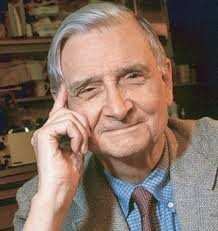
Open Wilson, E.O.'s interactive page (graphs of influences, similar and opposing positions, and quotes)
Background
E. O. Wilson
Born: June 10, 1929 in Birmingham, Alabama
Died: December 26, 2021 (aged 92) Burlington,
Massachusetts
Alan Matre: University of Alabama (BS, MS),
Harvard University (PhD)
Main Interests: Biology, evolution
Known for: Popularizing sociobiology, Epic of
evolution, Character displacement, Island
biogeography, Biophilia hypothesis
Influences: Charles Darwin, Robert Trivers,
Richard Evans Schultes, William Morton
Wheeler, Henry David Thoreau
Influenced: Napoleon Chagnon, Herbert Gintis,
Daniel Oerther, Christopher T. Walsh,
Raghavendra Gadagkar, Choi Jae-cheon,
Thomas Dyer Seeley, Daniel Simberloff, Corrie
Moreau, Donald J. Farish
From Wikipedia
E. O. Wilson has been called "the father of socio- biology", "the father of biodiversity" and the "natural heir" to Charles Darwin. He has been praised for his environmental advocacy, and his secular-humanist and deist ideas pertaining to religious and ethical matters. Among his contribu- tions to ecological theory is the theory of island biogeography (developed in collaboration with the mathematical ecologist Robert MacArthur), which served as the foundation of the field of conservation area design….
Introductory Comments
In his landmark 1975 book Sociobiology: The New Synthesis, E. O. Wilson defined sociobiol-ogy as the systematic study of the biological basis of social behavior in all organisms - ants, antelopes, and, most controversially, us. Draw- ing on evolutionary theory, genetics, and his deep expertise in ant colonies (where he had, you might say, done his fieldwork from the ground up), Wilson argued that social behaviors like altruism, aggression, mate selection, and tribalism are not free-floating cultural inven- tions but adaptations sculpted by natural selec-tion. Genes that produced behaviors enhancing survival and reproduction got passed along and the rest fizzled out and disappeared.
This does not mean that humans are mere pup- pets of instinct: Genes hold our varied social experiments on an leash, but the leash is elastic; it allows for further roaming - further experi-ments. Wilson is not a determinist. Sociobiology is simply asking us to take seriously a humbling proposition: that before we are philosophers, citizens, or saints, we are primates with strong moral and social instincts shaped by survival and reproduction. Wilson believed that recog- nizing our biological nature need not lead to fatalism or cynicism, but rather to a more honest and ultimately more compassionate understanding of who we are - animals with ancient instincts and improbable aspirations, forever negotiating between the two.
Some of E. O. Wilson's Key Positions
Though many think our moral and social behav-ior is entirely shaped by environmental influ- ences, what underlies and explains much of our behavior is biology - those moral and social instincts belonging to the human animal. Like all our traits, these moral and social instincts are products of natural selection, because they have proven useful to our survival and to our ability to pass on our genes to our offspring.
Our "genes hold culture on a leash" insofar as they prevent culture from drifting too far from the behavior of our evolutionary ancestors - their fears, comforts, motives, taboos, attach- ments, hatreds. The genetic leash is elastic e- nough for culture to go off in a variety of direc-tions, each of which can influence our actions and interactions in a variety of ways, but only so far. We can never break the genetic leash.
We are not the blank slates described by Locke, nor are we disembodied minds trying to make sense of the world. Rather, we are intelligent animals endowed with many strong and at times surprisingly specific instincts. One of these instincts is biophilia - our instinctive love for nature. This love for nature is of course linked to conservation - to our attachment to the nat-ural world and resistance to ecological destruc-tion. Yet we have other short-term interests and instincts that threaten to do just that: destroy the long-term health of our planet.
Place in the History of Ideas
E. O. Wilson's Place in History
Michael Ruse: [Wilson] proposed that the essentially biological principles on which animal societies are based also apply to humans. This thesis provoked condemnation from prominent researchers and scholars in a broad range of disciplines, who regarded it as an attempt to justify harmful or destructive behavior and unjust social relations in human societies. In fact, however, Wilson maintained that as little as 10 percent of human behavior is genetically induced, the rest being attributable to environment.
James Watson: Since 1978, when a pail of water was dumped over... E. O. Wilson for saying that genes influence human behavior, the assault against human behavioral genetics by wishful thinking has remained vigorous. But irrational- ity must soon recede. It will soon be possible to read individual genetic messages at costs which will not bankrupt our health systems. In so doing, I hope we see whether changes in DNA sequence, not environmental influences, result in behavior differences.
Bert Hölldobler: … Wilson witnessed the human-made habitat destruction and mass extinction of life forms, which finally drove him to become a chief advocate for the new field of conservation biology and the study of biodiversity. His pioneering work provided the intellectual foundation for this advance.
Random Thoughts on E. O. Wilson
In Biophilia (1984), E. O. Wilson proposed that human beings possess an innate, evolved affini-ty for life and lifelike processes - a deep-seated need to affiliate with other living things. Having spent the bulk of human evolution on African savannas rather than in cubicles, we are, Wilson argued, hardwired to respond to the natural world: to find beauty in a flowering meadow, comfort in the rustle of leaves, and a peculiar fascination in creatures that could conceivably eat us. Biophilia is not a sentimental attach-ment but a biological inheritance, as much a part of our equipment as binocular vision or opposable thumbs. We did not invent our love of nature; nature, in a sense, invented it in us.
Once you start looking, biophilia turns up in the oddest corners of modern life. We pay premium rents for apartments overlooking a scrap of park, then decorate the windowless rooms with houseplants we routinely overwater. Hospital patients with a view of trees recover faster than those staring at brick walls - a finding that has quietly rewritten architectural guidelines. We keep aquariums in dentists' offices to soothe the nerves of people about to be drilled, and we cheerfully share our beds with domesticated wolves who shed on everything. Even our screensavers default to forests and beaches. In the end, biophilia reveals that we proud "con- querors of nature" are but homesick apes forever trying to bring the wild back indoors.
Influences
Wilson, E.O. was influenced by: Darwin, Schultes, R. E., Thoreau, Trivers, Robert, Wheeler, W. M.
Wilson, E.O. influenced: Chagnon, N., Farish, Donald, Gadagkar, R., Gintis, Herbert, Jae-cheon, C., Moreau, Corrie, Oerther, D., Seeley, T. D., Simberloff, D., Walsh, C. T.
Similar and opposing positions
Thinkers with similar positions:
- Dawkins (Intricate design in the natural world can be explained thru science.)
- Goethe (Science and philosophy need to ponder the dynamic character of nature.)
- Humboldt, A. (Nature is a "living whole” where all organisms are interdependent)
- Humboldt, A. (We must pursue science to further our understanding of nature.)
- Muir (In Wildness is the preservation of the world and the renewal of the self.)
- Petrarch (Exploring nature outdoors is both a pleasure and an inspiration.)
- Singer, Peter (Since subject to pain, animals deserve certain legal protections.)
- Thoreau (We have an instinctive need and love for nature & her creatures.)
- Whitman (Communion with Nature has a moral and spiritual dimension.)
Thinkers with opposing positions:
- Descartes (Animals have no rights because they are unconscious machines.)
- Edwards (Intricate design in the natural world is the work of God alone.)
- Huxley (Evolution can't account for the origin of morality in our species.)
- Ibn Tufail (The mind at birth is a blank slate that experience will write upon.)
- Leibniz (The intricate interactions of nature reflect a pre-established harmony.)
- Plantinga (Evolution is not an entirely natural process. God helps guide it.)
- Sorel (Science is imaginary creation, not an accurate explanation of reality.)
What others said about Wilson, E.O.
- Michael Ruse: He was... the foremost proponent of sociobiology, the study of the genetic basis of the social behavior of all animals, including humans.
- David Sloan Wilson: I’ll tell you something about Ed - he’s a bit of an intellectual grenade thrower. He likes to be a provocateur. That’s unusual in someone as established as he is.
- Robert Finch: His critics accuse him of a reductionist and mechanistic view of culture and morality, with dangerous eugenic and racist overtones, while his admirers claim that his work is Darwinian in scope and that... he is the target of philistines who object to his conclusions on ethical and emotional, rather than scientific, grounds.
- Dawkins: Wilson now rejects 'kin selection ' and replaces it with a revival of "group selection" - the poorly defined and incoherent view that evolution is driven by the differential survival of whole groups of organisms.
- Paula J. Ehrlich: His courageous scientific focus and poetic voice transformed our way of understanding ourselves and our planet.
- Massimo Introvigne: Wilson himself argued that it would be in the best interest of humanity if organized religions as we know them would disappear. There is, however, a misunderstanding. Wilson was not an atheist….
- Michael Ruse: In his later career Wilson turned increasingly to religious and philosophical topics. In "Consilience: The Unity of Knowledge" (1998), he strove to demonstrate the interrelatedness and evolutionary origins of all human thought. In "Creation: An Appeal to Save Life on Earth" (2006), he developed [an] evolutionarily informed humanism….
- Paul Ehrlich: [Wilson's book "Biophilia"] is the best thing I have ever read on the need for developing a deep environmental ethic if our civilization is to persist.
Schools: Humanism, Innatism, Naturalism, Secular Humanism, Social Liberalism
Main interests: Biology, Environment/Conservation, Evolution, Evolutionary Psychology, Free/Unfree Will, Nature, Power, Psychology, Science, Zoology
Wilson, E.O.'s answers to philosophical questions
Economics
Apropos ants: "Karl Marx was right, socialism works, it is just that he had the wrong species."
Education
"Pure knowledge is the ultimate emancipator. It equalizes people & sovereign states, erodes the... barriers of superstition...."
"You teach me, I forget. You show me, I remember. You involve me, I understand."
Epistemology
We should trust our rational faculties: "Sometimes a concept is baffling not because it is profound but because it is wrong."
Ethics
Ethics is not a science: "Science and technology are what we can do; morality is what we agree we should or should not do."
History
"If history and science have taught us anything, it is that passion and desire are not the same as truth."
Metaphysics
The workings of the human mind are too subtle and complex to be predicted. We're therefore free in this fundamental sense.
Mind
"Under stressful conditions even the 'true' self cannot be precisely defined, as Erving Goffman observes."
"The cardinal mystery of neurobiology is not self-love or dreams of immortality but intentionality."
Intellect is not spirit: "[T]hose who hunger for both intellectual and religious truth will never acquire both in full measure."
Nature
"Nature holds the key to our aesthetic, intellectual, cognitive and even spiritual satisfaction."
When we fully grasp & accept our kinship with all other forms of life, we'll be able to build the enduring ethic nature deserves.
"We are also the greatest destroyer of life since the ten-kilometer-wide meteorite… ended the Age of Reptile…."
To convince people to act more humanely toward animals, we must show that such behavior is in fact in our own interest.
“I will argue that every scrap of biological diversity is priceless, to be learned & cherished, & never to be surrendered...."
It's not surprising we feel a strong need for nature: The brain evolved over a long period when we were hunter-gatherers.
Psychology
Since we are not conscious of the material basis of behavior and mind, we must rely on science to explore this material basis.
Reason, like family, love, & cooperation, is another instinctive tool we have to survive long enough to pass on our genes.
"Animals use aggression as a technique for gaining control over necessities... that are scarce or are likely to become so."
Us vs. them: "We [are] comfortable only when the remainder of humanity can be labeled as members versus nonmembers."
The human mind has evolved to meet certain biological needs and is therefore both biased and constrained to a great degree.
"Daily life is a compromised blend of posturing for the sake of role-playing and of varying degrees of self-revelation. "
Religion and Theology
Belief in God is in large part a product of evolution. Even the rituals of religion have been shaped by our inherited instincts.
"People need a sacred narrative. They must have a sense of larger purpose, in one form or another, however intellectualized."
"God remains a viable hypothesis as the prime mover, however undefinable and untestable that conception may be."
We don't need faith: "Preferring a search for objective reality over revelation is another way of satisfying religious hunger."
"True character arises from a deeper well than religion. It is the internalization of moral principles of a society…."
"The most dangerous of devotions, in my opinion, is the one endemic to Christianity: 'I was not born to be of this world.'"
"I'm very much a Christian in ideals and ethics, especially in terms of belief in fairness, a deep set obligation to others…."
"I drifted away from the church, not definitively agnostic or atheistic, just Baptist and Christian no more."
Science
"The love of complexity without reductionism makes art; the love of complexity with reductionism makes science."
Science can kill: "We have Paleolithic emotions, medieval institutions & godlike technology. And it is terrifically dangerous...."
"Hands-on experience at the critical time, not systematic knowledge, is what counts in the making of a naturalist."
The scientist combines imagination with scrutiny: "The ideal scientist thinks like a poet & only later works like a bookkeeper."
All scientists think in images: "To know how scientists engage in visual imagery is to understand how they think creatively."
"Science and religion are two of the most potent forces on Earth and they should come together to save the creation."
Sex and Gender
"The education of women is the best way to save the environment."
Society
Because culture adapts us to ever-changing challenges, "biological evolution is always quickly outrun by cultural change."
We need "synthesizers, people able to put together the right information at the right time [&] make important choices wisely."
Culture & biology at times conflict: "Human nature is deeper & broader than the artificial contrivance of any existing culture."
"Nationalism and racism, to take two examples, are the culturally nurtured outgrowths of simple tribalism."